Civitas Conversations: John Yoo Discusses Andrew Jackson's Gunslinger Presidency
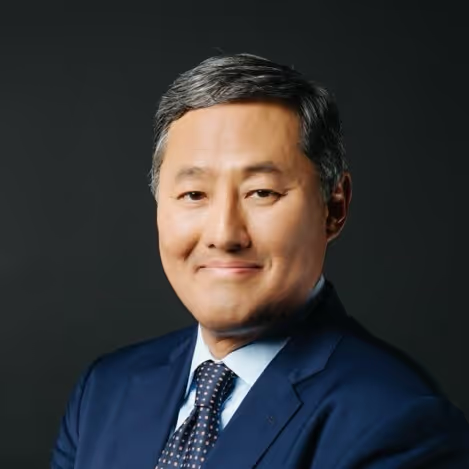

A conversation with John Yoo on the meaning of Andrew Jackson's presidency.
Civitas Outlook editor-in-chief Richard M. Reinsch II interviews John Yoo about his recent Outlook article on Andrew Jackson, which examines how Jackson fundamentally changed the presidency into the powerful institution we know today.
Yoo argues that, in contrast with George Washington's model of public virtue, Jackson proved that presidents don't necessarily need personal virtue to be effective. Jackson made the presidency the direct representative of the people, claiming independent authority to interpret the Constitution and veto laws on policy grounds, and in doing so helped to create the modern presidency.
John Yoo is a Senior Research Fellow at the Civitas Institute, Emanuel S. Heller Professor of Law at the University of California, Berkeley, and a nonresident senior fellow at the American Enterprise Institute.

Constitutionalism
Amicus Brief: Hon. William P. Barr and Hon. Michael B. Mukasey in Support of Petitioners
Former AGs Barr and Mukasey Cite Civitas in a SCOTUS Brief

Rational Judicial Review: Constitutions as Power-sharing Agreements, Secession, and the Problem of Dred Scott
Judicial review and originalism serve as valuable commitment mechanisms to enforce future compliance with a political bargain.
.avif)






.png)
.png)
.png)
.png)
An Unsurprising Term from an Unsurprising Court
The Supreme Court decided almost every case as observers predicted.
.png)
Farewell to the President’s New East Wing
Both Congress and the President have acted in violation of the public trust doctrine.