The Constitution and Birthright Citizenship: A Rejoinder to Professor Yoo

A nation is not merely the land it occupies or the people born on its soil; it is a distinct political community defined by shared history, culture, a common commitment to its own sovereignty and survival.
Professor Yoo and I have engaged in a long, friendly debate over the question of whether the Fourteenth Amendment’s guarantee of birthright citizenship extends to those who have broken our laws to come and/or remain here illegally or would engage in birth tourism. According to Professor Yoo, the main failure of my position regarding the correct interpretation of the citizenship clause is that I inappropriately try to fill areas of constitutional ambiguity with political philosophy. Political philosophy, according to Professor Yoo, cannot ever govern legal interpretation, even when that interpretation would bring about a salutary outcome:
If the Founders adopted a constitutional provision with a clear meaning, even if it advances a policy that does more harm than good, we must still follow the original understanding.
The heart of Professor Yoo’s disagreement with me is that I attempt to impose my own idiosyncratic “natural rights theory” derived from the Declaration of Independence. He asserts that I quote “the famous passage about the right to ‘Life, Liberty, and the Pursuit of Happiness’ and then claim that natural rights theory must supply the answer to every question left open by the constitutional text.” This is, of course, a complete misunderstanding of my stated position. What I do believe, along with every framer of our Constitution (the writings of historians Bernard Bailyn and Gordon Wood to the contrary notwithstanding), is that the American Founding constitutes a singular event in political history: the first deliberate attempt by a people to constitute a political community on the basis of a universal principle—the natural equality of all human beings and its corollary that all legitimate government derives from the consent of the governed. Adherence to these principles articulated in the Declaration of Independence is what formed the “one people” who declared themselves a free, independent, and sovereign state.
It is undeniable that the Constitution realizes those principles. The Declaration functions not merely as a revolutionary manifesto but as a permanent, aspirational standard against which the Constitution and subsequent American practice must be measured. The Constitution is the law, but the Declaration is the spirit that gives the law meaning. In one of the clearest statements from the Founding era linking the two documents, James Wilson, a signer of both the Declaration and the Constitution and a leading advocate for ratification in Pennsylvania, explicitly identifies the Declaration’s principles of equality and consent as the “broad basis” and “certain and solid foundation” upon which the new constitutional system rests.
James Madison in The Federalist, regarded the Declaration as supplying the fundamental principles of the Constitution, which was designed to put those principles into institutional motion through a legitimate government which arises from unanimous consent and exists solely to secure antecedent natural rights. Professor Yoo speculates that
Suppose the Framers did not share a consensus that natural rights, whatever their content, should act as a governing philosophy that would automatically fill in the gaps left by the constitutional text.
To the contrary, it is manifestly clear that the Framers did share a consensus that the protection of natural rights was the governing philosophy that created the Constitution. The fact that there were disputes in the early years of the Republic over how the Constitution should be interpreted should never be confused with a fundamental disagreement over the natural law principles the Constitution was implemented to realize.
He then continues:
She has not shown that the Framers would have agreed that the content of natural law should prevail over the separation of powers and federalism limits on the powers of the national government in general, and of the judiciary in particular.
It is rather strange to ask me to show what I do not believe. The separation of powers, federalism, and the other limits on governmental power are themselves the practical application of the fundamental principle that government must be based upon consent. As James Madison noted in Federalist No. 39, wherein he discusses the republican character of the new Constitution and asserts its federal composition:
It is evident that no other form [of government] would be reconcilable with the genius of the people of America; with the fundamental principles of the revolution; or with that honorable determination, which animates every votary of freedom, to rest all our political experiments on the capacity of mankind for self-government.
Madison’s appeal to “the fundamental principles of the revolution” clearly references the Declaration’s assertions of natural equality and the right of the people to institute government by consent. The Constitution, in Madison and the Framers’ view, must align with these revolutionary principles to be legitimate.
And again, in Federalist #51, Madison explains how the checks and balances preserve a true separation of powers, not for the sake of some theoretical doctrine of pure separation but to protect against the possibility of tyranny.
In framing a government which is to be administered by men over men, the great difficulty lies in this: you must first enable the government to control the governed; and in the next place oblige it to control itself. A dependence on the people is no doubt the primary control on government; but experience has taught mankind the necessity of auxiliary precautions.
In other words, the distribution of powers as they appear in the Constitution was not some accident; it was the deliberate and rational institutional arrangement designed to guarantee a government based upon the consent of the people. Professor Yoo argues that “it is not clear what those natural rights are, why and when they may override constitutional structures – such as federalism and the separation of powers – and whether there must be agreement in society to adopt natural rights as governing philosophy.” Again, this is a mischaracterization of my position. Our entire constitutional system was built upon the natural law principles of the Declaration: to assert that natural rights may “override constitutional structures” misunderstands the fundamental purpose and structure of our Constitution, and is certainly neither the opinion I hold nor articulated.
America is exceptional because America is unique. To quote my teacher and mentor, Edward Erler, “The American Founding represents the first time in human history that a people attempted to constitute itself by dedication to a principle—the principle that “all men are created equal” and its necessary concomitant that all legitimate government must be derived from the consent of the governed.” That is the core definition of American exceptionalism. Foreigners can come to America and become “Americans” not by their mere presence on American soil but by embracing the principles upon which this country was founded. And for more than two centuries now, that is why they come. As the philosopher Leo Strauss noted, “The nation dedicated to this proposition has now become, no doubt partly as a consequence of this dedication, the most powerful and prosperous of the nations of the earth.”
This is the most important reason the Supreme Court erred in defining “birthright citizenship” as extending to the children of those who would willingly break our laws. The United States will remain exceptional only insofar as the social contract remains intact. America has generally welcomed immigrants, and immigrants have often sacrificed much to come to this country and have contributed to it immeasurably.
To become a naturalized U.S. citizen, one must take an oath, which includes the solemn promise to:
- Support the Constitution;
- Renounce and abjure absolutely and entirely all allegiance and fidelity to any foreign prince, potentate, state, or sovereignty of whom or which the applicant was before a subject or citizen;
- Support and defend the Constitution and laws of the United States against all enemies, foreign and domestic;
- Bear true faith and allegiance to the same
I would ask Professor Yoo (and, for that matter, the U.S. Supreme Court) to explain how the Fourteenth Amendment’s citizenship clause, which applies to both those born or naturalized in the United States, can require a prospective naturalized citizen to “renounce and abjure absolutely and entirely all allegiance and fidelity to any foreign prince, potentate, state, or sovereignty,” while the infant born here to parents who owe allegiance to a foreign sovereign and who have violated our laws to come here is not held to the same standard.
Professor Yoo makes the somewhat specious argument that my “interpretive maneuver…would override the Constitution’s location of the primary policymaking authority in the states. She would instead transfer power from our decentralized state-based system to federal judges.” I am not sure how he arrives at that conclusion, because my position is and has been that Section 5 of the Fourteenth Amendment, clearly gives power to define the meaning of the citizenship clause to Congress:
The Congress shall have power to enforce, by appropriate legislation, the provisions of this article.
One of the many unfortunate outcomes of the Trump v. Barbara case is that rather than follow Justice Kavanaugh’s narrower path of invalidating the executive order on statutory grounds alone, the majority constitutionalized birthright citizenship for illegal aliens—transforming a disputed policy into settled Fourteenth Amendment orthodoxy. In my view, the majority opinion first rejected the original public meaning of the citizenship clause and then stripped the people’s elected representatives of the ability to recover that meaning. That is hardly a position favoring the transfer of power to federal judges.
Professor Yoo notes that, prior to the Fourteenth Amendment, the Constitution left the question of citizenship up to the states. I agree wholeheartedly, and indeed provided conclusive evidence that states required consent as a condition of citizenship. Those who had taken Loyalist positions during the early years of the Republic were denied citizenship by the states unless they took an oath of allegiance to the newly independent United States and renounced their allegiance to the King. In other words, those whose allegiance had remained with King George once the United States declared itself an independent and sovereign nation had to consent to become part of the new republic—and the states in their sovereign capacity, created the conditions whereby the sovereign people exercised their consent to accept them into the body politic.
Yet Professor Yoo insists that because states adopted many elements of the British common law, they must have adopted the common law of subjectship, and that rejecting this understanding rejects the “foundation of the Anglo-American legal system.” The truth of the matter, however, is that American jurisdictions generally received English common law “as of” a cutoff date (often 1776 or earlier colonial statutes) only insofar as it suited local conditions and was not “repugnant” to republican principles; many feudal, ecclesiastical, or monarchical elements fell away. These included trial by combat, deodand (an object forfeited to the Crown because it had caused the death of a person), and the law of primogeniture, all of which were rejected because of their antagonism to republican principles. Birthright citizenship under the British common law was not adopted wholesale by the states; indeed, it was specifically rejected by the states in the early years of the Republic.
However, the fact that early state practices regarding citizenship were based upon consent is important, but somewhat beside the point. After all, the entire purpose of the citizenship clause of the Fourteenth Amendment was to redefine citizenship such that federal citizenship became primary and state citizenship derivative.
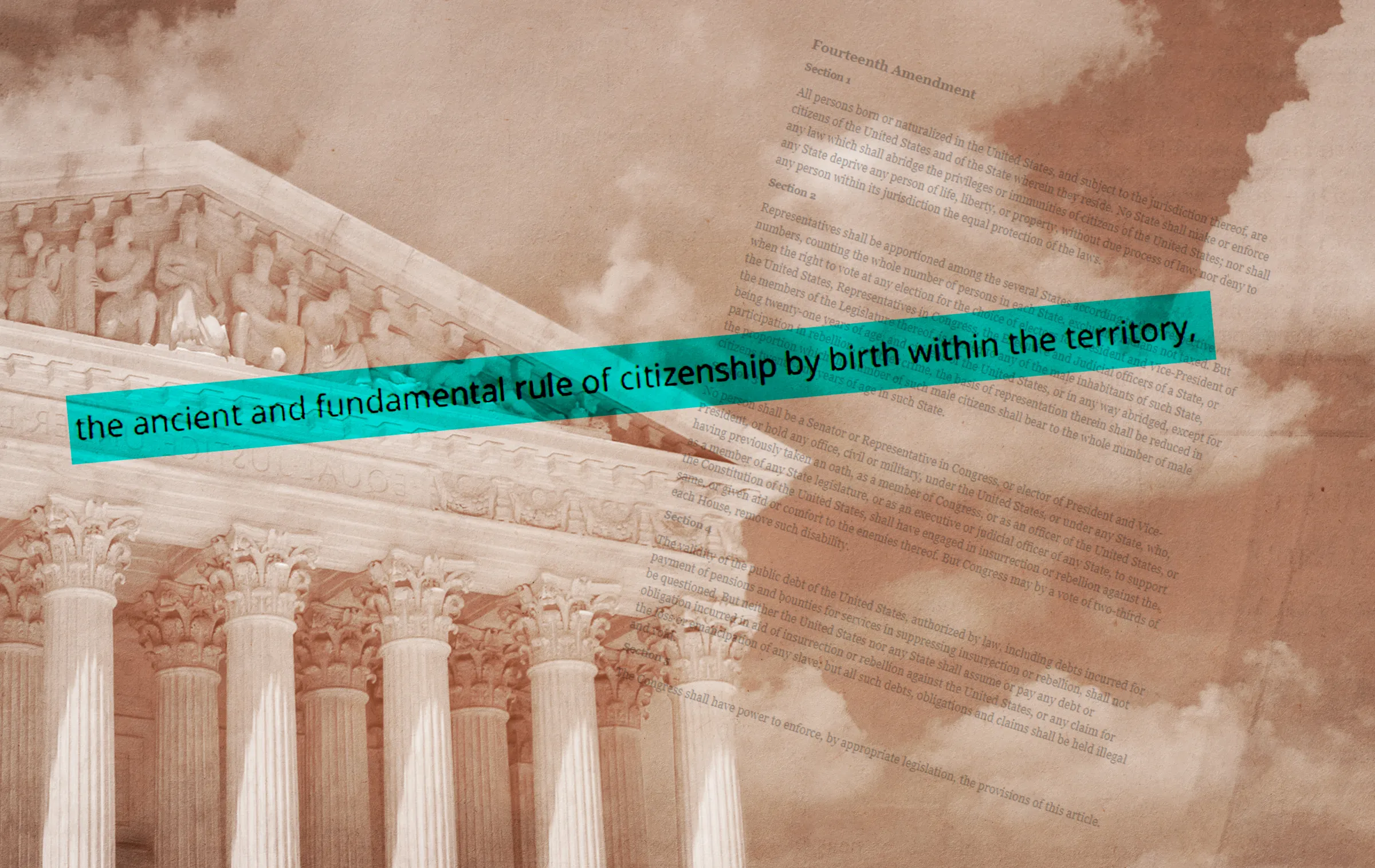
All persons born or naturalized in the United States, and subject to the jurisdiction thereof, are citizens of the United States and of the State wherein they reside (emphasis added).
Not only did this formulation overturn the Supreme Court’s infamous Dred Scott decision that blacks could not be citizens of the United States; it also guaranteed that states could not deprive the newly freed slaves of the protections of privileges and immunities, due process, and equal protection, articulated in the remainder of Section 1 of the Fourteenth Amendment, by denying them state citizenship. And again, Congress (not the Supreme Court) was authorized to enforce these protections by appropriate legislation. It is implausible to assert that the common law practice of states prior to the Civil War should govern our understanding of the citizenship clause, when the purpose of the Fourteenth Amendment was to revoke state authority over national citizenship and to ensure that Congress, not the states, would have the enforcement power.
Professor Yoo also argues that
No Congress, no President, and no Supreme Court appear to have ever denied American citizenship to a baby born on American territory, except for the case of Indians – who are specifically excluded by the constitutional text.
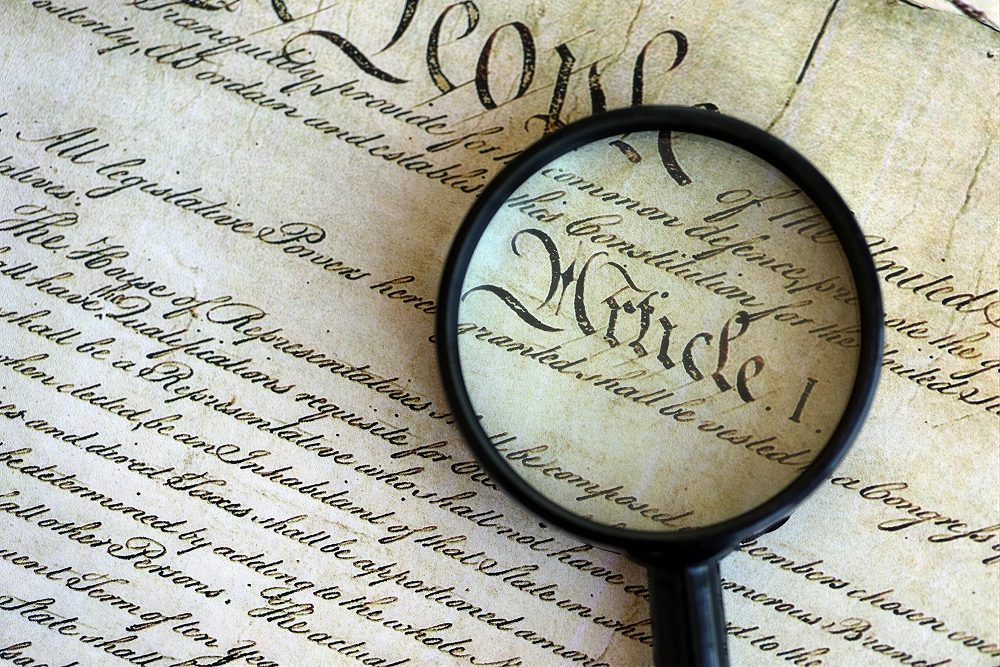
Professor Yoo claims that Indians are the only exception to the ironclad adherence by every government official everywhere and always to the rule of birthright citizenship. He also claims that such an exception is clearly indicated in the constitutional text. Curiously, however, that exclusion does not even appear in the paragraph containing the citizenship clause; rather, it is found in the subsequent paragraph dealing with the question of determining representation in the House of Representatives that overturned the three-fifths compromise. Indeed, it repeats verbatim the language of Article I, Section 2, “excluding Indians not taxed.” In other words, there is no basis for asserting that the phrase “excluding Indians not taxed” was a specific textual exception to “subject to the jurisdiction thereof.”
Where the phrase “Indians not taxed” is explicitly mentioned is in the Civil Rights Act of 1866 with respect to citizenship: “That all persons born in the United States and not subject to any foreign power, excluding Indians not taxed, are hereby declared to be citizens of the United States (emphasis added).” The legislative debates over the Fourteenth Amendment’s citizenship clause clearly demonstrate that both “not subject to any foreign power” and “excluding Indians not taxed” were understood as part of the definition of “subject to the jurisdiction thereof.” It required Congress (not the Supreme Court) to legislate the terms whereby Native Americans could avail themselves of birthright citizenship, which it did in the Indian Citizenship Act of 1924.
Professor Yoo rightly notes that my position goes further even than Justice Clarence Thomas’ dissent. Whether Justice Thomas would agree with my position I cannot say, but he certainly does not need me to elucidate his 91-page opinion. He also takes exception to my inclusion of the policy implications of Trump v. Barbara. However, what he does not acknowledge, because of his aversion to theory, is that the adverse policy implications of the decision are not limited to the continued damage from illegal entry, rewarding birth tourism, and the real potential of endangering our national security. As Justice Thomas rightly notes, the Court’s decision “devalues” American citizenship. Moreover, it undermines the foundations of the American political community. A nation is not merely the land it occupies or the people born on its soil; it is a distinct political community defined by shared history, culture, a common commitment to its own sovereignty and survival, and, in the American case, dedicated to the proposition that legitimate government is based upon consent.
Linda Denno is a senior fellow at the Civitas Institute. She is also Associate Dean of the University of Arizona, College of Applied Science and Technology headquartered at the branch campus in Sierra Vista, Arizona.

Constitutionalism
Amicus Brief: Hon. William P. Barr and Hon. Michael B. Mukasey in Support of Petitioners
Former AGs Barr and Mukasey Cite Civitas in a SCOTUS Brief

Rational Judicial Review: Constitutions as Power-sharing Agreements, Secession, and the Problem of Dred Scott
Judicial review and originalism serve as valuable commitment mechanisms to enforce future compliance with a political bargain.
.avif)







.png)
.png)
.png)
A Theory of Natural Rights Citizenship Must Comport with the Constitution’s Text
The fundamental problem with political theorists interpreting the Constitution is that they are not interpreting it. Instead, they are using the Constitution to advance a political theory.