The Fifth Circuit’s Chance to Expose the Inflation Reduction Act’s Unconstitutionality

The Biden-era drug-pricing program may or may not ultimately survive constitutional review.
In 2022, the Biden-Harris administration heralded the Medicare Drug Price Negotiation Program as a transformative step toward affordable prescription drugs. In practice, the program has delivered far less than advertised and instead produced serious consequences for medical innovation and patient care.
Introduced under President Biden’s notoriously poorly-titled “Inflation Reduction Act,” the damage to the drug development pipeline has already been swift and severe.
Among the most damaging is the IRA’s so-called “pill penalty,” a structural flaw that gives small molecule drugs, which account for over 90 percent of all prescriptions, four fewer years of market exclusivity than biologics before government price controls kick in. That four-year gap has distorted investment across the industry. Studies have found that small-molecule investment has decreased by 68 percent since the program’s introduction, with clinical trials declining by nearly 47 percent, and researchers projecting that 188 fewer treatments will reach the patients who need them most. While marketed as a fix that would save seniors “millions,” the truth is much starker as investments targeting treatments for Medicare-aged patients have fallen by nearly three-quarters since the IRA was enacted.
Beyond the harm to patients and drug innovation, the program carries a deeper flaw — its “negotiation” process is coercive by design, leaving manufacturers with no meaningful choice but to accept government-set prices or face a punishing excise tax estimated at 1,900 percent of daily drug revenues.
Despite the mounting evidence of harm, the program remains law — and the Justice Department continues to defend it in federal court, notwithstanding the Trump administration’s own acknowledgment that it is distorting drug development.
On May 18, the U.S. Supreme Court elected not to consider six industry challenges to the Inflation Reduction Act’s Medicare drug pricing program, denying certiorari. The justices issued the denials without comment—no opinion, no endorsement of the rulings below, no indication that the constitutional objections had been evaluated and rejected.
Yet almost immediately, the Justice Department tried to turn that silence into a talking point in the still-pending Fifth Circuit case, National Infusion Center Association v. Kennedy. What DOJ did not get from the Court—a decision on the merits—it now hopes to manufacture by treating a routine cert denial as if it were a stamp of approval. That is not how the legal system works.
That posture is telling, as just last month, the DOJ had argued that Supreme Court review would be “premature.” Its position was that lower courts were still sorting through the issues and that further percolation was warranted before the justices stepped in. That’s right. The Supreme Court regularly refuses to hear a case until it is fully ripe. Every first-year law student is taught that a denial of certiorari is not a ruling on the merits; it simply reflects the Court’s decision not to take the case.
The Fifth Circuit is one of the last places where the constitutional questions can still get a fresh look. In National Infusion Center Association v. Kennedy, argued last October and still awaiting decision, the challengers contend that the Biden-era IRA program violates due process, the Excessive Fines Clause, separation of powers, and the nondelegation doctrine. Those claims go to whether the government can force participation in a so-called negotiation backed by penalties so severe that refusal is not a viable option. Their latest response brief makes the point plainly: the Supreme Court’s refusal to hear other cases changes nothing about the merits of theirs. If anything, the Supreme Court is waiting to add this decision to the mix so that all the legal arguments are fully developed, and any conflicting approaches can be adjudicated by the Court, which is how our brilliant legal system is designed.
The government’s larger defense of the IRA program has long depended on a legal fiction, namely that participation is voluntary. Supposedly, a manufacturer can always decline to “negotiate.” But that claim collapses the moment one even glances at the draconian enforcement mechanism.
Manufacturers who refuse to submit to the crooked negotiation regime face an excise tax structured to become economically crushing. The whole point of that penalty is to make walking away fiscally untenable. Just as the Biden Administration and its congressional allies intended.
That is why Judge Thomas Hardiman’s dissent in the Third Circuit’s Bristol Myers Squibb/Janssen case remains the most important writing in this litigation. Hardiman saw what the voluntariness theory tries to obscure: when the government effectively puts a gun to a company’s head with enterprise crippling tax penalties, the resulting “agreement” can never be consensual. He saw that the IRA scheme is coercive rather than voluntary. Negotiations that you can’t walk away from (and survive) are not negotiations. Therefore, the Takings Clause and compelled speech objections come into sharp focus.
The compelled speech problem is especially striking. The IRA does not merely pressure a manufacturer to accept a government-dictated price. It also requires the company to treat the result as a “maximum fair price,” as though compelled language could transform federal leverage into mutual assent. The government may regulate markets. It may not so easily force private parties to affirm its preferred narrative of what just happened.
The Fifth Circuit is well-positioned to say so. Unlike courts that leaned heavily on the notion of voluntariness, this panel is not required to accept a premise that falters upon analysis. And because the case before it includes structural and due process claims in addition to the better-known arguments, it offers a chance to assess the IRA program on the merits rather than on a misreading of the Supreme Court’s silence.
The broader point should not be lost. The Biden-era drug-pricing program may or may not ultimately survive constitutional review. But if it does, it should be of the standard judicial process, which includes allowing different circuit courts to rule on the merits. If and when those circuits conflict, the case is ripe for review by the highest court.
Jeff Stier is an Advisor to the Heartland Institute.

Constitutionalism
Amicus Brief: Hon. William P. Barr and Hon. Michael B. Mukasey in Support of Petitioners
Former AGs Barr and Mukasey Cite Civitas in a SCOTUS Brief

Rational Judicial Review: Constitutions as Power-sharing Agreements, Secession, and the Problem of Dred Scott
Judicial review and originalism serve as valuable commitment mechanisms to enforce future compliance with a political bargain.
.avif)






.png)
.png)
.png)
How the Zelman Decision Revitalized Religious Freedom
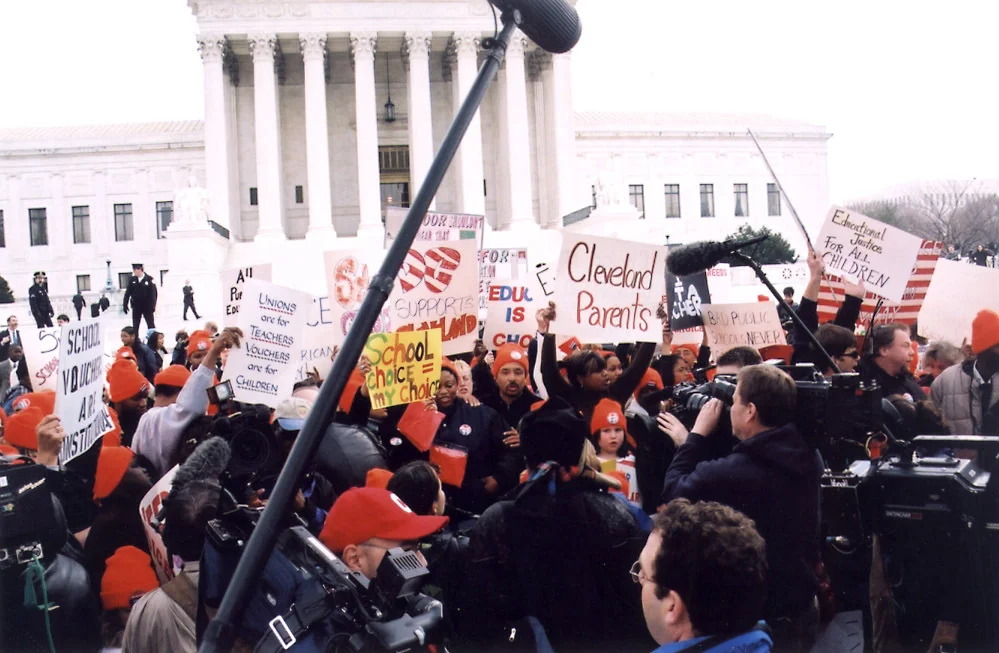
'Zelman v. Simmons-Harris' catalyzed a judicial recovery of the founding vision for the Establishment Clause and, more broadly, the relationship between church and state.