How the Zelman Decision Revitalized Religious Freedom

A religious people cannot persist without the means to educate the next generation in religious truths and precepts.
As America celebrates its 250th anniversary, we should pause to mark the 25th anniversary of an oft-overlooked Supreme Court decision that catalyzed a judicial recovery of the founding vision for the Establishment Clause and, more broadly, the relationship between church and state. In Zelman v. Simmons-Harris, the Court upheld an Ohio school voucher program and began a decades-long reversal of precedents that pitted the state against religion. Like a modern-day juridical Battle of Tours, Zelman represents a decisive historical hinge point—though not recognized as such at the time—that turned back the advance of forces that, if left unchecked, would have reshaped the fundamental founding bargain between the institutions of church and state.
The “Wall of Separation”
The First Amendment to the U.S. Constitution provides, in part, that “Congress shall make no law respecting an establishment of religion, or prohibiting the free exercise thereof.” For the first 170 years of our nation’s history, the bar against establishment was understood to prohibit an act of Congress, but not the states, establishing a religion. That began to change in 1940 when, in Cantwell v. Connecticut, the Supreme Court found that the Fourteenth Amendment incorporated the First Amendment against the states, rendering them “as incompetent as Congress to enact such laws.”
The full force of that ruling was felt seven years later in Everson v. Board of Education, a decision that Justice Souter claimed in Zelman “inaugurated the modern era of establishment doctrine.” In Everson, the Court articulated an interpretation of the Establishment Clause that not only barred Congress from establishing a national religion but also prohibited states from passing laws that “aid” or “prefer” religion, including via taxpayer support of “any religious activities or institutions.” The Court justified this rule by importing language from Thomas Jefferson’s 1802 Letter to the Danbury Baptists into its constitutional jurisprudence, asserting that the “First Amendment has erected a wall between church and state” that “must be kept high and impregnable.”
What followed was a multi-decade-long judicial march through public education seeking to eradicate any vestige of religious practice funded by taxpayer money. The Court barred public-school-led prayer and Bible readings, released-time programs allowing voluntary religious instruction in public school buildings, and the provision of state-financed salary supplements for teachers in religious schools. That final ruling, issued in Lemon v. Kurtzman, produced the infamous “Lemon Test” for evaluating alleged Establishment Clause violations. The test, itself an unmoored amalgamation of previous judge-created standards, included requirements that a challenged law possess a secular purpose, have a “primary effect” that neither advances nor inhibits religion, and avoid “excessive entanglement” with religion.
In the 1973 case Committee for Public Education v. Nyquist, the Court applied the Lemon Test to invalidate New York programs—including tuition grants and tax incentives for private-school parents—designed to relieve pressure on public schools by aiding struggling private schools, including religious ones. Though the programs had a valid secular purpose, the Court held their “primary effect” was to advance religion. It brushed aside the fact that parents were free to choose non-religious private schools, hundreds of which participated, emphasizing instead that most participating schools were religious and that the law did not bar them from spending public dollars on religious purposes. That indirect benefit was enough under Lemon to doom the programs.
The “Circuit Breaker”
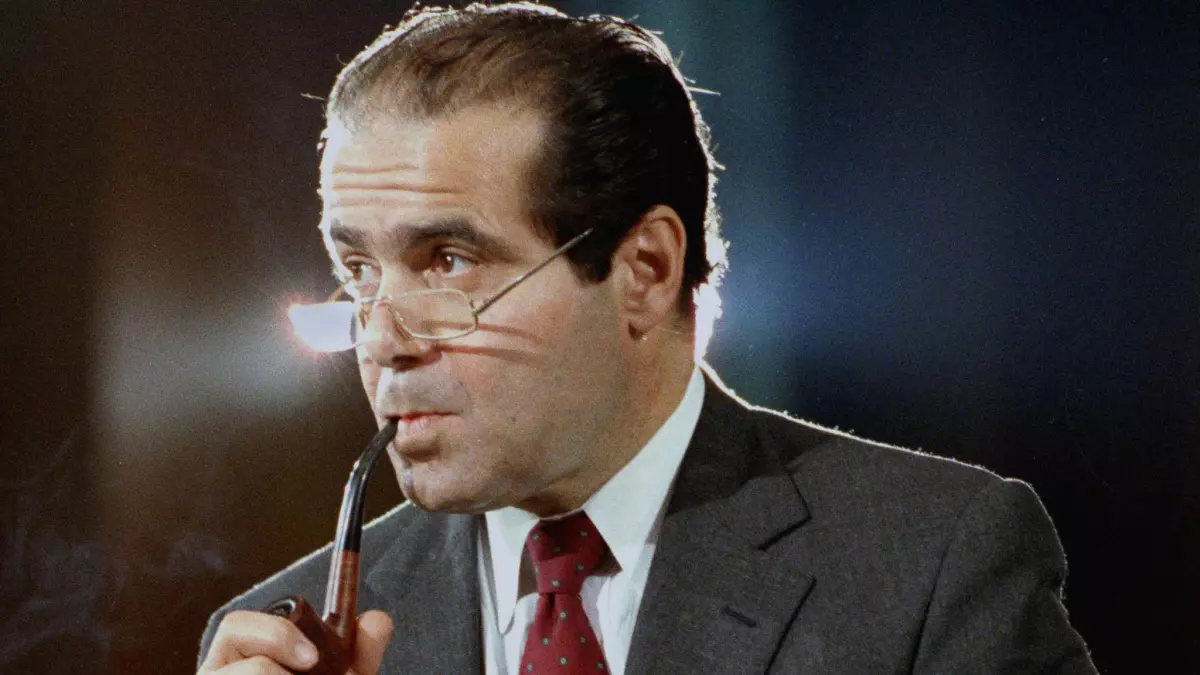
Dissenting in Nyquist was Associate Justice William Rehnquist. Twenty years later, Chief Justice Rehnquist would revive his dissent in the majority opinion in Zelman.
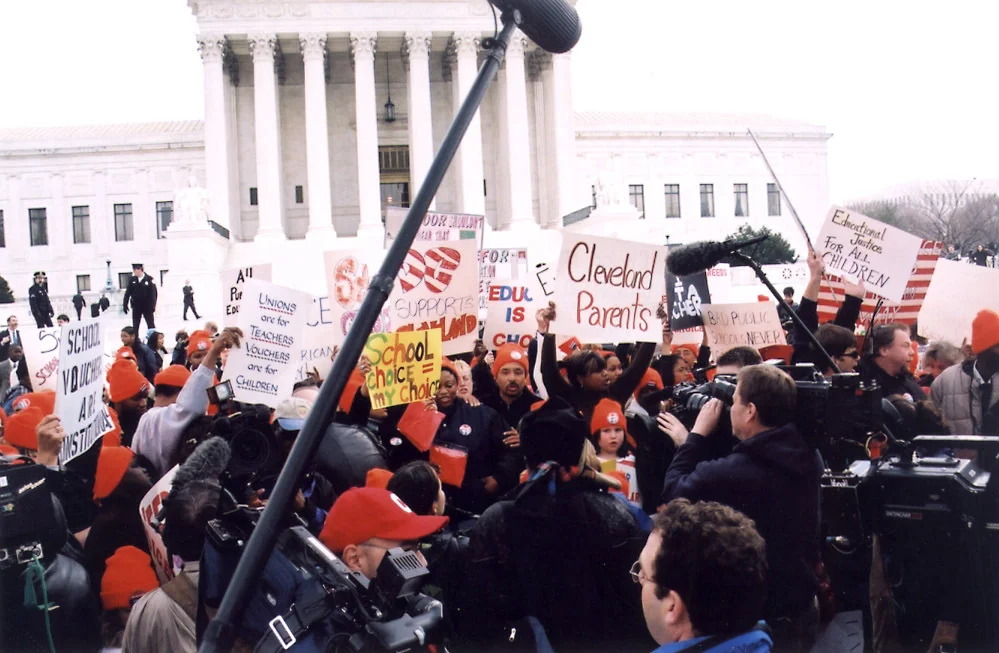
At issue in Zelman was Ohio’s Pilot Project Scholarship Program. Faced with an ongoing crisis in Cleveland’s public schools, the Ohio legislature enacted the program to provide immediate assistance to the more than 75,000 affected schoolchildren, most of whom were from low-income and minority families. The program provided tuition aid to families so they could attend a participating public or private school of their choice. It also provided tutorial aid to students who chose to remain in their public school. Critically, the tuition aid followed the parents: its destination depended wholly upon where the receiving parents chose to send it.
Several Ohio taxpayers challenged the program, arguing it violated the Establishment Clause, and obtained relief from the courts below. Those courts found that the Ohio program, much like the program at issue in Nyquist, had the primary effect of advancing religion, largely because 96 percent of the parents who received tuition aid directed it toward private religious schools.
In response, Chief Justice Rehnquist marshaled arguments from three cases—two of which he authored—demonstrating that government benefits provided to a broad group of citizens without reference to religion would survive the Lemon Test even if religious institutions received an “attenuated benefit.” These programs included tax deductions for general educational expenses, education aid to the visually handicapped, and subsidies for sign language interpreters for deaf students. Each of the programs distributed benefits neutrally, regardless of religion, and each depended on recipients’ private choices to determine whether the funds benefited a religious or a secular school.
None of those programs, however, had the practical effect of the Ohio voucher program, which created a publicly funded benefit directed primarily at private religious schools. The Chief Justice saw no difficulty in that distinction, however, noting that the Ohio program was “neutral in all respects toward religion” because it made benefits available to both private and public schools without reference to their religious character. Moreover, the fact that the aid flowing to private schools overwhelmingly went to religious schools did not create the perception of government endorsement of religion because it flowed “solely as a result of the numerous independent decisions of private individuals.”
The net effect of the majority’s decision was to interpose two requirements—neutrality and private choice—as a “circuit breaker” that defused Establishment Clause concerns when public funds landed in the coffers of private religious institutions. That circuit breaker, in turn, proved a critical hinge on which the doorway leading through the looming wall of separation constructed by Everson and its progeny turned.
The Door Swings Open
Zelman carved a door that provided safe passage through the wall of separation, one that would swing ever wider in the coming decades. An immediate consequence of Zelman was that opponents of school choice turned to no-aid provisions nestled in state constitutions. Known as Blaine Amendments, these products of anti-Catholic bigotry were on the books in 38 states, and were invoked to block state funds from reaching religious institutions regardless of private choice.
That move spawned a trilogy of landmark cases that further opened the aperture for school choice. In Trinity Lutheran Church v. Comer, the Court held that Missouri’s Blaine Amendment violated the Free Exercise Clause when it was used to exclude a church preschool from a neutral, generally available playground-resurfacing program. In Espinoza v. Montana Department of Revenue, the Court struck down the application of Montana’s Blaine Amendment to a state scholarship program, holding that it could not bar public funds from flowing to students attending religious schools. And in Carson v. Makin, the Court held that Maine’s no-aid provision could not prevent parents from using state tuition assistance at religious secondary schools where local districts offered no public option. These cases dramatically narrowed the distance between what the Establishment Clause permits and the Free Exercise Clause demands by confirming that once public aid is made available on neutral terms, it cannot be denied based solely on a potential recipient’s religious status or practice.
A less direct, but no less profound, consequence of Zelman was to highlight the sheer unworkability of the Lemon Test, which had the practical effect of enforcing a regime of overt state hostility toward religion. The majority in Zelman took pains to distinguish the Ohio program from the New York program at issue in Nyquist—an effort the dissent credibly found strained given the broad sweep of Lemon’s “primary effect” test. Two decades later, the Court in Kennedy v. Bremerton School District would abandon the “ahistorical” approach of the Lemon Test in its entirety, opting for an analysis grounded in the “original history and meaning” of the Establishment Clause. The Court’s unwillingness in Zelman and subsequent cases to follow the Lemon Test’s crushing logic to its anti-religious endpoint set the stage for Kennedy and the Lemon Test’s undoing.
Conclusion
Justice William Douglas wrote in Zorach v. Clauson, “We are a religious people whose institutions presuppose a Supreme Being.” A religious people cannot persist without the means to educate the next generation in religious truths and precepts. Nor can they be governed by a legal and political regime overtly hostile to their interests. Zelman marked a crucial turn toward preserving a Constitutional regime fit to serve a religious people and the institutions they established. So, as we toast our nation’s 250th anniversary, spare a word for the late Chief Justice Rehnquist and his masterful decision in Zelman.
Ryan Bangert serves as senior vice president for strategic initiatives and special counsel to the president at Alliance Defending Freedom.

Constitutionalism
Amicus Brief: Hon. William P. Barr and Hon. Michael B. Mukasey in Support of Petitioners
Former AGs Barr and Mukasey Cite Civitas in a SCOTUS Brief
Rational Judicial Review: Constitutions as Power-sharing Agreements, Secession, and the Problem of Dred Scott
Judicial review and originalism serve as valuable commitment mechanisms to enforce future compliance with a political bargain.
.avif)





.png)
.png)
.png)
The Fifth Circuit’s Chance to Expose the Inflation Reduction Act’s Unconstitutionality
Despite the mounting evidence of harm, the Medicare Drug Price Negotiation Program remains law — and the Justice Department continues to defend it in federal court.