A Theory of Natural Rights Citizenship Must Comport with the Constitution’s Text

If the Constitution sets a rule that runs counter to good policy, we must follow the former, not the latter.
I do not support “birth tourism,” the practice of alien mothers coming to the United States solely to win citizenship for their babies. Nor do I think that it is good policy to grant citizenship automatically to those who break our laws to enter the country. I’ve long thought that the United States should seek to reduce illegal immigration to as close to zero as feasible, but should increase its offer of permanent residency beyond the current 1.3 million a year.
Yet, if the Constitution sets a rule that runs counter to good policy, we must follow the former, not the latter. It is an unfortunate sign of the times that many commentators assume that one’s views on the Constitution are shaped always to agree with one’s political or policy views. It is an even worse sign of the times that critics often treat contrary views as sophistry, rather than good faith substantive arguments – hence easier to dismiss without having to think too hard about them. And it is maybe the worst sign of the times that critics will accuse their opponents of being less patriotic and less believers in American exceptionalism because of a dispute over constitutional interpretation. As I noted in my first response to Linda Denno, birthright citizenship, in fact, is part of what makes the United States an exceptional nation. Welcoming immigrants to join the American people separates the United States from the nations of the Old World; efforts to change the rule, it seems to me, seek to dilute that exceptionalism in favor of a return to European notions of citizenship that depend on the blood of the parents.
And in my defense, I can turn not just to Chief Justice Roberts’ majority opinion in Barbara, and not just to Justice Thomas’s dissent in Barbara, but even President Donald Trump! President Trump’s new executive order on birthright citizenship highlights the differences between rule by constitutional law and rule by political philosophy. Despite their differences on the outcomes, the White House, the Barbara majority, and Justice Thomas’s primary dissent work within a shared originalist approach to constitutional interpretation. Professor Linda Denno and her fellow Claremont political philosophers, who have supplied the intellectual foundations for the challenge to birthright, would replace constitutional law with their preferred public morality.
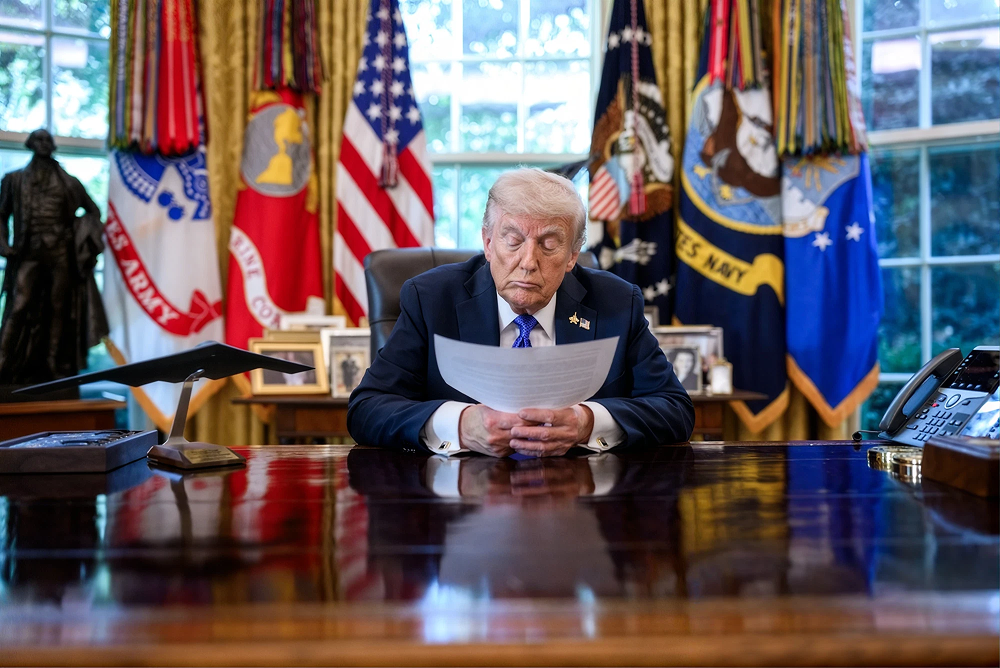
The executive order issued last week by the White House works within the same originalist structure as the majority and dissent in this summer’s Supreme Court opinion on birthright. The executive order seeks to deny citizenship to children born on the territory of the United States, but whose parents: a) are members of foreign terrorist organizations; b) are officers or employees of foreign countries or international organizations; or c) engage in a commercial transaction for purposes of birth tourism.
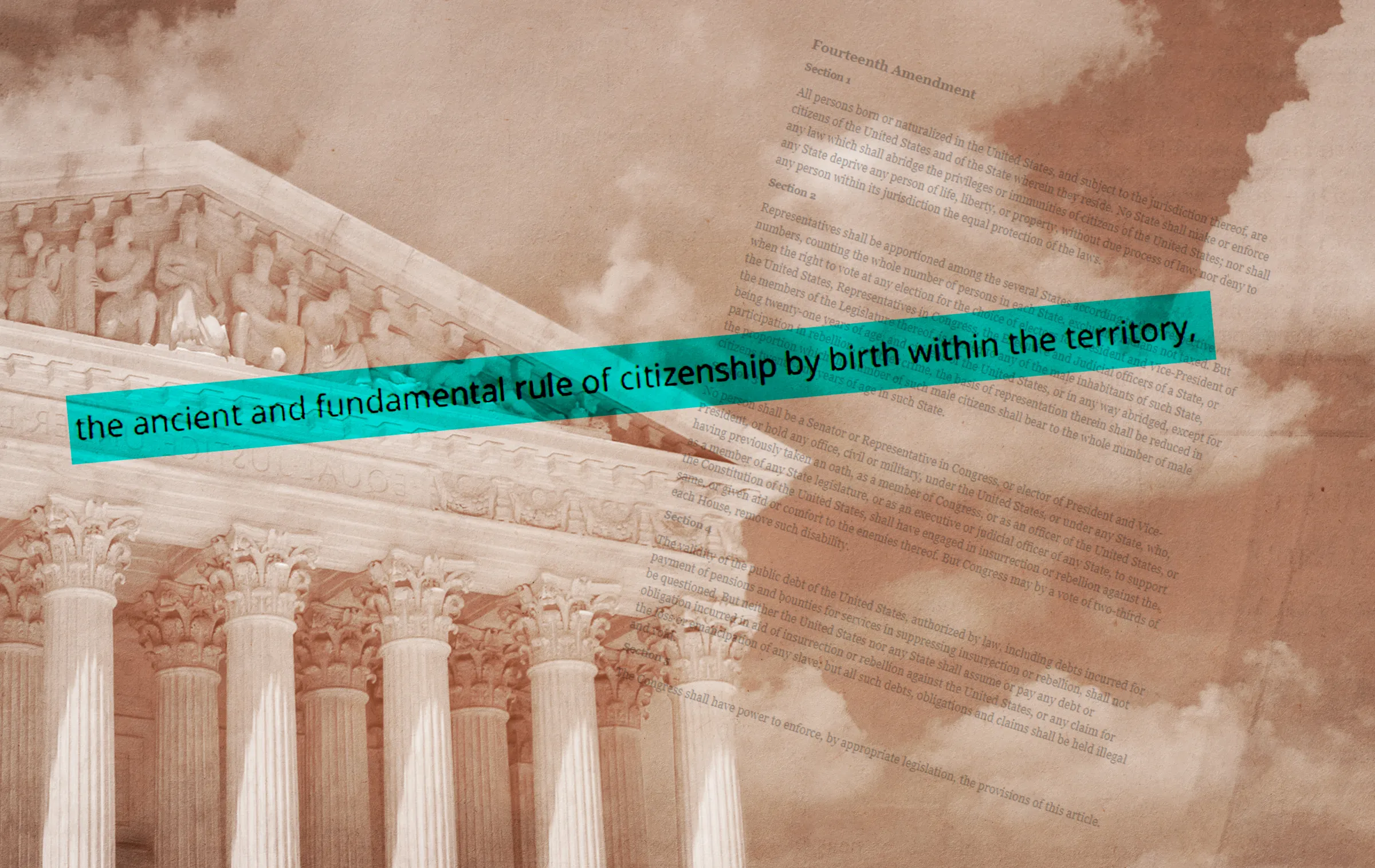
Writing for a 5-4 majority, Chief Justice John Roberts properly found that the starting point for answering the question of citizenship rests in the Fourteenth Amendment’s phrase: “All persons born or naturalized in the United States and subject to the jurisdiction thereof, are citizens of the United States of the State wherein they reside.” The text clearly grants citizenship to “persons” born in the United States. The only dispute between the majority, Justice Thomas’s dissent, and the Trump executive order is whether “subject to the jurisdiction thereof” creates broad or narrow exceptions to the rule.
Both the majority and the dissent agree on a minimum scope of “subject to the jurisdiction” that includes much of the new executive order. As held by the Supreme Court in Wong Kim Ark, an occupying army or foreign diplomats could sit on U.S. territory but not fall within the exercise of our laws. Expanding the category of enemy armies to include members of foreign terrorist organizations should prevail, especially after the Supreme Court in Hamdi v. Rumsfeld (2004) upheld the expansion of war to such non-state actors. Including the employees of foreign governments and international organizations should fall within Barbara and Wong Kim Ark’s exception for foreign diplomats. Another category in the executive order, which denies birthright to children born in the territories where Congress has not already extended citizenship, should fall within another Supreme Court rule, the Insular Cases, which refused to fully apply the Constitution to the U.S.’s overseas possessions.
These elements of the executive order show the Trump administration engaging with, rather than denying, Barbara. Despite the exaggerated alarums bandied about in the popular media, Trump has not defied the Supreme Court, just as he has obeyed the Court in the many other cases he has lost. A fourth provision of the executive order, however, directly challenges the authority of the Court and fail unless a Justice in the majority were to retire. Section 2(c) denies citizenship to a child if “either parent of that person engaged in a commercial transaction to purchase or access birthright citizenship for the person, or engaged in fraudulent activity to obtain citizenship.” The order further defines this category to target “birth tourism” by denying citizenship to children whose parents “engage[d] in a commercial transaction” so the mother or a surrogate could give birth in the United States.
Barbara recognizes no such exception to birthright citizenship. Indeed, the executive order at issue in that case sought to deny citizenship to children whose mother “was unlawfully present” in the United States or was “lawful but temporary.” Like Wong Kim Ark, Barbara rejected the argument that the conduct of the parents could deprive children of citizenship by birth. “What the Court held in Wong Kim Ark was simple: the Citizenship Clause incorporated the common law and granted citizenship to nearly all children born in the United States,” Chief Justice Roberts wrote. “Not surprisingly, then, in the 128 years since, we have repeatedly understood the rule of Wong Kim Ark to guarantee citizenship to all children born in the United States and subject to its power. . . We see no reason to depart from that view today.”
Barbara, of course, does not settle the matter. A President has the right – even the duty – under the Take Care Clause to advance his good faith reading of the Constitution in the areas under his constitutional responsibility. He cannot force the courts to agree, just as the courts cannot force him to adopt their opinions. But Trump has the right, which he exercised in Barbara, to attempt to persuade the Court to change precedent. If he wanted to press his executive powers to the extreme, he could even continue to order subordinate executive officers not to apply Barbara when they enforce the law – here, for example, in refusing to issue Social Security numbers or passports to children born here as part of birth tourism schemes. And the Court could hold those decisions illegal and order the granting of citizenship to each baby in an individual case, one-by-one. I have little doubt that the Court will continue to enforce Barbara, even as Trump raises doubts about its reasoning and even challenges its reach. The federal and state governments have ample powers to deter birth tourism, such as barring pregnant aliens from entering the country, prosecuting individuals and businesses that are aiding and abetting the conduct, or even arresting the mothers for immigration fraud. But Trump’s order to exclude the children from citizenship flatly conflicts with the holding of Barbara and should fail (again) in the federal courts.
Trump can call upon the example set by no less a President than Abraham Lincoln, who argued that, as President, he had no obligation to enforce the notorious Dred Scott beyond the parties to the case. “[N]or do I deny that such decisions must be binding in any case, upon the parties to a suit, as to the object of that suit,” Lincoln explained in his First Inaugural Address. Decisions of the Court should receive “very high respect and consideration, in all paral[l]el cases, by all other departments of the government.” It might even be worth following erroneous decisions at times because the costs of reversing them might be high. But “if the policy of the government, upon vital questions, affecting the whole people, is to be irrevocably fixed by decisions of the Supreme Court,” Lincoln argued, “the people will have ceased to be their own rulers, having, to that extent, practically resigned their government, into the hands of that eminent tribunal.” Lincoln followed in the footsteps of Andrew Jackson, who properly argued that he could veto the re-authorization of the Bank of the United States even though the Court had upheld its constitutionality in McCullough v. Maryland. But a President who over-uses the power claimed by Jackson or Lincoln in the wrong circumstances risks undermining his cause and the long-term institutional strength of his office.
This struggle between the Trump White House and the majority and minority opinions in Barbara makes plain the error made by those, like Professor Denno, who demand a broader rejection of birthright citizenship on political theory grounds. Professor Denno’s argument retains its basic structure, which I will try to make clear, but cannot find the support it needs in case law, the proper approach to constitutional interpretation, or, indeed, the natural rights theory that she believes governs all questions in the American republic. As I understand it, Professor Denno argues that the Framers universally believed in natural rights as shown by the Declaration of Independence, that the purpose of government is to protect those rights as shown by the Constitution, and that therefore the Constitution must be read in harmony with a social contract theory of government along the lines proposed by John Locke. In her view, the newly independent states did not adopt the common law rule because it reflected a political theory of monarchy. Instead, they replaced it with a social contract approach in which both the individual and society agree to admit a new member.
Professor Denno’s argument is at odds with the Court’s majority and minority, and, by extension, the Trump White House. Neither Chief Justice Roberts nor Justice Thomas disagree about the textual, structural, or methodological starting points to answering the birthright question. They share the view that the Constitution looked to the states, not the federal government, to set the conditions for citizenship. The states could have adopted any system they chose, but they all chose to adopt the system of the British common law. And neither Chief Justice Roberts nor Justice Thomas disputes that the British common law used place of birth to determine citizenship. Their disagreement stems from whether the common law also included the domicile of the parents as part of the birthright rule. And on this point, as Chief Justice Roberts points out, Justice Thomas’s dissent does not identify examples of the U.S. government in the antebellum period denying U.S. citizenship to children born on U.S. territory, but whose parents were not domiciled here. Instead, the dissent draws an analogy to scattered cases where state A held that the citizens from state B were not automatically the citizens of state B, unless the movers demonstrated domicile – the intent to remain – in state B. But that analogy may not hold, no matter if this were the rule or not, the citizens of both state A and B were U.S. citizens. To prevail, Justice Thomas’s dissent would have to present evidence of the government denying citizenship, through rejecting applicants of the right to benefits, or the right to vote and serve on juries, because of the absence of domicile on the part of their parents. Such cases may never have arisen due to the United States’ encouraging attitude toward immigration in the years before and after the Civil War.
That disagreement over the initial common law rule of citizenship drives the rest of Barbara. Both majority and minority agree that Dred Scott grievously misread the Founding to deprive blacks – both slave and free – of citizenship, even though they were entitled to it under the common law rule of birthright. They both agree that the Fourteenth Amendment overruled Dred Scott but otherwise sought to work no great change in the common law rule, other than to establish it nationwide and henceforth outside the powers of the states. They even both agree that Wong Kim Ark recognized this history of American citizenship. Chief Justice Roberts and Justice Thomas only disagree over whether the original birthright starting point included domicile as a requirement. For this reason, Justice Thomas’s dissent does not argue that the children of illegal aliens who intend to remain within the United States, which would satisfy his domicile condition, fail to benefit from birthright citizenship. His dissent only addresses birth tourism: children whose parents give birth on U.S. territory but then leave. On this point, President Trump’s new executive order has withdrawn from the broader claim of his first order, which attempted to deny citizenship to any children of mothers in the U.S. illegally.
Professor Denno’s argument would replace this unobjectionable, even normal disagreement over the original understanding with a radical theory rooted in philosophy, not history. She believes that a natural rights republic requires that the people and a new member both agree to citizenship – this is the very meaning of government by consent at the heart of social contract theory. But there is no evidence that the antebellum states adopted this social contract theory of citizenship for children born on U.S. territory. Neither the majority nor the minority opinions in Barbara present evidence – or even argue – that citizenship in the antebellum states switched from the common law to a consent-based approach. If so, we should see cases where the law held that children either were not citizens or were only presumptively citizens, because they could not yet give their consent. We should expect to see cases where states sought some perfection of a presumed citizenship when children became adults. We would expect to see cases where states denied the rights and duties of citizenship – jury duty, voting, veterans benefits – to adults who did not consent to citizenship through a formal process upon turning 18.
Instead, both the majority and minority in Barbara agree that birthright was the rule universally applied to citizenship by the states before the Fourteenth Amendment. Even if domicile were part of that rule, as Justice Thomas claims, this does not impose a social contract theory of citizenship, as even illegal aliens can have a domicile if they intend to remain in the United States. But neither the majority nor dissent seeks any sign of any consent mechanism for citizenship because one did not exist and, more importantly, neither side adopts Professor Denno’s radical approach to citizenship. In fact, as far as I can tell, there is no evidence that any antebellum state rejected the common law rule, nor is there any evidence that any antebellum state adopted anything like her consent-based theory of citizenship. The consistent practice of the states, as recorded by historians of American immigration and by the majority and minority in Barbara, adopted the common law rule of birthplace citizenship.
Professor Denno’s claim about practice during the Revolution does not prove the contrary. Of course, at the time of the Revolution, every American started out as a British subject. During the War for Independence, they had to choose whether they wanted to retain their status or break that relationship and become a new society. That was a choice that had to be made because, by default, every adult was already a British subject, and so had to declare whether they would abjure their former status and join the independent United States. But sorting out individual citizenship in the wake of a revolution does not somehow dictate the rule that the new society will choose to recognize new citizens in the future. Professor Denno’s argument is like saying that when two teams choose their players from an existing pool, they start out with a random assignment, and that therefore they must forever choose new players randomly too. The starting point for choosing, however, does not dictate the method afterwards. Professor Denno may think that it is logical for one to follow the other, but the constitutional text does not require it; instead, the federalist structure of the Constitution gave this question to the antebellum states, which chose the common law.
After reading Professor Denno’s rejoinder, it has become clear to me that the fundamental problem with political theorists interpreting the Constitution is that they are not interpreting it. Instead, they are using the Constitution to advance a political theory. Whether a reader agrees with Professor Denno will depend, in part, on whether one agrees with her theory, not with the Constitution. One could also hold my view, that agrees with parts of her natural rights theory, but acknowledges that we advance it through the democratic process of elections and legislation, not courts and constitutional interpretation. The question becomes whether Americans want their fundamental constitutional questions settled by lawyers such as Chief Justice Roberts or Justice Thomas or even Presidents like Donald Trump, who, despite their differences in outcomes, operate within a shared framework of original constitutional meaning. Or do Americans want to be governed by philosophers like Harry Jaffa or Leo Strauss (or even their friendly disciples)? I expect most Americans today, and at the time of the Framing, would vote for the former. Professor Denno and her fellow Claremont-inspired philosophers would choose the latter. And maybe some of her philosopher friends would also secretly pick the former, if they wanted to respect constitutional text, history, and practice over abstract theory.
John Yoo is a senior research fellow at the Civitas Institute and a distinguished visiting professor at the School of Civic Leadership at the University of Texas at Austin.

Constitutionalism
Amicus Brief: Hon. William P. Barr and Hon. Michael B. Mukasey in Support of Petitioners
Former AGs Barr and Mukasey Cite Civitas in a SCOTUS Brief

Rational Judicial Review: Constitutions as Power-sharing Agreements, Secession, and the Problem of Dred Scott
Judicial review and originalism serve as valuable commitment mechanisms to enforce future compliance with a political bargain.
.avif)







.png)
.png)
.png)
The Constitution and Birthright Citizenship: A Rejoinder to Professor Yoo
Foreigners can come to America and become “Americans” not by their mere presence on American soil but by embracing the principles upon which this country was founded.