Why Amtrak Needs Airport-Level Security

The fact that Cole Allen was able to move weapons across the country using Amtrak is not just an isolated failure but a reflection of a much broader systemic security gap.
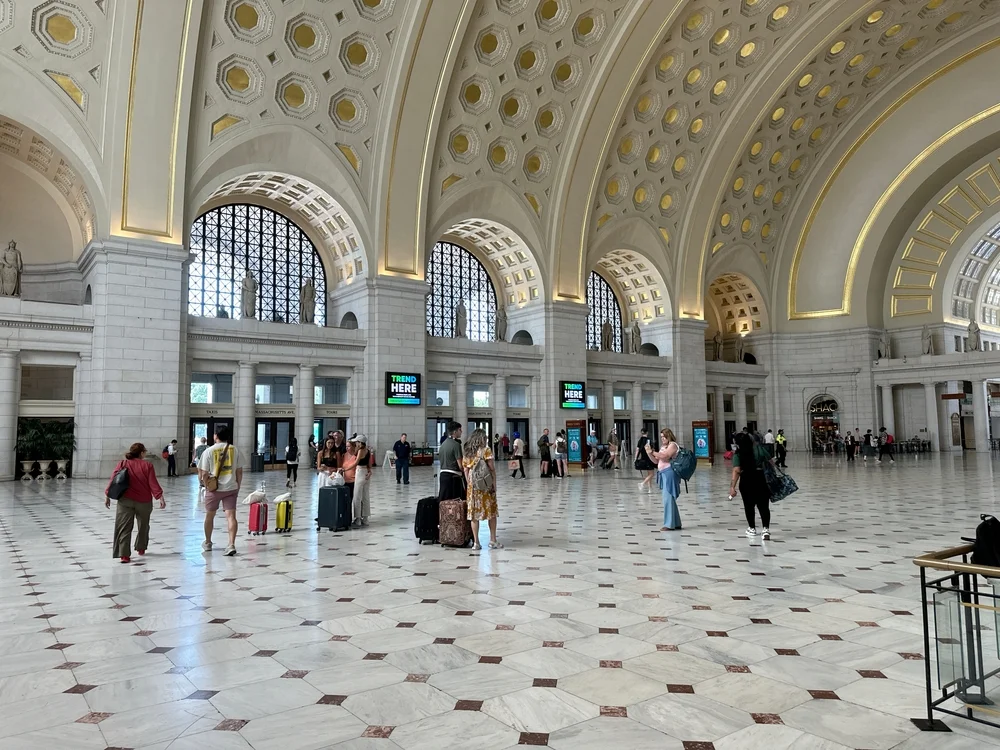
The case of Cole Allen, who attempted to assassinate President Trump and his cabinet earlier this month, highlights the issue of lax security on our national trains. He was able to travel across the country from California to the East Coast by train (first to Chicago, then to DC) while transporting several weapons he planned to use in the foiled attack. The details of this event point to a broader problem about security within the US: Passenger rail in the United States, unlike air travel, allows individuals to board with minimal identity verification and little baggage screening. Passengers can arrive shortly before departure and carry large amounts of luggage without inspection. While Amtrak maintains a police force to deter crime in stations and on trains, this approach is highly insufficient in the absence of meaningful screening of passengers and baggage. This environment creates a clear gap in the overall nationwide transportation security framework, which the federal government should address.
By comparison, aviation security underwent a major transformation after the September 11 attacks. Airports now rely on multiple layers of screening, including identification checks, baggage scans, and physical screening of passengers. Each layer contributes to reducing the probability of a successful security breach. The combined effect is a system that deters and detects threats more effectively than a single measure could achieve.
One reason for this gap is our existing national transportation security policy. The Transportation Security Administration (TSA) applies comprehensive screening to aviation but has a far more limited role in passenger rail. This creates an uneven security standard across transportation modes, even when the potential risks are comparable.
Some argue that rail systems cannot adopt similar procedures because they are more open and decentralized. Stations are often designed for easy access, and imposing strict screening could introduce delays. While these concerns are valid, they do not eliminate the underlying risk. The relevant question is whether the current level of security is appropriate given the potential consequences of a failure. A system that allows large numbers of unscreened passengers to travel long distances poses a clear security risk to the nation.
History provides a clear warning about what can happen when rail systems are targeted. The 2004 Madrid train bombings killed nearly 200 people and injured thousands more. The attackers exploited the openness of the rail network and the absence of systematic screening. While the United States has not experienced an attack of that scale on passenger rail, the vulnerability is structurally similar. There have also been warning signs closer to home. In 2017, a bombing at Parsons Green station in London, while not on a long-distance rail line, demonstrated how mass transit systems with open access can be exploited. In the United States, law enforcement has repeatedly disrupted plots targeting transportation hubs, underscoring that intent exists even when large-scale attacks are prevented.
There are existing examples of enhanced rail security. Brightline, a new private rail company that operates across Florida and soon will have a new line between Los Angeles and Las Vegas, has implemented screening measures that include bag checks and controlled boarding areas. These procedures are less extensive than those used in airports, but they demonstrate that improved security can be incorporated into rail operations. The experience of Brightline suggests that screening can be introduced without eliminating the convenience that attracts passengers to rail travel.
Expanding such measures to the national Amtrak network would require a phased approach. Major Amtrak stations could serve as initial points for implementation. Screening could focus on high volume Amtrak routes and long distance services where the risks are more pronounced. Technological tools like advanced baggage scanning and identity verification systems could help maintain efficiency while improving security outcomes.
The economic case for enhanced rail security is also relevant. A single significant security incident would impose large costs, including loss of life, disruption to transportation networks, and reduced public confidence. Preventive measures can be viewed as an investment in our nation’s security infrastructure that meaningfully reduces the probability of these left-tail outcomes. While there are upfront costs, these could be justified by the reduction in long term risk.
Of course, there are tradeoffs associated with increased screening. Rail travel is valued for its relative ease and flexibility. Additional security measures may increase travel time and reduce convenience. However, the objective is not to replicate every aspect of airport security. The objective is to adopt those elements that meaningfully reduce risk while preserving as much efficiency as possible.
The fact that Cole Allen was able to move weapons across the country using Amtrak is not just an isolated failure but a reflection of a much broader systemic security gap. Current rail security practices rely on assumptions that may no longer be appropriate or are outdated. Incidents like Cole Allen’s travel with weapons across the country on rail demonstrate that vulnerabilities exist. A simple, gradual move toward more comprehensive screening, informed by existing models that are supported by modern technology, would strengthen the resilience of the transportation system.
Jon Hartley is research fellow at the Civitas Institute, a Policy Fellow at the Hoover Institution, and senior fellow at the Foundation for Research on Equal Opportunity

Politics
%20Richard%20Samuelson%20%20-%20Is%20American%20Nationalism%20Still%20Creed-able_-1.jpg)
Is American Nationalism Still Creed-able?
We are not there now, but there is reason to worry that the United States is in danger, if we are not careful, of ceasing to be a nation with the principles of 1776 at its core.

National Civitas Institute Poll: Americans are Anxious and Frustrated, Creating a Challenging Environment for Leaders
The poll reveals a deeply pessimistic American electorate, with a majority convinced the nation is on the wrong track.
.webp)
%20(1).avif)

The G7 Is Failing To Address Global Imbalances
The G7 was not created to issue an endless procession of carefully calibrated communiqués.

Immigration Alone Won't Solve Canada's Population Decline
Rather than looking abroad for solutions, we should ensure young Canadians have a hopeful future








Can Britain’s Next Prime Minister Escape the Net Zero Trap?
Britain has burned through five Prime Ministers and is paying some of the highest electricity prices in the world.

The Scanner at the Gate: Europe’s China Policy Litmus Test
China’s industrial policy is entering Europe through public procurement—and reshaping sensitive markets from within.

Confronting the New Antisemitism
"The postwar effort 'to rebrand Judaism as a religion' has made it impossible for American Jews to understand what they are facing today, because what we are facing today is an attack on the idea of Jewish peoplehood.”

“Democratic” Socialism Is Undemocratic
By promoting class hatred, suppressing private initiative, and seeking enhanced control of our lives, today’s democratic socialists undermine patriotism and individual initiative—two qualities that have long distinguished the United States from other major nations.

