%20Richard%20Samuelson%20%20-%20Is%20American%20Nationalism%20Still%20Creed-able_-1.jpg)
Is American Nationalism Still Creed-able?

The political, institutional, and legal elements that historically enabled us to create and build a creedal nation are under serious threat.
Executive Summary
Our principles, which Lincoln recognized as a “truth applicable to all men at all times,” are universal and timeless. That truth is not just “ideology,” a concept that didn’t even exist in 1776. It was, in fact, genuinely true. At the same time, the American project is to embody the truths listed in the Declaration within our specific nation, with a particular constitution, laws, and political practices. Above all, the American project has been to show against would-be aristocrats and kings that it is possible to create and maintain such a nation. Are the critics of creedal nationalism, Left and Right, all wrong? Perhaps the better question isn’t if we have been a creedal nation in the past, but if we are still a creedal nation today: do we still believe in these truths? Can we? That second question—whether we can or not—raises a different kind of issue.
What conditions enabled a nation to become creedal, and do our current circumstances still satisfy those conditions? Our major issues lie in a few areas. One is the drastic growth of our state compared to its size at the Founding. Is creedal nationalism compatible with such expansion? The second is the rise of cosmopolitan ideals. How does this shift affect the unity of American identity?
Does our elite now see itself as transnational or post-national? And does the latter mean that we no longer expect immigrants to assimilate and join us as fellow Americans, adopting the way of life that has traditionally suited a creedal nation? America may have always been multicultural in some sense, but the ideology of “multiculturalism” is modern. Is it compatible with creedal nationalism?
Is American Nationalism Still Creed-able?
Is America a “Creedal Nation”? It’s a hotly contested question. Gordon Wood, America’s most distinguished living historian, argued in his speech accepting the Irving Kristol Award at the American Enterprise Institute, published afterward in the Wall Street Journal, that we are a creedal nation, not a “blood and soil” nation: all kinds of people from all over the world, he notes, have become American.
Yet many Progressives believe that “progress” entails progress beyond the nation-state: How can our creed be peculiar to America when the principles are universal? Particularity has always scandalized Progressives. Vice President J.D Vance, on the other side of the political aisle, implicitly agreed with this Progressive view of creedal nationalism at a recent Claremont Institute event where he was awarded its prized Statesmanship Award. In his acceptance speech, he declared that it is a mistake to say American nationalism means “purely agreement with the creedal principles of America.” That definition, he says, is “over-inclusive and under-inclusive. It would include hundreds of millions, maybe billions, of foreigners. Must we admit them tomorrow?” On the under-inclusive side, he suggested that if we make subscription to the American creed the key to citizenship, it “would also reject a lot of people the ADL would label domestic extremists, even though their own ancestors were here at the time of the Revolutionary War.” Is the Vice President onto something about the dangers of universalism?
What his criticism ignores is that a particular nation can have a universal creed at its core. The Vice President highlighted sovereignty and citizenship, yet our creed helps us set boundaries between America and Americans on the one hand, and other peoples on the other, and helps us understand what good citizenship means. And that very creed, embracing principles of liberty as it does, itself is at odds with the proposition that citizens who want a monarch, or an established national church, or who agree with, for example, Jeremy Bentham’s critique of the Declaration of Independence, cease to be citizens.
Let’s return to Professor Wood. His account, which highlights Lincoln’s importance, echoes the great political philosopher, Harry Jaffa. It also suggests he has turned back to the mid-century Consensus History that his Republican School pushed aside. And yet, Wood can’t quite escape the tendency to embrace a European norm. He asserts that “Americans created a state before they were a nation.” In his essay, he rejects Benjamin Rush’s view that after we ratified the Constitution, “we have become a nation.” Since the modern academic historian is trained to describe, not argue with, the past, a historian’s criticism of his subjects often indicates that the past’s ideas challenge his assumptions about its nature. In this case, it suggests that Professor Wood accepts the European practice of treating nations as cultural units. Yet American nationality has always been a different kind of thing than European nationality: it has been primarily political and only secondarily cultural. We became a nation “among the powers of the earth,” as the Declaration has it, before we had a state. And Americans related to that nation as citizens. Our nationalism is not, despite Paine’s comment in Common Sense that “all Europeans meeting in America, or any other quarter of the globe, are countrymen,” built upon a generic European culture: America is, well, a New World, and our creedal nationalism is suited to it. The day someone becomes a citizen, they become an American in the full sense of the term. Our Creed has been fundamental to that story
Are the critics of creedal nationalism, Left and Right, all wrong? Perhaps the better question is not if we have been a creedal nation in the past, but if we are still a creedal nation today: do we still hold these truths? Can we? That second question—whether we can or not—raises a different kind of point.
These are the kind of questions that historians, back to Thucydides, have asked, but perhaps are not the questions that historians have been trained to ask since the creation of the Ph.D. in history in the nineteenth century. The modern historian tends to study the past, even past politics, from the perspective of cultural evolution, yet politics is often autonomous. Classical historians always kept in mind that there is a human nature and a human condition; not all things are possible in all circumstances. Stated as an abstract proposition, the modern historian might allow that to be true, but concurrently, he is not usually trained to consider how human life’s unchanging elements shape what change happens or does not happen over time, and how it sets parameters that are related to the possibilities and likelihoods in any given circumstance.
From this perspective, some of the questions we might ask are: What conditions made it possible to become the creedal nation Wood describes, and whether our circumstances still meet those conditions. Our biggest problems are in a couple of areas. One is our state’s radical expansion compared with its size at the Founding. Is creedal nationalism compatible with that expansion? The second is the cosmopolitan turn. Does our elite now see itself as trans-national or post-national? And does the latter mean that we no longer expect immigrants to assimilate and join us as fellow Americans, adopting the way of life that has been suitable to a creedal nation? America may always have been multicultural in a sense, but the “multiculturalism” ideology is modern. Is it compatible with creedal nationalism?
Before considering those problems, it’s worth briefly outlining the rise of creedal citizenship between the Founding and the Civil War.
All Nations Are Not Creeded Equal
In the 1790s, America was a new nation. We had only recently assumed “among the powers of the earth, the separate and equal station to which the Laws of Nature and of Nature’s God” entitled us. How new was it? When John Quincy Adams arrived at the gate of Berlin in 1797 as our first official Minister to Prussia, the guard would not let him enter; he didn’t know there was such a thing as the United States. Similarly, Americans were still willing to debate our name: is “American” the best word for us, they wondered? In a lighthearted letter to a friend in 1800, President Adams remarked that “We are such an Hotch potch of people—such an omnium gatherum of English, Irish, German Dutch Sweedes, French &c that it is difficult to give a name to the Country, characteristic of the people.” He elaborated: “I never was pleased with the word Columbia, or Columbians” he said, and added a similar comment about using the name “Americus Vesputius” for our moniker. Wood cites this letter as evidence that Adams was skeptical that any country could be so diverse, which doesn’t seem to match what Adams actually wrote. But it does show that the founding generation recognized that we were unusually heterogeneous in many ways, and yet still a nation in the fundamental political sense.
This polyglot, or “hotch potch” nationality was a different sort of thing than European nationality. It was not about blood, nor was it about mere soil. And it was not fundamentally about having a shared culture dating back centuries. Our central national celebration—July 4—would be the celebration of a political event. Interestingly, John Adams predicted as much in early July 1776: he anticipated that an annual celebration of Independence Day would become an important civic ritual, because he read history in the classical way, and he knew that creating such rituals over events like independence was exactly the kind of thing that nations do. Such rituals, like 2026’s celebration of our 250th anniversary, are fundamental to sustaining our peculiar form of nationalism.
During his debates with Stephen Douglas, Lincoln noted that among our countrymen are those descended from the men “we claim as our fathers and grandfathers” who fought for independence in 1776. But, as Wood notes, Lincoln also argued that there are many others who are no less our national brethren: “We have besides these men—descended by blood from our ancestors—among us perhaps half our people who are not descendants at all of these men, they are men who have come from Europe—German, Irish, French and Scandinavian—men that have come from Europe themselves, or whose ancestors have come hither and settled here, finding themselves our equals in all things.” They are no less American. Why? Because the principles of 1776 make them “feel that that moral sentiment taught in that day evidences their relation to those men, that it is the father of all moral principle in them, and that they have a right to claim it as though they were blood of the blood, and flesh of the flesh of the men who wrote that Declaration.” The Declaration, he said, “is the electric cord that links the hearts of patriotic and liberty-loving men together.” The principles of 1776 bind us, enabling the diverse peoples who have settled here to become fellow Americans.
Our principles, which Lincoln recognized as a “truth applicable to all men at all times,” are universal and trans-historical. That truth is not mere “ideology,” a concept that did not even exist in 1776. It was, well, actually true. At the same time, the American project is to embody the truths listed in the Declaration in our particular nation, with a particular constitution, laws, and political practices. Above all, the American project has been to demonstrate against would-be aristocrats and kings that it is possible to create and to sustain such a nation. Cultural nationalism is fundamental in an aristocratic world in which the typical citizen or subject is not politically active, or his political activity is not essential. In America, the burden of political responsibility falls upon us all. Hence, politics, not culture, is our nationality’s core. It is this principled heart of our regime, combined with a robust sphere of free civil society, that has enabled us to assimilate so many from so many different places and cultures to be Americans. It is also why we are, nonetheless, a particular people. A certain degree of cultural unity (the kind Professor Wood describes so well in his book Radicalism of the American Revolution) follows from that. But at its heart, their political character, as a nation of citizens, has primarily defined the American people. From the start, the principles outlined in the Declaration have been the final cause driving our politics, guiding the path from 1776 to the ratification of a constitution “by the consent of the governed,” as the Declaration puts it, and shaping American life in countless other ways.
Creedal Nationalism and a Limited Federal Government
In Lincoln’s day, as in Jefferson’s, our federal government’s powers were radically more limited in scope than they are today. Crucially, there was no federal police power; the police power is the technical legal term meaning the right to regulate health, safety, and morals. Even Alexander Hamilton, known for his expansive interpretation of the Constitution, recognized that limitation.
The federal element is an essential part of democratic practice because it makes consent a practical reality. The very same sentence of the Declaration that proclaims that “all men are created equal” and “endowed by their creator with certain inalienable rights” also declares that governments “derive their just powers from the consent of the governed.” Those two elements are part of the same thought. Consent implies informed consent if it is to reflect the right of self-government, and to respect the equal right we the people have to rule rather than be ruled. Given our limited time and ability to focus on politics, it necessarily follows that the more government does centrally, the greater the distance between our consent and the laws under which we live.
Consent has two levels. There is, at the fundamental level, constitutional consent. The U.S. Constitution followed what was, by 1787 and 1788, well-established procedure (first established in Massachusetts in 1780, most of which John Adams drafted in 1779) of calling a convention to draft the Constitution and then sending the document to the people for ratification. That was a way of enshrining the rights described in the Declaration in political practice. That practice implies that the people are sovereign and that we create a written constitution and delegate certain powers to the government.
We must understand that there has always been, and always will be, a tension between the principles of 1776 and their practical application. Logically speaking, consent rested on the equality of men. Hence, in principle, it was hostile to slavery. It is no coincidence that the Massachusetts Constitution proved terminal to slavery in the state. But not every state did or could do that. Massachusetts was unable to end its religious establishment until the 1830s (Adams let others write that part of the state constitution) for the same reason that Virginia was unable to end slavery at the time; there was too much cultural, institutional, and, particularly with regard to slavery in the South, economic investment. Our principles mean that we must defer to public opinion. Consent is a practice, not merely a theory, and men have been known to embrace contradictions. To get the actual people living in America in 1787 and 1788 to consent, they had to allow slavery to remain in place.
The tension between principles and practice was a gravitational force beneath our politics from the Founding to the Civil War, and beyond. As Lincoln knew, the same principles that made slavery wrong also meant that we are bound by the Constitution we ratified. To think politically is to recognize that there always will be tensions between the principle of equality, which makes consent essential, and the policies logically connected with it, and the practice of consent, which demands we meet public opinion where it is. And since the heart of creedal nationalism is citizenship, thinking politically is fundamental to preserving our way of life. Lincoln understood that we were duty-bound to follow the Constitution as it was until we changed it via amendment. Radically reinterpreting the Constitution without recurring to the people for an amendment would imply that we need not consent to constitutional change, a large step back toward the aristocratic ways of Britain we had left behind.
In addition to constitutional consent, there is ongoing consent to the laws under which we live, exercised through regular elections. Allocating that power to so many people was a radical proposition. In the second volume of his Defence of the Constitutions, John Adams discusses Aristotle’s brief for aristocracy. According to the Philosopher, “Seven sorts of men, therefore, are necessary to a city: husbandmen, artificers, soldiers, merchants, rich men, priests, and judges.” And, Aristotle adds that only the last few groups have the time and leisure to be involved in politics:
those men, therefore, are not parts of a city, the operations of whom are not directed to those virtues; such are the husbandmen who are occupied, not in wisdom and prudence, but in laboring the earth; such are the artisans, who fatigue themselves night and day to gain a livelihood for themselves and their poor families; such, finally, are the merchants, who watch and labor continually, not in wisdom and prudence, but in the acquisition of gold. It is therefore clear, that neither husbandmen, artificers, nor merchants, are parts of a city, nor ought to be numbered among the citizens, but only as instruments which subserve certain uses and conveniences of the city.
Adams bristled at this view: “We must pause here and admire! The foregoing are not only the grave sentiments . . . of Aristotle, but form the doctrine almost of the whole earth, and of all mankind; not only every despotism, empire, and monarchy, in Asia, Africa, and Europe, but every aristocratical republic.” He noted that other parts of Aristotle suggest a different view of politics, but what mattered to Adams was that the perversely anti-egalitarian view was common in his day, and that Adams, like the rest of the men of 1776, knew it was incompatible with the principles of 1776. He continued, “until this wicked position, which is worse than the slavery of the ancient republics, or modern West Indies, shall be held up to the derision and contempt, the execration and horror, of mankind, it will be to little purpose to talk or write about liberty.” Note the centrality of political responsibility in Adams’s Americanism.
To think that most Americans are too busy with other matters or simply too stupid to be trusted with the rights and duties of self-government is to take an aristocratic turn. Moreover, Adams understood that the American republic was an experiment dedicated to the proposition that this version of Aristotelianism (which he recognized was not necessarily Aristotle’s final word on the subject) was wrong.
At the Founding the franchise was limited, but that didn’t last. In the nineteenth century, the franchise was limited by race and sex, but among white men, and whites were 88 percent of the population in Lincoln’s day, extremely high percentages of Americans participated regularly in elections, and not only once every four years. Local elections were spread across the calendar, and Americans participated actively. The Fifteenth and Nineteenth Amendments, passed because they, like ending slavey, followed from the American creed of equality, expanding the franchise.
Do our elections still matter the way they used to? Do we citizens still regard the regular democratic political process as a citizen’s fundamental act? Judging by the low turnout for most elections, we are failing at that. We don’t show up to vote, and our ruling class seems to prefer it that way. The decline in the importance we assign to most of our state and local elections reflects a practical movement away from the American creed, and the reduction of what citizenship entails. It shows that we don’t take what President Washington called “the duties of men and citizens” as seriously as we used to. If citizenship is fundamentally political, and active participation in elections from our towns, counties, and cities on up is the fundamental political act, the divorce of government and even law-making from the democratic process has reduced the importance of citizenship for the American.
Men and women learn by doing. To transfer law-making power out of the legislative and deliberative democratic process teaches us that we are subjects who follow rules the elite make outside the democratic political process. It was the democratic process’s broad scope that helped to take the creed from parchment to practice. How far did that go? How strong was the respect for the common citizen? Before the Civil War, American juries were known to have the right to rule on both law and fact. In one case, a judge even told a jury that if they believed the underlying statute “was void for unconstitutionality,” they ought not to convict.
As the Covid emergency showed us, many of our leaders have much less respect now for the common citizen. They are moving back to the elite prejudice Adams denounced, as they seem to think that we are too stupid, and perhaps too lacking in wisdom and self-control, to be told the unvarnished truth. They talk to us the way aristocrats talk to commoners. Similarly, the federal government has developed a habit of re-tasking old laws for new purposes when the legislature fails, thereby doing an end run around the democratic process, again showing contempt for the practice of citizenship. When Congress did not pass a law to deal with climate change in the George W. Bush years, our government re-tasked a 1970s-era law designed to combat smog. President Trump is now trying to reverse that re-tasked law. Such flipping and flopping by the executive should not happen in a democratic republic, and yet it follows inevitably from the delegation of law-making to the executive. That process, repeated regularly, separates politics from the democratic process and hence diminishes citizenship. When the local football team in Washington, D.C. decided to choose a new name, they came up with the “Commanders,” saying that the name “broadly resonated with our fans,” reflecting Washington D.C.’s contemporary ethos. That suggests an attitude that also cuts against the American creed.
On the other side, the rise of populist practices aimed more at emoting than working practically for political change suggests that many Americans have lost the kind of self-respect for themselves as men and citizens that led people to spend hours in hot open fields in an Illinois summer to hear the Lincoln-Douglas debates, or to read the lengthy transcripts of them in the newspapers. The gulf separating the engagement we had when calling the Senate “the world’s greatest deliberative body” was not a joke, and today’s world, in which 240 characters is sometimes too much for many people to read, is vast. In other words, our elite and our common political culture are less attuned to the civic practices the creed demands than they used to be.
The Compound Republic and the National Republic
This attenuation of citizenship is connected with the government’s nationalization. Madison saw this quite clearly. The Federalist described the United States as a “compound republic” rather than a national one. In the 1790s, Madison worried that if we began to interpret the Constitution in ways that expanded federal power, it would transform the federal republic into a consolidated one, and that would point us back toward monarchy.
To consolidate the States into one sovereignty, nothing more can be wanted, than to supercede their respective sovereignties in the cases reserved to them, by extending the sovereignty of the United States to all cases of the “general welfare,” that is to say, to all cases whatever.
The effect of such a transformation would be to transfer power from the legislative to the executive.
One consequence must be, to enlarge the sphere of discretion allotted to the executive magistrate. . .. In proportion as the objects of legislative care might be multiplied, would the time allowed for each be diminished, and the difficulty of providing uniform and particular regulations for all, be increased. From these sources would necessarily ensue, a greater latitude to the agency of that department which is always in existence, and which could best mould regulations of a general nature, so as to suit them to the diversity of particular situations. And it is in this latitude, as a supplement to the deficiency of the laws, that the degree of executive prerogative materially consists.
It is no coincidence that Madison used almost the exact same term as he did in Federalist 10 when he said expanding federal power would “enlarge the sphere” of executive power. Madison connected Federalist 10’s enlarged sphere with the “compound republic” he described when he recapitulated his extended sphere argument in Federalist 51. Hence, if we consolidate powers federally, the factions that the extended sphere is designed to cure no longer work. He put it this way: the consequence of such a turn would be “an excessive augmentation of the offices, honors, and emoluments depending on the executive will. . .. [and to] turn over to the federal government, and the patronage of the executive would necessarily be as much swelled in this case, as its prerogative would be in the other.” In other words, a significant increase in the powers of the federal government would, by the force of political gravitation, necessarily move more government away from we the people in Congress and toward the executive.
Precisely because we are a large, compound republic, our ranks include a diversity of political cultures. Democratic politics take place in the discussion, debate, bargaining, and compromising that only a democratically elected legislature makes possible. If we concentrate power nationally, we must delegate that power to the executive branch, which means delegating law-making out of the democratic process and the debate and deal-making that is fundamental to it. That turn reduces the democratic process in our lives, as the importance of the legislative branch shrinks. And, by political osmosis, we citizens are likely to internalize the lesson of the republican government’s decreasing sphere.
Congress today is a shadow of its former self. In the Progressive era, we began to move more powers to Washington; that trend accelerated under FDR’s stewardship. The Progressives used the crisis of the Depression to justify the work they had long wished to complete. Recall that the “Commonwealth Club” speech outlining FDR’s agenda in 1932 was officially a “Campaign Address on Progressive government.” The conceit—or perhaps the hope—was that rather than move all power to the President, with the dangers such a turn would entail, we would, instead, assign authority to scientifically trained experts who would not truly be under the President’s control.
Rejecting the Founders’ view that all men tend to grasp at more power unless checked and balanced (another way in which all men are equal), Progressives posited that experts would simply follow science and do so rationally. But there’s a problem: as many saw then, and as about all of us recognize now: men, even scientists, are not above self-interest or self-deceit. Men in and near power tend to exaggerate their importance and to believe their expertise encompasses a larger field than it does. Similarly, we recognize that public policy is not a science in the modern sense of the term, and it cannot be. The modern scientific method might be able to tell us the consequence of picking one horn or the other of a policy dilemma, but the choice is political, not scientific.
Given the expansion of federal power, Americans face a terrible choice. Either we allow unelected men and women to make political decisions, a version of aristocracy, or we have a single person, however elected, in charge of an unthinkable amount of power. The former, it is worth noting, is an echo of the “Civil List” (numbers of men paid directly by the king, and working for the government, but not subject to the increasingly powerful local assemblies), royal governors wanted to have in the 1760s.
The Founding’s unitary executive was the alternative to aristocratic government by independent gentlemen, but it was designed with the Founding era’s limited federal government in mind. It was not designed for a government with the scope the federal government has today. Many note that Congress likely would not have created “Independent Agencies” like the Securities and Exchange Commission, or would have created them in a very different fashion, if they had anticipated that the Supreme Court would rule that the executive had the right to fire the people running it. If the Court, as seems likely, rules that the President has the right to fire commissioners because the Constitution gives authority over the executive branch to him, it will raise an important issue. In our system, if we are to remain a democratic republic, that issue is for the legislature to resolve.
As for democratic consent, having hordes of men and women whose job it is to make all kinds of public policy decisions, and whose self-understanding and egos are invested in the belief that they are special because their decisions are helping the common citizen, has created a class of people whose daily work and whose self-image is invested in the belief that the common citizen is not up to the task of consent. In a word, they see themselves as “commanders.” On the other side, the common citizen tends to internalize that lesson and takes his responsibilities less seriously than he used to. Regular voting at all levels used to be citizens’ common task. Has filing a tax return taken its place?
The result has been that on one side we have seen the creation of an elan in our governing class that sees itself as special, better than the common American, and that elan sees its job as making Americans better than they are now. Meanwhile, on the other side, debased citizenship fosters a lack of self-respect on Capitol Hill and among the citizenry. Our most important legislators no longer debate each other in Congress; instead, they speak to the camera in an otherwise empty chamber, or shout talking points at each other on X. Meanwhile, citizens all too often seem to think that their job is mostly to mouth off about their frustrations, rather than to deliberate and discuss what today’s problems are, and what are reasonable ways of mitigating them.
Immigration, Assimilation, Big Government, and the Principles of 1776
When he was Secretary of State, John Quincy Adams reflected upon this element of American nationalism in a public “letter” to a potential immigrant. When one moves to America and becomes an American:
To one thing they must make up their minds, or, they will be disappointed in every expectation of happiness as Americans. They must cast off the European skin, never to resume it. They must look forward to their posterity rather than backward to their ancestors;- they must be sure that whatever their own feelings may be, those of their children will cling to the prejudices of this country, and will partake of that proud spirit, not unmingled with disdain, which you have observed is remarkable in the general character of this people, and as perhaps belonging peculiarly to those of German descent, born in this country. That feeling- of superiority over other nations which you have noticed, and which has been so offensive to other strangers, who have visited these shores, arises from the consciousness of every individual that, as a member of society, no man in the country is above him; and, exulting in this sentiment, he looks down upon those nations where the mass of the people feel themselves the inferiors of privileged classes, and where men are high or low, according to the accidents of their birth.
Immigration scholars used to speak of a “bitter bargain,” meaning roughly what Adams meant by “casting off the European skin.” One moved to America and became a citizen, but at the cost of losing one’s former identity. Note the connection between American equality and American patriotism, between the rejection of the Old World and old allegiances, and American patriotism in their children, if not the immigrants themselves. Americans can and have accepted millions of foreigners from all parts of the world as our brethren when they become citizens, precisely because we accept that in becoming citizens, they have adopted as their own the principles of 1776, while they concurrently agreed to adopt the country born of those principles as their national home, and reject all foreign allegiances, as the oath of allegiance has it.
Today’s elite does not share Adams’s view of assimilation, which passes as bigotry to many Americans today. And that’s how our schools, from K-12 to higher education, teach it. My fellow historians of late colonial and revolutionary era American history, for example, have turned to “Atlantic History” and, of late, even more global approaches to the era, pushing out the classic colonial American history. Although there’s no necessary reason to connect the basic teaching of American history, which is done for civic reasons, with the changing interests of professional historians, this turn has changed the way we teach rising citizens. And that is unfortunate, for it erases borders and turns our focus away from our common country. Given that tendency, how do our children become patriots? What could possibly justify favoring one’s own country over others? Similarly, if the teaching of American history focuses on slavery and other sins, rather than America’s great and good accomplishments, why assimilate? Formerly, the prevailing way of teaching slavery was the Lincolnian way, holding that slavery was an evil and an American sin, but it was also against the principles at our regime’s heart. It remained present because it was a longstanding practice. The drama of Lincoln’s life was working to find a way that was in line with the Constitution to bring our practice more in line with our principles.
Today our schools and our popular culture seldom present the story this way. A good example is the musical Hamilton. In the original production the only white person on stage is King George III, and when the Schuyler sisters sing the Declaration, the main takeaway is that they are excluded: “When I meet Thomas Jefferson. . . “I’ma compel him to include women in the sequal.” The point? The story of the American creed is not that it has been what has made us all American, Lincoln’s “electric cord.” It is, instead, something that has been forced upon reluctant white male nationalists. And the “Hamilton” version is mild compared to how it’s often taught in grade school and on campus. We are actively unplugging Lincoln’s electric cord.
In this multicultural nationalism, where are the people who are not people of color? They are the outsiders to the American creed. It is no surprise we recently saw a boomlet for “Heritage Americans,” and a rejection of creedal nationalism as impossible to reconcile with our particularity as Americans. Thankfully, that passed. On the other hand, I fear that the Vice President’s choice to cite the Anti-Defamation League, a group connected with a particular religion and ethnicity, rather than an ideological group like the Southern Poverty Law Center in the passage I quoted suggests that he’s flirting with the post-American right which understands American nationality as something analogous to a European nationality. Everyone wants to be somebody. The effort to make minorities the true Americans has the unfortunate effect of producing such a turn.
On the Progressive side, this turn’s logical culmination arrived last summer when Illinois’s Representative Ramirez declared at a conference in Mexico City “I’m a proud Guatemalan before I’m an American.” If our creed is universal, if our nation has never been great, and if caring more about one’s own nation above others is antiquated bigotry, then that’s perfectly reasonable. American patriotism, Guatemalan patriotism, or, for that matter, sexual identity, religious identity, or other like elements of what we call identity today are all fair game. It’s up to us to choose how to set priorities among them, or we are not free.
It used to be common to say, “Go ahead, it’s a free country.” That phrase implies that we’re a particular country, which logically implies that we have freedom compatible with being a country as such. Our creed ensured that we were a free country, with exceptions as noted, much more than that has generally been the case across history. Yet it also suggested that some limitations, those that were necessary for us to be a country, and that would seem to suggest that a preference for one’s own country over others, is a necessary part of it. Recall what we require citizenship applicants to do when they take the oath of citizenship. “I absolutely and entirely renounce and abjure all allegiance and fidelity to any foreign prince, potentate, state, or sovereignty.” Few countries require that. Ireland, for example, allows bloodlines to be part of citizenship by allowing anyone with an Irish grandparent to become a citizen. There’s no need to move to Ireland to claim the passport. By contrast, the First Congress in 1790 declared that a child born to an American abroad was “natural born,” not the grandchild, unless he moved back home. American citizenship was not a matter of bloodline: it was connected to the principles of the social compact.
The logical follow-up to that view of the place of the principles of 1776 in American life is the view that they are not fundamental to our national particularity. Instead, they are external universals that point us beyond patriotism to global citizenship. The same conclusion follows from the attenuation of democratic politics; we don’t live the connection between our universal principles and our common practices the way we used to because the political process matters so much less than it did in the past. Our principles are universal and trans-national; our politics are tribal. We seek goodies from the government (as entitlements, subsidies, and tax breaks in business and beyond) rather than seeing ourselves as the boss, telling the government what it should and should not be doing, and how it should and should not do it. Assimilation is the assimilation of new clients, at all economic levels, into this modern administrative state.
Note that this turn is also coincident with our laws’ ever-increasing encroachment into what used to be an open private sphere. We see this turn in the transformation of our Civil Rights laws banning discrimination based on race and other characteristics into laws requiring us to take race into account every time someone walks into a job interview, applies for college, or even steps into a business meeting or café. Jim Crow was a great wrong that was clearly incompatible with the principles of 1776. That does not mean that the policies we created to fight Jim Crow do not need reform now that Jim Crow is long gone.
To end Jim Crow and to fight the private discrimination it sustained, the federal government needed to adopt a federal police power. The national government had to step in and actively block both local governments and private parties from restricting black men and women’s access to buses, restaurants, college campuses, stores, entertainment venues, etc. That was necessary because race was an area in which most American citizens demonstrated that we cannot be trusted; monitoring was therefore necessary. Yet it’s important to recognize that Jim Crow represented an exception to the general rule, very much related to the American Creed, that the typical citizen can be trusted with the responsibilities that accompany liberty. And today, thanks to that work, Jim Crow and other like practices are long gone. The kinds of discrimination that are in place today are of a radically different sort.
If we add post-1964 immigration to this story, we begin to see the problem’s dimensions and the threat to the creed’s place in our lives. The combination of civil rights enforcement with disparate impact law requires us to keep a statistical demographic tally of every workplace, store, school, etc., and an ever-expanding list of groups against whom discrimination is illegal; such enforcement creates core problems for law and citizenship. It reinforces the hyphenization of American citizenship, pointing us away from our common humanity and from the recognition that race and ethnicity are morally and metaphysically trivial. The categories “Asian” and “Hispanic” are not naturally occurring categories. People from India, Indonesia, China, and Japan, among others, are hardly one people; ditto the various peoples of Mexico, Argentina, Venezuela, etc. The radicalization of what we now call “birthright citizenship,” a term, like “jus soli,” the law of soil, that was absent or, almost completely absent, from the 14th Amendment debates, threatens to make mere soil rather than our creed central to making citizens in an age of high illegal immigration, probably does not help.
Consolidating foreigners into imagined ethnic communities is, ironically, a bit of cultural imperialism. But that consolidation is necessary for our enforcement bureaucracy to do its work effectively. If we considered ethnic and other groups from across the globe and tried to create a situation in which there were, for example, proportionate numbers of students from each country and each ethnic group within each country, it would create an acutely byzantine, unworkable system. Hence, our large bureaucracies impose simplistic Americanized identities on immigrants. Had we counted and litigated the numbers of people of German, Irish, or Italian ethnicities on campus, or in our businesses, or in other areas of American life, the immigrants from our previous great wave of immigration would not have assimilated, or, more likely, would have assimilated to something rather different. The multicultural ideology that follows from applying civil rights law to every non-European ethnicity would suggest that each group have its equivalent of the German American Bund that infamously backed Hitler in the 1930s. In other words, it sees America as the United Nations in miniature; a particular American nationalism and particular American patriotism is an anachronism.
In sum, the modern state has taken so much oxygen out of our democratic practices and from what used to be a more open civil society, that it is much harder to see our citizenship as American nationality’s defining feature. Combined with the post-political turn accompanying our centralized administrative state’s rise and the post-national turn seeking a global order, the problem’s other dimensions begin to appear.
From the perspective of Progressive America, this is not a problem. America, like other advanced nations, they claim, is a vessel in which each of us can live out his own version of the idea that “at the heart of liberty is the right to define one’s own concept of existence, of meaning, of the universe,” as Justice Kennedy put it in the Casey decision. That is a turn against the Declaration as a truth applicable to all men at all times, and the political ways that coincide with it. That is also why our elite consensus spent decades ignoring duly enacted immigration law. Border enforcement was ramped up periodically (often cynically in a way that maximized apparent rather than real enforcement, as when President Obama started to count people blocked from entering at the border as “deportations”), but the decades-long trend was to let it slide. If borders are bigotry, an echo of Jim Crow, enforcement would be immoral and something that only yahoos want. That those yahoos often were the American majority reinforced the prejudice against democratic politics and for elite rule. Elite post-national rule will continue until morality improves.
The trouble is that men are political animals by nature. And if that is the case, then to treat men as equals, one must put the democratic political process at the center of American life the way it was in the nineteenth century, or one is pointing the ship of state away from the equality that is central to our creed. The trouble on the other side is that respect for human equality means meeting people where they are in terms of public opinion, and that often entails allowing injustices to continue in the short and medium term. To run over public opinion in the name of the democratic ideal teaches the leadership class that their job is that of aristocrats, to do what they think is right, and to change the people.
A Post-American Order?
We are not there now, but there is reason to worry that the United States is in danger, if we are not careful, of ceasing to be a nation with the principles of 1776 at its core. Note that changes in how a nation’s politics operate have a slow effect on political culture over time. Hence, as history demonstrates, there is often a significant lag between institutional and legal changes and the cultural changes that follow. At the conclusion of his massive three-volume Defence of the Constitutions of the United States of America, John Adams argued that “The best republics will be virtuous, and have been so; but we may hazard a conjecture, that the virtues have been the effect of the well ordered constitution, rather than the cause.” More broadly, as history repeatedly demonstrates, citizens’ practices, in and out of government, profoundly influence the ideas discussed in a given place and shape common citizens’ beliefs. People learn by doing.
In sum, our government’s transformation from a democratic federal republic, in which the democratic political process was fundamentally in charge, to one in which the administrative state runs things and asks us to ratify its legitimacy in an election every four years, pushes out the very practices that made it possible for us to be a creedal nation. Meanwhile, the regulation of social relations reinforces those attitudes. Modern government, in other words, cuts against American nationalism’s creedal element, and if we are not careful, it will eventually push it aside altogether. The political, institutional, and legal elements that historically enabled us to create and build a creedal nation are under serious threat. Perhaps we will still be called “Americans,” but the name will no longer be fitting.
Richard Samuelson is an Associate Professor of Government at Hillsdale College’s D.C. campus and a historian of the American founding and constitutional thought. Previously, he taught at California State University San Bernardino from 2007 to 2022 and was the 2009-2010 Garwood Visiting Fellow at Princeton’s James Madison Program.
Download the Paper
Click here to download the print-friendly version

Politics
National Civitas Institute Poll: Americans are Anxious and Frustrated, Creating a Challenging Environment for Leaders
The poll reveals a deeply pessimistic American electorate, with a majority convinced the nation is on the wrong track.
.webp)
Liberal Democracy Reexamined: Leo Strauss on Alexis de Tocqueville
This article explores Leo Strauss’s thoughts on Alexis de Tocqueville in his 1954 “Natural Right” course transcript.
%20(1).avif)
Long Distance Migration as a Two-Step Sorting Process: The Resettlement of Californians in Texas
Here we press the question of whether the well-documented stream of migrants relocating from California to Texas has been sufficient to alter the political complexion of the destination state.
%20(3).avif)
Who's That Knocking? A Study of the Strategic Choices Facing Large-Scale Grassroots Canvassing Efforts
Although there is a consensus that personalized forms of campaign outreach are more likely to be effective at either mobilizing or even persuading voters, there remains uncertainty about how campaigns should implement get-out-the-vote (GOTV) programs, especially at a truly expansive scale.




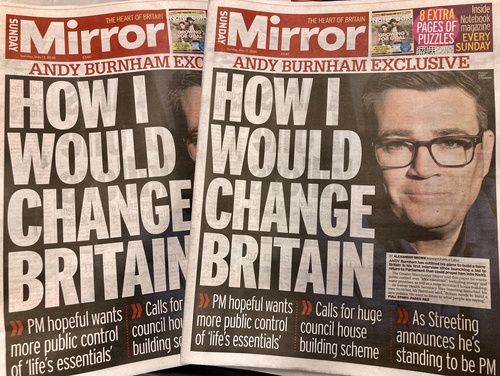
Can Britain’s Next Prime Minister Escape the Net Zero Trap?
Britain has burned through five Prime Ministers and is paying some of the highest electricity prices in the world.

The Scanner at the Gate: Europe’s China Policy Litmus Test
China’s industrial policy is entering Europe through public procurement—and reshaping sensitive markets from within.

Confronting the New Antisemitism
"The postwar effort 'to rebrand Judaism as a religion' has made it impossible for American Jews to understand what they are facing today, because what we are facing today is an attack on the idea of Jewish peoplehood.”
“Democratic” Socialism Is Undemocratic
By promoting class hatred, suppressing private initiative, and seeking enhanced control of our lives, today’s democratic socialists undermine patriotism and individual initiative—two qualities that have long distinguished the United States from other major nations.

