
The Iran War and the Coming Global Struggle

There is a growing sense in the U.S. that order and stability are not always in our best interests.
It is unclear how the ongoing war with Iran will end. It is simply too early to say; deeply rooted conflicts don’t resolve themselves in a matter of a few weeks. The radical regime in Tehran may survive as a diminished power, but it will continue its decades-long march to regional domination and attempted destruction of Israel, the United States, and the West more broadly. It may also collapse under the strain of the war and domestic pressures. Or it may turn into an unstable rump polity, with a destroyed military, buried missiles, and a shattered nuclear weapons industry, in a prolonged slide toward political failure. Each of these outcomes will have different impacts on regional and global politics.
But the mere fact that the United States decided to strike Iran is already reshaping geopolitical dynamics. The American action has, in effect, clarified three realities that had gone unstated until now but have been developing over the last few years. First, we are facing a global conflict of growing intensity, and the U.S. is preparing the battlefield for it. Second, to succeed, the U.S. has to accept greater risks than those once considered unthinkable. Third, in a rivalry turning into a conflict, order and stability are not always beneficial to the U.S. Underlying all this is a pervasive sense that in the next few years, we are facing a great confrontation, perhaps even a large-scale and long war, not relegated to regional theaters hermetically separated from each other. We are seeing the first steps in this coming war.
First, there is logic to American actions despite the vociferous domestic and foreign criticism that President Trump lacks strategic coherence. The military operations against Iran are simply an attempt to eliminate, or at least to minimize for some time, the threat of the radical and potentially nuclear-armed regime in Tehran. A nuclear Iran, capable of lobbing missiles in and beyond the region, is in itself a problem. But combined with a westward-expanding imperial Russia and a rapidly militarizing China with global ambitions, it is more than a mere regional nuisance. A more intense, longer confrontation with China will be more difficult to endure if Iran remains a growing menace in the Middle East, radiating its destabilizing power not just to the Strait of Hormuz but also to the Mediterranean, Russia, the Indian Ocean, and the Red Sea. It will be impossible to defend against simultaneous aggressions in different regions of the world.
The basic strategic debate in Washington has been about how to sequence the regions. Should we deal with Russia in Ukraine first and let the Middle East fester? Or should we focus all efforts on the Pacific to counter China? Despite the 2025 National Security Strategy ranking the Middle East below the other three main geographic regions (Western Hemisphere, Europe, and Asia), Trump seems to have picked the Middle East as the primary theater to pacify, taking the opportunity of having a motivated regional ally, Israel, willing to lead the way against Iran. If we succeed, one of America’s longest and most violent enemies will cease to exercise pressure in the middle of Eurasia. There may therefore be good reasons to choose Iran as the first threat to eliminate before concentrating on China. The ongoing military and diplomatic operations are preparing the global battlefield.
Second, the American risk calculus has changed. Washington is willing to take much greater risks than in the past years. This reflects more than just the President’s unique personality. Risk aversion works when the balance of power favors us. In that situation, there is no reason to shake things up in a costly fashion; the status quo is beneficial. But the equilibrium of power that existed over the last decades has been changing, reshaped by Russia’s war in Ukraine, China’s economic growth turning into military power, and Iran’s regional expansion fueled by nuclear ambitions. At the same time, the U.S. has serious fiscal problems that no political leader is willing to address. And despite some small signs of rearming, European states talk big about existential threats (from Russia) but do not mobilize their societies and continue to live off debt while appeasing China and Iran. The trends have destabilized Eurasian equilibria, creating dangerous conditions for the United States and the West. It is only natural, therefore, to see the U.S. take risks that were inconceivable a few years ago.
A lot of the criticism directed at American actions in Iran stems from the assumption that the status quo, that is, continuing diplomatic efforts to persuade Tehran to arrest its nuclear project, was almost risk-free. But such an approach, advocated by the Obama and Biden administrations as well as by most European leaders, minimized the danger of Iranian proxies (Hamas, Hezbollah, and the Houthis) and ignored the massive growth of Tehran’s missile capabilities. To deal with these realities, the Trump administration seems to have calculated that a very risky military operation with uncertain outcomes (including the closing of the Strait of Hormuz) was preferable to the risks of inaction.
The war with Iran may yet force the U.S. into a prolonged Middle Eastern commitment, draining the finite military capabilities needed in the Pacific to deter China. The longer American forces remain tied down in the Persian Gulf — expending munitions to bury Tehran’s nuclear industry and eliminate its missiles — the greater the risk that Beijing seizes the moment to move on Taiwan or beyond. The stakes are high; the risk is enormous. But the very fact that the U.S. was willing to accept such risks is itself revealing: the geopolitical landscape has grown so treacherous that a low-risk strategy is a luxury that Washington can no longer afford. The age of low-risk actions is ending.
Finally, there is a growing sense in the U.S. that order and stability are not always in our best interests. To put it simply, stability in some regions matters to the United States more than in others. An orderly Caribbean and Western Hemisphere (especially Mexico) is of paramount importance; an unstable Mediterranean or Persian Gulf is less so. Moreover, a messy region of great importance to our rivals increases their costs, thereby bringing strategic benefits to us. This may be the case with the Strait of Hormuz. The United States is no longer as dependent on the flow of oil through this chokepoint as it was a decade ago. China’s economy, on the other hand, is heavily reliant on Middle Eastern oil (about 50 percent of its imports). So is Europe and much of Asia. In other words, the war with Iran has created a problem (the closing of the Strait of Hormuz) that is a much greater problem for others than for us.
The American economy will certainly bear some costs, too. Higher energy prices slow economic growth, not to mention generate political pressures that no elected leader can ignore for long. But the instability of the Strait damages others more. Similarly, this logic points to an American interest in the instability of, for instance, Central Asia, which creates costs for Russia and China. At a minimum, it is evident that the U.S. has no blanket objective of preserving order everywhere. The costs of maintaining such an order may outweigh the benefits, simply because, in some cases, the greatest beneficiaries are powers that turned out to be Western enemies, such as China.
It is telling that many critics of the current war, especially in Europe and Asia, complain that the U.S. has become a force of chaos, rather than order. They assess this as a negative development for themselves and suggest it for the U.S. But such criticism misses the shift in the American security calculus because it views current events through the prism of unchallenged American global supremacy. Then, Washington could afford to provide order benefiting all in the hopeful expectation of a growing harmonization of interests among all powers. This has not happened. China is not a friend, Russia has not become a democracy, and Iran is not a contained and satisfied power — all the while the U.S. was providing global order, especially on the seas. To continue to provide order that benefits our rivals is not merely naive; it is outright damaging to U.S. interests. It should not be surprising, therefore, that Washington is willing to endure unprecedented instability in the Persian Gulf: the costs to us are smaller than those to others. The idea of a U.S.-led global order as a central tenet of American foreign policy, treating stability everywhere as equally valuable, is a thing of the past.
The war has not ended, and whether it ultimately benefits or harms American interests remains an open question. What is already clear, however, is that it represents an epochal inflection point — one that signals a United States that is growing more risk-tolerant, more willing to accept regional instability as a strategic tool, and more deliberately positioning itself for the far greater challenge of confronting China in the coming decades.
Jakub Grygiel is a professor at The Catholic University of America, a visiting fellow at the Hoover Institution, and a senior advisor at The Marathon Initiative.

Politics
%20Richard%20Samuelson%20%20-%20Is%20American%20Nationalism%20Still%20Creed-able_-1.jpg)
Is American Nationalism Still Creed-able?
We are not there now, but there is reason to worry that the United States is in danger, if we are not careful, of ceasing to be a nation with the principles of 1776 at its core.
National Civitas Institute Poll: Americans are Anxious and Frustrated, Creating a Challenging Environment for Leaders
The poll reveals a deeply pessimistic American electorate, with a majority convinced the nation is on the wrong track.
.webp)
%20(1).avif)


.jpg)

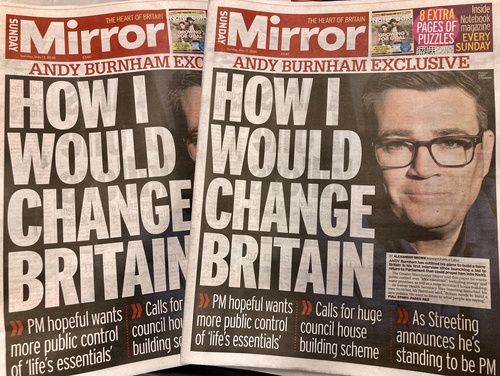
Can Britain’s Next Prime Minister Escape the Net Zero Trap?
Britain has burned through five Prime Ministers and is paying some of the highest electricity prices in the world.
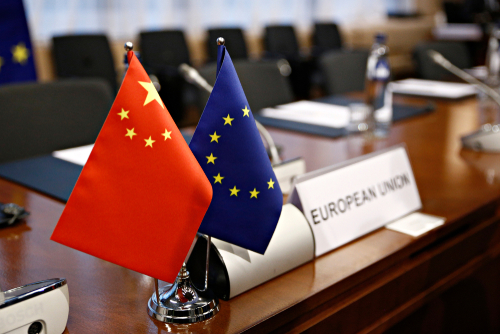
The Scanner at the Gate: Europe’s China Policy Litmus Test
China’s industrial policy is entering Europe through public procurement—and reshaping sensitive markets from within.

Confronting the New Antisemitism
"The postwar effort 'to rebrand Judaism as a religion' has made it impossible for American Jews to understand what they are facing today, because what we are facing today is an attack on the idea of Jewish peoplehood.”
“Democratic” Socialism Is Undemocratic
By promoting class hatred, suppressing private initiative, and seeking enhanced control of our lives, today’s democratic socialists undermine patriotism and individual initiative—two qualities that have long distinguished the United States from other major nations.

