
Confronting the New Antisemitism

For many Jewish Democrats in particular, the post-10/7 period has meant progressing through the Five Stages of Grief. Those who reach acceptance will be positioned to lead American Jewry forward, developing the necessary, innovative solutions for this next chapter of Jewish history.
Hamas’ October 7 pogrom attack triggered ripple effects worldwide. Among them, American Jews’ long-term relationship with the American left, which had already begun fraying, deteriorated rapidly. Longtime Jewish Democrats have responded differently, but life has undeniably changed for American Jews at school, at work, and in the political sphere. Those shifts and efforts to grapple with them figured prominently at the American Jewish Committee (AJC)’s recent Global Forum.
The three-day, Washington-based conference showcased the pro-Israel, generally center-left American Jewish mainstream discussing this historical moment. Speakers addressed antizionism — that is, left-coded, socially acceptable Jew-hatred — and its related problems. And panels covered related topics, including: Jew-hatred in education, the generational divide on Israel and Zionism, the entertainment industry’s handling of Jew-hatred, and the United Nations’ bias. There was even a well-attended session entitled “Antizionism as a Hate Movement.”
Speakers acknowledged that the landscape has morphed. Dr. Laura Shaw Frank, AJC Vice President for Education, opened a plenary, “America at 250: Navigating This Moment in Jewish History,” by noting, “many Jews are experiencing a renewed sense of vulnerability. We are confronting rising antisemitism, growing hostility toward Israel, and a broader climate that raises urgent questions about belonging, security, and the future.” As author Dara Horn observed, “The problem now is that [the postwar effort “to rebrand Judaism as a religion”] has made it impossible for American Jews to understand what they are facing today, because what we are facing today is an attack on the idea of Jewish peoplehood.”
This is a feature of Jew-hatred’s current, third era (antizionism). Earlier iterations targeted Jews as religiously wrong (antijudaism) and racial polluters (antisemitism).
At the entertainment industry panel, writer, producer, actor, and comedian Jamie Denbo described working within the system to effect change at the progressive show “Grey’s Anatomy” for a season and a half after October 7. Denbo hoped to develop a storyline about what Jews were experiencing and to educate staff about Jews, as the network regularly does for other salient issues. When those efforts failed, she left. Now unfettered, Denbo dubbed producing director Debbie Allen an “antisemite” and former “Grey’s” star and Tony winner Jesse Williams a “raging antisemite” who “started preaching some of the most vile antisemitic rhetoric out there,” including “dog rape . . . before anyone.” Denbo’s experience underscored that responses to Jew-hatred must evolve, along with the metastasizing problem.
Writer and educator Boaz Munro raised the importance of Jews “drawing boundaries against [our enemies]” and confronting “a very obvious hate movement” at the antizionism panel. That session smashed the long-standing conventional wisdom that right-wing antisemitism is worse than antizionism. Munro contended that “antizionism is just as bad as antisemitism.”
Vanderbilt University Professor of Jewish Studies and Sociology Shaul Kelner disagreed, characterizing antizionism as “worse.” Kelner explained, “You are more likely, in your own social circles, to be encountering discrimination from antizionists, rather than from racist antisemites. So, it hits us more directly, and because it’s . . . ‘intellectually legitimized,’ and because it hits us in the places where we work, and shop, and play, and the books that we read, and the museums that we go to, it’s systemic, and it’s institutionalized.”
Trends in Blue America indisputably affect American Jews more. Jews may experience antisemitic abuse from strangers online, but facing antizionist comments or discrimination from friends and colleagues is worse.
The antizionism session’s focus on Jewish self-respect, along with naming and confronting antizionism, was welcome. Some other moments at the conference were disappointing, though, as they better reflected American Jews’ reassuring past than the more complicated present.
The first such moment was a revealing off-hand comment from AJC Chief Impact and Operations Officer Casey Kustin, who discussed the fall’s American and Israeli elections with journalists. Kustin asked Axios’ Barak Ravid, “What happens in the fall if the House of Representatives flips to a Democratic House — and we’ll still have a strong pro-Israel majority leader in Hakeem Jeffries — but what happens if there’s a new [Israeli] Prime Minister?”
Calling Hakeem Jeffries strongly pro-Israel is overpromising at this point. First, even if Jeffries continues to personally support Israel, he’s unlikely to introduce pro-Israel bills if his caucus opposes them, should he become House Speaker. Second, Jeffries has surely seen recent polling of his base. Gallup announced that “65% of Democrats say their sympathies lie more with the Palestinians, while 17% say they sympathize more with the Israelis.” Pew Research reported that “eight-in-ten Democrats and Democratic-leaning independents currently have an unfavorable view of Israel.” The Manhattan Institute found “only 16% [of Democrats’ coalition] are willing to say that Israel is a legitimate country facing serious security threats, and that while its actions are not perfect, it is largely acting in self-defense.” If Democrats win the House in November, and Israel becomes a litmus test in a House Speaker’s race, it’s more likely that Jeffries weakens his support or sidesteps the issue as much as possible.
Jeffries is a team player. In 2024, he endorsed anti-Israel Democrats Jamaal Bowman (D-NY), Cori Bush (D-MO), and Summer Lee (D-PA). This spring, Jeffries warmly welcomed the victory of Pennsylvania House candidate Chris Rabb, who’d tweeted “the Nakba never ended,” and New Jersey House candidate Adam Hamawy, who volunteered with an al-Qaeda front group and testified on behalf of the Blind Sheikh, who was tried and convicted on terrorism-related charges and sentenced to life in prison in 1996. Jeffries’ track record isn’t that of someone likely to make a principled last stand for Israel.
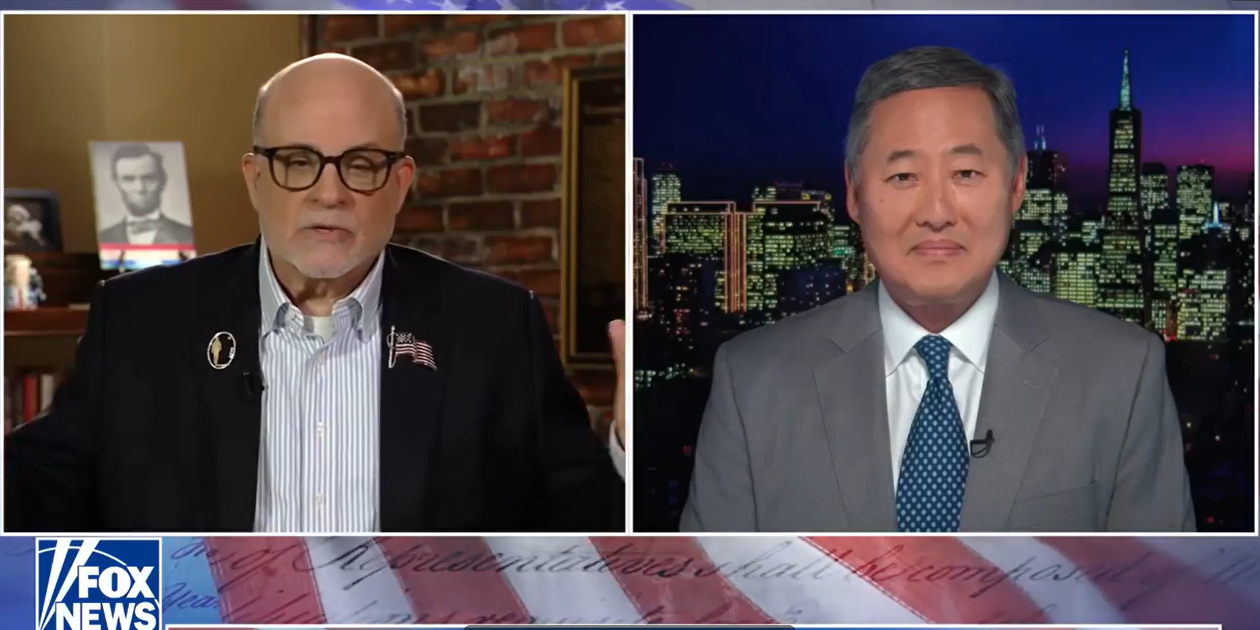
By contrast, Sen. John Fetterman (D-PA), who conversed with AJC CEO Ted Deutsch and Sen. Dave McCormick (R-PA), has already withstood attacks for making such a stand. Asked what’s prompted his reassuring statements since October 7, Fetterman said he’s “a student of history.” Societies have repeatedly turned on Jews “when they’re under siege . . . I have always promised that I will never be one part of that, and” among Democrats, “I plan to be the last man standing.”
The second disappointment came when Deutsch asked Fetterman about Democrats’ Jew-hatred. Deutsch framed the issue as “encroaching antisemitism on the far-left,” and as a problem “in some circles within the Democratic Party” that acceptance now requires being “anti-Israel.” It’s positive that Deutsch asked, but this is not a fringe problem.
The Manhattan Institute reported, “only 4% of [Democratic coalition] respondents describe themselves as openly antisemitic, though 18–29 year old voters (8%) are much more likely to do so than over-65 voters (1%).” (Many more respondents would presumably self-identify as antizionists.) Regardless, the majority tolerates these views. “Less than half (44%) say that such individuals are unwelcome and do not represent their views.” Another “15% say they’ve had enough of purity tests, and antisemitism should not be counted against people, and an additional 15% say it is acceptable to seek the votes of antisemites, but they should not be in positions of power and leadership.”
Fetterman rightly addressed left-wing Jew-hatred by pointing to Democratic candidates. “You know, we’re old enough to remember that if somebody had a Nazi tattoo, they’re a Nazi sympathizer. But now, that’s okay. People will defend that.” Fetterman also cited Pennsylvania’s Rabb, who “ran on being very, very anti-Israel,” which is “not just acceptable; it’s actually [considered] a virtue.” Fetterman added, “Democrats will campaign and proudly stand with Hasan Piker,” who’s said, “Hamas is 1,000% better than Israel.” Lastly, “people in our party probably announce they will now vote against Iron Dome. You know, purely defensive [weaponry] . . . even an organization like J Street now said, ‘That’s okay.’ That’s their official view. You know, that’s political cover for people to vote against these things.”
Fetterman sees his party and its failings on Israel and Jew-hatred clearly. His clarity was matched by current undergraduates, who recounted stories of campus Jew-hatred later that morning and asked practical questions about combating it at the antizionism panel. These young Jewish adults see the threat because they face it regularly on campus and online. They’ve also only ever known a youth culture that stigmatizes Zionists.
For Jews of Gen X and older, who knew America as a country with minimal open Jew-hatred, this has been an unpleasant adjustment. And for many Jewish Democrats in particular, the post-10/7 period has meant progressing through the Five Stages of Grief for lost friends and political allies. It’s those Jews who reach acceptance, though, who will be positioned to lead American Jewry forward, developing the necessary, innovative solutions for this next chapter of Jewish history.
Melissa Langsam Braunstein is an independent journalist in metro Washington.

Politics
%20Richard%20Samuelson%20%20-%20Is%20American%20Nationalism%20Still%20Creed-able_-1.jpg)
Is American Nationalism Still Creed-able?
We are not there now, but there is reason to worry that the United States is in danger, if we are not careful, of ceasing to be a nation with the principles of 1776 at its core.

National Civitas Institute Poll: Americans are Anxious and Frustrated, Creating a Challenging Environment for Leaders
The poll reveals a deeply pessimistic American electorate, with a majority convinced the nation is on the wrong track.
.webp)
%20(1).avif)


The G7 Is Failing To Address Global Imbalances
The G7 was not created to issue an endless procession of carefully calibrated communiqués.

Immigration Alone Won't Solve Canada's Population Decline
Rather than looking abroad for solutions, we should ensure young Canadians have a hopeful future







Can Britain’s Next Prime Minister Escape the Net Zero Trap?
Britain has burned through five Prime Ministers and is paying some of the highest electricity prices in the world.

The Scanner at the Gate: Europe’s China Policy Litmus Test
China’s industrial policy is entering Europe through public procurement—and reshaping sensitive markets from within.

“Democratic” Socialism Is Undemocratic
By promoting class hatred, suppressing private initiative, and seeking enhanced control of our lives, today’s democratic socialists undermine patriotism and individual initiative—two qualities that have long distinguished the United States from other major nations.