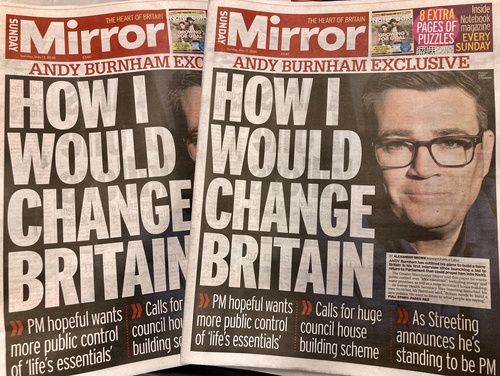
Can Britain’s Next Prime Minister Escape the Net Zero Trap?

Five Prime Ministers have fallen since Britain passed its Net Zero law. Andy Burnham has a chance to break the pattern by choosing domestic production over imports and Chinese renewables.
LONDON— With the end of London’s Climate Action Week, the UK is suffering from disruptions in both weather and politics as a heat wave grips a country where only four percent of homes have air conditioning. Sir Keir Starmer has resigned as Labour Prime Minister, and former Manchester mayor Andy Burnham, elected earlier this month as MP from Makerfield, is slated to replace him.
Since former Conservative Prime Minister Theresa May signed Britain up to the amended Climate Change Act in 2019, a binding law requiring a 100 percent reduction in emissions by 2050 compared to 1990 levels, Britain has had five Prime Ministers. This outpaces Italy, which has had three, long the byword for political instability in the Western world.
After Mrs. May herself, Britain cycled through Boris Johnson, Liz Truss, Rishi Sunak, and now Sir Keir— none of them popular, none of them successful, all of them departing under economic pressure and in failure. This general dissatisfaction is not a coincidence, but linked to higher energy prices, which reduce growth and employment.
But today’s disruptions could be useful if Sir Keir’s resignation opened a window for Britain to reset its energy policy. Mr. Burnham, dubbed the King of the North, has already signaled that he wants affordable power and British jobs, especially in Britain’s north.
In his victory speech after winning his return to Parliament, Mr. Burnham declared:
“We do need to bring down water bills, energy bills, rail fares, just as we brought down bus fares in Greater Manchester, to make life more affordable for people.”
If he means it, energy is the place to start. Britain pays 42 cents per kilowatt-hour for electricity. Germany, Europe’s other great champion of the green transition, pays 43 cents. The United States, which has no national Net Zero law, pays 20 cents, less than half. Almost every EU country with binding emissions targets pays above 30 cents.
European policy choices have mandated expensive generation, loaded green levies onto bills, and prematurely wound down reliable conventional power. The Brits are paying a Net Zero surcharge on every unit of electricity they consume, every single day, with no measurable effect on global temperatures in 2100. And Britain’s wind and solar dependency funnels money to Chinese state-subsidized manufacturers and workers rather than British ones.
This means slower UK growth. Since the end of 2019, before the pandemic, the United States has recorded total GDP growth of 15.1 percent, compared to just 6 percent for the UK. Forecasts offer little comfort: the OECD projects UK growth of just 0.8 percent in 2026, against 2.3 percent for the United States. Countries with the highest electricity prices are growing the slowest.
And it’s not like Britain is getting top value for its money. Last week, temperatures above 25 degrees Celsius (77 degrees Fahrenheit) reduced the efficiency of UK solar panels, and a lack of wind stalled the wind turbines. With electricity demand running at about 36 gigawatts, Britain had to import 20 percent of its electricity from the European Union.
The good news is that Mr. Burnham, with his flexible views, can take a different path. Britain is not a resource-poor nation forced to depend on foreign suppliers, but a resource-rich nation that has chosen dependency through planning rules, regulatory obstruction, and a Net Zero framework that treats domestic oil and gas production as a moral failing rather than a strategic necessity.
In the short run, Britain could produce more North Sea oil and gas and approve stalled domestic natural gas projects. In the long run, Britain could speed up permitting for nuclear power plants, including new technologies such as floating nuclear reactors in harbors, as proposed by the British company Core Power.
Britain now imports oil and gas from Norway rather than allowing British workers to be well paid to extract them from the same North Sea—and pay taxes on the earnings. While Britain sits on the sidelines, Norway’s Equinor is raising output projections for the Norwegian continental shelf due to technological improvements and rising demand.
Mr. Burnham can move forward with offshore projects in the North Sea and North Atlantic totaling between 157,000 and 162,500 barrels of oil equivalent per day, with combined lifetime recoverable reserves ranging from 560 million to 920 million barrels of oil equivalent. Ithaca Energy’s Cambo project and Adura’s Rosebank and Jackdaw fields are all currently awaiting approval.
Adura estimates that Rosebank and Jackdaw will generate almost $38 billion in gross value added over their lifespans, generate almost $2 billion in tax revenues before the end of the current Parliament in 2029, and support 3,500 jobs.
In addition, the Gainsborough Trough, a major sedimentary basin between Lincolnshire and South Yorkshire, holds about 16 trillion cubic feet of recoverable gas, equivalent to 2,750 million barrels of oil. With hydrofracturing, it could power Britain for ten years and create a quarter of a million jobs. Egdon Resources has long wanted to develop it, and no government funds would be needed.
Using these domestic resources would create well-paying jobs in northern communities that have seen manufacturing and mining decline over decades — precisely the area that Mr. Burnham wants to win from Reform.
To achieve Mr. Burnham’s desired growth, the government must remove the planning restrictions, the moratorium on hydraulic fracturing, and the regulatory framework that makes hydrocarbon investment impossible. Mr. Burnham needs to say plainly that Britain’s growth matters more than the approval of green lobbying groups.
The question is whether Mr. Burnham will move Secretary of State for Energy Security and Net Zero Ed Miliband to the coveted position of Chancellor of the Exchequer. Miliband has been the defining force in Sir Keir’s Cabinet against developing a realistic energy policy.
Mr. Miliband now presides over the planning regime that blocks hydrocarbon development, and it is his ideology, the belief that Britain can lead the world to Net Zero by making itself dependent on foreign energy while foreigners burn their own, that keeps British electricity rates among the highest in the world.
If Mr. Miliband were promoted to Chancellor of the Exchequer, he would oversee balancing the budget, or at least minimizing the deficit, and he might see energy production in an entirely different light. As current Chancellor Rachel Reeves has discovered, raising taxes and taking away senior citizens’ winter fuel credits are unpopular options (and may cost her her position).
Unfortunately, Mr. Burnham has floated the idea of nationalizing energy companies and other public infrastructure, even though money would have to be borrowed, taxed, or diverted from other priorities. Public ownership of expensive infrastructure would not achieve Mr. Burnham’s objective of lowering prices. The history of state-owned enterprises in Britain, reversed by former Prime Minister Margaret Thatcher, is a history of inefficiency, underinvestment, and costs ultimately borne by taxpayers. What Mr. Burnham needs is private investment in cheap domestic production.
Energy is foundational to economic growth and to the costs of manufacturing, transportation, heating, and food production and storage. When governments require shifts from cheaper to more expensive energy options (such as from fossil fuels to more expensive renewables), they raise energy costs across the entire economy. Higher energy costs result in higher prices for goods and services, squeezing household budgets and eroding real wages.
Businesses facing higher power bills invest less, hire fewer workers, and, in some cases, relocate to cheaper jurisdictions abroad. The result is an economy that grows more slowly than it should, generates fewer job opportunities than it could, and delivers lower living standards than voters expect. People pay more for electricity and gas, groceries, and gasoline. And they take it out on whoever is leading the country. In Britain, this is the Prime Minister.
For years, Britain has turned its back on its own hydrocarbon wealth in pursuit of wind and solar targets that have driven up bills, exported jobs, and left the country dependent on imported LNG priced by global markets. The paradox is glaring: Britain sits atop significant untapped gas reserves yet pays premium prices for fuel shipped from abroad.
The economics are straightforward. North Sea drilling and domestic gas development are cheaper than the combined cost of offshore wind, grid expansion, and the battery storage needed to cover the days the wind doesn’t blow. Every pound spent on domestic production is a pound that stays in Britain, is taxed in Britain, and is employed in Britain rather than enriching foreign exporters.
Burnham says he wants to be the voice of the North. Here is his chance to prove it. An energy policy built around private investment in domestic production, lower bills, and British jobs recognizes that the transition must work for working people, not just for the investment banks financing wind farms.
Reform is siphoning off votes from both Labour and the Conservatives because it speaks to the cost of living in terms voters recognize. Mr. Burnham can occupy that ground without abandoning Labour’s broader commitments, simply by insisting that British energy for British homes comes before imported energy at any price.
Partly due to the costs of its Net Zero laws, Britain has burned through five Prime Ministers and is paying some of the highest electricity prices in the world. The King of the North has a chance to change that if he chooses a different path.
Diana Furchtgott-Roth, former Deputy Assistant Secretary for Research and Technology at the U.S. Department of Transportation, is a Distinguished Fellow at the Energy Policy Research Foundation and an adjunct professor at George Washington University.

Politics
%20Richard%20Samuelson%20%20-%20Is%20American%20Nationalism%20Still%20Creed-able_-1.jpg)
Is American Nationalism Still Creed-able?
We are not there now, but there is reason to worry that the United States is in danger, if we are not careful, of ceasing to be a nation with the principles of 1776 at its core.

National Civitas Institute Poll: Americans are Anxious and Frustrated, Creating a Challenging Environment for Leaders
The poll reveals a deeply pessimistic American electorate, with a majority convinced the nation is on the wrong track.
.webp)
%20(1).avif)









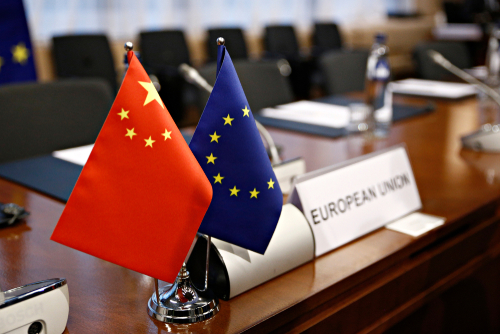
The Scanner at the Gate: Europe’s China Policy Litmus Test
China’s industrial policy is entering Europe through public procurement—and reshaping sensitive markets from within.

Confronting the New Antisemitism
"The postwar effort 'to rebrand Judaism as a religion' has made it impossible for American Jews to understand what they are facing today, because what we are facing today is an attack on the idea of Jewish peoplehood.”
“Democratic” Socialism Is Undemocratic
By promoting class hatred, suppressing private initiative, and seeking enhanced control of our lives, today’s democratic socialists undermine patriotism and individual initiative—two qualities that have long distinguished the United States from other major nations.