Colorado’s Secularist Hostility Strikes Again
The Court’s decision to take St. Mary confirms what has become increasingly apparent — that its trilogy of religious liberty decisions in Trinity Lutheran, Espinoza, and Carson has caused militant state secularism to settle into its crevices and trapdoors.
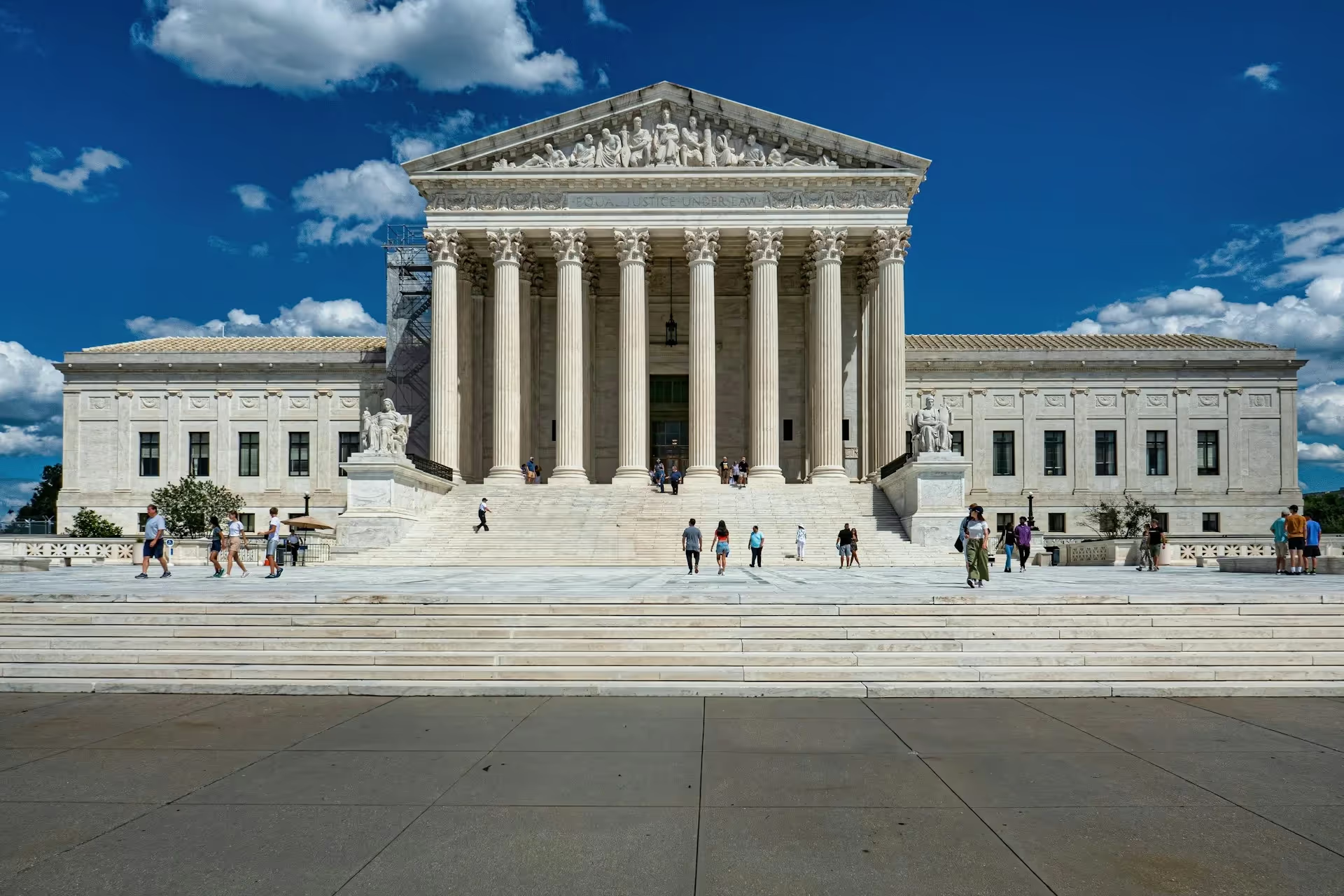
The Supreme Court has agreed to hear St. Mary Catholic Parish v. Roy, granting certiorari on the first two questions presented: whether Colorado’s universal preschool program unconstitutionally burdens religious schools by conditioning their participation on rules that conflict with their faith, and whether the Tenth Circuit erred in holding that the Free Exercise Clause is not implicated because Colorado’s exclusion lacks an explicitly religious classification. The Court’s decision to take the case confirms what has become increasingly apparent — that its trilogy of religious liberty decisions in Trinity Lutheran, Espinoza, and Carson has not settled the law so much as it has caused militant state secularism to settle into its crevices and trapdoors.
Before turning to this landscape, it is worth pausing to celebrate this cert grant and appreciate how far the religious liberty movement has come. Twenty-five years ago, religious schools were routinely shut out of public benefit programs, state Blaine amendments were treated as unimpeachable despite their obvious anti-Catholicism, and the Establishment Clause was deployed as a weapon against faith-based institutions rather than a shield for them. The transformation since then has been remarkable — and it is, without question, one of the conservative legal movement’s greatest achievements. Through patient institution-building, first-rate appellate lawyering, and the political process yielding jurists committed to restoring the First Amendment’s pro-religion orientation, advocates for religious liberty have made life concretely better, more affordable, and freer for millions of Americans of faith. Parents can now direct public education funds to religious schools. Churches can access neutral grant programs. Religious organizations can participate in social services without being forced to secularize. Chalk it up as another real answer to the cynical question of what contemporary conservatism has conserved.
Back to St. Mary and the opportunities it portends. Colorado runs a universal preschool program — a public benefit available, in principle, to all qualifying providers. St. Mary Catholic Parish and other faith-based schools sought to participate. Colorado said they could, but only if they agreed to conditions that, in practice, require them to operate contrary to their religious convictions. The schools declined on those terms and sued. The Tenth Circuit ruled against them, reasoning that because Colorado’s conditions are facially neutral — they don’t say “no religious schools” — the Free Exercise Clause is not triggered in the way it was in Carson or Espinoza.
That reasoning deserves the scrutiny the Court will now give it. The whole point of Carson v. Makin was to close exactly this kind of escape hatch. In that case, Maine had tried to draw a distinction between a school’s religious identity (which Espinoza protected) and a school’s religious conduct — the actual practice of teaching through a religious lens. The Court rejected that distinction as artificial. (For those who are interested, Professor Michael A. Helfand’s explanation of why the distinction was itself a kind of religious chauvinism is fascinating.) A school that provides a genuinely religious education cannot separate what it is from what it does. Maine’s rule, whatever its formal framing, “operate[d] to identify and exclude otherwise eligible schools on the basis of their religious exercise.” The Court said that is discrimination against religion.
In the wake of that ruling, the Notre Dame Education Law Project — in partnership with the Notre Dame Law School Religious Liberty Clinic, the EPIC Coalition, and the orthodox Jewish Teach Coalition— launched a project and website, ReligiousEquality.net, to identify and challenge state and federal laws that exclude religious organizations from government funding programs. The initiative catalogs hundreds of “hidden” religious exclusions in public funding for education, healthcare, and social services and argues that such exclusions are unconstitutional under Carson and its predecessors. It is exactly the kind of patient, granular, interfaith coalition work that the religious liberty movement needs more of —Jews, Catholics, and Protestants, united by a shared recognition that militant secularism will not be beaten back by any single community fighting alone.
Colorado’s gambit is the same move as Maine’s, dressed in different clothes. Rather than declaring religious schools ineligible, the state attaches conditions it knows many religious schools cannot accept — touching on admissions, employment, and the expression of religious beliefs in the classroom. The mechanism may be more sophisticated, but the result is identical to an explicit exclusion: faith-based schools are shut out.
This is not a Colorado idiosyncrasy — though it is worth noting that Colorado seems particularly adept at appearing before the Supreme Court on religious-liberty claims. This is, after all, the same state whose Civil Rights Commission pursued Jack Phillips, the Lakewood baker, with such naked hostility that the Supreme Court ruled against it in Masterpiece Cakeshop v. Colorado Civil Rights Commission — and then watched the state come after Phillips again, prompting a second round of litigation. Colorado keeps finding new ways to make religious believers feel unwelcome, and the Court keeps having to remind it that the Constitution does not permit that.
Even before Carson was decided, Maine amended its nondiscrimination statutes to preempt the ruling it expected to lose. Vermont enacted a grandfather clause that conditioned program eligibility on enrollment thresholds that religious schools — newly eligible for the first time — could not possibly meet, eliminating all twelve participating religious schools while leaving eighteen secular ones untouched. A New York Times op-ed published days after Carson, written by one of Justice Sonia Sotomayor’s former law clerks, openly celebrated Maine’s approach as “a model for lawmakers” who wished to “outmaneuver the court.” Maryland, New Hampshire, Minnesota, Iowa, and Tennessee have pursued variations on the same theme. This is a coordinated legal strategy, and it is working in some courts.
To put an end to those shenanigans and states’ massive resistance to religious liberty, the Supreme Court needs to give lower courts a more workable test for determining when facially neutral conditions constitute a religious exclusion in practice. The doctrine of neutral and generally applicable laws — governing free exercise claims since Employment Division v. Smith — has always been somewhat underspecified at the edges. When is a law genuinely neutral? When is it genuinely generally applicable? Some cases are easy, such as those where there is animus targeting a particular faith, or conditions that whittle the law’s applications down to very few cases. The harder question is how courts should scrutinize laws that are neutral on their face but whose design, history, or effect—or some combination of those and other factors—reveals that the apparent neutrality is merely a cover for hostility to religious exercise. St. Mary is an opportunity to answer it, without descending into logical fallacies that parallel “disparate impact” theory.
Notably, the Court declined to take up the third question presented — whether Smith itself should be overruled. That is not surprising. The Court passed on similar invitations in Fulton v. City of Philadelphia and elsewhere. The pattern suggests the current majority has little appetite for the sweeping doctrinal overhaul that overruling Smith would require, even if individual justices have expressed doubts about its foundations. The Court is simply not interested in fundamentally reshaping the free exercise doctrine. Perhaps someday a differently composed Court will push up against the limits of its current approach and consider ripping the Smith bandage off, but that day does not seem near on the horizon.
St. Mary, meantime, invites more incremental progress. The Court is poised to speak clearly to states seeking to hollow out the Court’s recent landmark decisions by adopting the same exclusions in a subtler register. The answer, if Carson means anything, should be that they cannot.
Tal Fortgang is a contributing editor to Civitas Outlook and is a legal policy fellow at the Manhattan Institute.

Constitutionalism
Amicus Brief: Hon. William P. Barr and Hon. Michael B. Mukasey in Support of Petitioners
Former AGs Barr and Mukasey Cite Civitas in a SCOTUS Brief
Rational Judicial Review: Constitutions as Power-sharing Agreements, Secession, and the Problem of Dred Scott
Judicial review and originalism serve as valuable commitment mechanisms to enforce future compliance with a political bargain.
.avif)




.png)
.png)
.png)
The Fifth Circuit’s Chance to Expose the Inflation Reduction Act’s Unconstitutionality
Despite the mounting evidence of harm, the Medicare Drug Price Negotiation Program remains law — and the Justice Department continues to defend it in federal court.