Founders Versus Managers: America’s Endless Civil War

The struggle between two mindsets—founders versus managers—will forever shape the future of the American nation.
This year, we celebrate the 250th anniversary of America’s founding. It’s also a year when U.S. power and influence seem almost unlimited.
That power had been demonstrated with the success of Artemis II, which has reinforced the success of America’s private companies like Elon Musk’s SpaceX and Jeff Bezos’s Blue Origin in dominating the world’s space sector, who are now competing to build the lander for Artemis III and the return to the moon for the first time since 1972.
We see it in the success of America’s AI industry, which today accounts for 74-75 percent of global AI supercomputing capacity (China holds just 15 percent). Its founders are transforming every sector from defense and health care to reindustrialization.
We see an energy sector that produces more oil and natural gas than Russia and Saudi Arabia combined, thanks to founders like Harold Hamm, who pioneered fracking technology.
We’ve even seen it in the war in Iran, where America’s unsurpassed military power has been unleashed by a former businessman, a president who understands Douglas MacArthur’s adage: “there is no substitute for victory.”
Each case reveals the power of what is called the founder’s mindset: the vision, energy, drive, and willingness to risk it all to achieve astonishing results. That mindset runs like an electric charge through American history.
From Washington and Jefferson to Henry Ford and Steve Jobs to Jeff Bezos and Elon Musk—even from Abraham Lincoln and Martin Luther King to Donald Trump and the late Charlie Kirk—that visionary and daring mindset forms the core of what we call American exceptionalism.
At the same time, and at every stage, American founders have had to face opposition and doubt. Indeed, it’s the constant struggle between founders and those who prefer managing problems rather than solving them through bold action that has shaped the nation from 1776 until now.
The need for bold action is how founders see the world. They are mission and vision-driven, with a commitment that is fierce and uncompromising. They hate delegating and want to oversee the details of every stage in making their vision happen. They are highly risk-tolerant, even notoriously so—whether it’s Washington crossing the Delaware or Elon Musk launching the first Falcon rocket. As founders, they tend to see risk as an opportunity rather than as a danger signal.
Yet another American mindset prefers certainty and predictability to venturing into the unknown—whether it’s heading into space or across the corporate balance sheet.
It lives by the mottos of “Stick to your knitting” and “Stay in your lane.” While founders have a built-in bias toward bold action, what we can call the manager’s mindset has another favorite adage: “Look before you leap.”
The manager mindset is risk-averse, not out of cowardice but because it feels institutions like corporations and governments do best sticking to the tried and known, whereas the unknown and untried are comfortable terrain to the typical founder.
The manager asks, “How can we do this better?” The founder asks, “Why are we doing this at all?” If the answer doesn’t satisfy, the founder is ready to strike out in an entirely new direction, even at the risk of everything they’ve created before.
That’s a way of operating that managers, government bureaucrats, lawyers, and conventional politicians are bound to see as a challenge, sometimes even an existential threat. They push back in ways that provide much of the drama and conflict in our 250-year history.
This happened during the American Revolution itself, with those at the Constitutional Congress who argued passionately against independence—and who believed we were entering a war with Britain, we could only lose.
Later, most, if not all, politicians argued that the answer to slavery and Southern secession had to be compromise and negotiation, not war. They condemned Lincoln as “King Lincoln” for daring to mobilize for a fight to the finish with the Confederacy. They would have been relieved to see Lincoln lose the 1864 election, rather than have him press on for final victory and the abolition of slavery across America as the fulfillment of its founding principles.
Then, after the Civil War, came those who defamed business founders like John D. Rockefeller, Andrew Carnegie, and railway magnate James J. Hill as “robber barons,” and who used anti-trust laws and the Interstate Commerce Commission to frustrate their success in making America the richest and most powerful industrial nation on earth.
Still later, there were those who saw FDR’s support for Britain in World War II as too risky and who demanded compromise with the Soviet Union during the Cold War, even as Ronald Reagan was organizing the final victory.
We see a similar mindset today in opposition to the twin revolutions in AI and crypto, and a desire to punish our leading Silicon Valley and tech founders and innovators for their success. We even see it with the pushback against Trump’s war with Iran, which has been amazingly successful, but where opponents only see disaster and doom.
The perpetual struggle between these two mindsets—founders versus managers—has shaped the outcome of America’s history from its very beginning. It’s also shaping our present and future.
All the same, it’s not a battle of good versus evil. Every corporate founder recognizes the value of good managers in keeping their vision alive—but also knows bad managers can doom their company to stagnation and decline.
Government bureaucrats and lawyers can ensure that founders obey the rule of law, while politicians make sure they respond to the requirements of democracy, although the latter can act as demagogues in condemning founders’ success.
In the end, and at the most crucial moments in our history, it’s been the ability of founders to break free of conventional constraints and expectations; to look beyond the immediate horizon and to venture into the unknown; to face down the doubters and incrementalists and move America forward; that has kept the nation true to its original founding principles—and kept it aimed to a bigger and better future.
Arthur Herman is the author of Freedom’s Forge: How American Business Produced Victory in World War Two. His latest book, Founder’s Fire: From 1776 to the Age of Trump, is now available from Center Street/Hachette.

Politics
%20Richard%20Samuelson%20%20-%20Is%20American%20Nationalism%20Still%20Creed-able_-1.jpg)
Is American Nationalism Still Creed-able?
We are not there now, but there is reason to worry that the United States is in danger, if we are not careful, of ceasing to be a nation with the principles of 1776 at its core.
National Civitas Institute Poll: Americans are Anxious and Frustrated, Creating a Challenging Environment for Leaders
The poll reveals a deeply pessimistic American electorate, with a majority convinced the nation is on the wrong track.
.webp)
%20(1).avif)


Rail Giants Hate the $71 Billion Merger. The Rest of Us Should Love It
Based on the record, the case for approving the merger is even stronger than when it was first announced.
The Democrats Are a Menace to America’s Jews
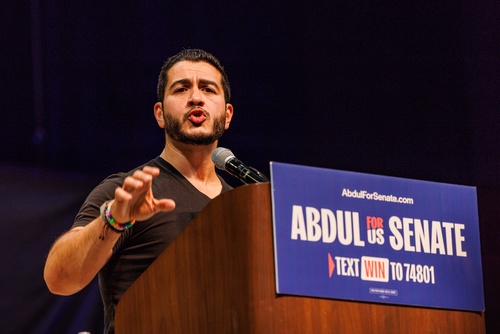
Abdul El-Sayed’s victory in Michigan’s Democratic primary is an ominous sign.



Can Britain’s Next Prime Minister Escape the Net Zero Trap?
Britain has burned through five Prime Ministers and is paying some of the highest electricity prices in the world.

The Scanner at the Gate: Europe’s China Policy Litmus Test
China’s industrial policy is entering Europe through public procurement—and reshaping sensitive markets from within.

Confronting the New Antisemitism
"The postwar effort 'to rebrand Judaism as a religion' has made it impossible for American Jews to understand what they are facing today, because what we are facing today is an attack on the idea of Jewish peoplehood.”
“Democratic” Socialism Is Undemocratic
By promoting class hatred, suppressing private initiative, and seeking enhanced control of our lives, today’s democratic socialists undermine patriotism and individual initiative—two qualities that have long distinguished the United States from other major nations.

