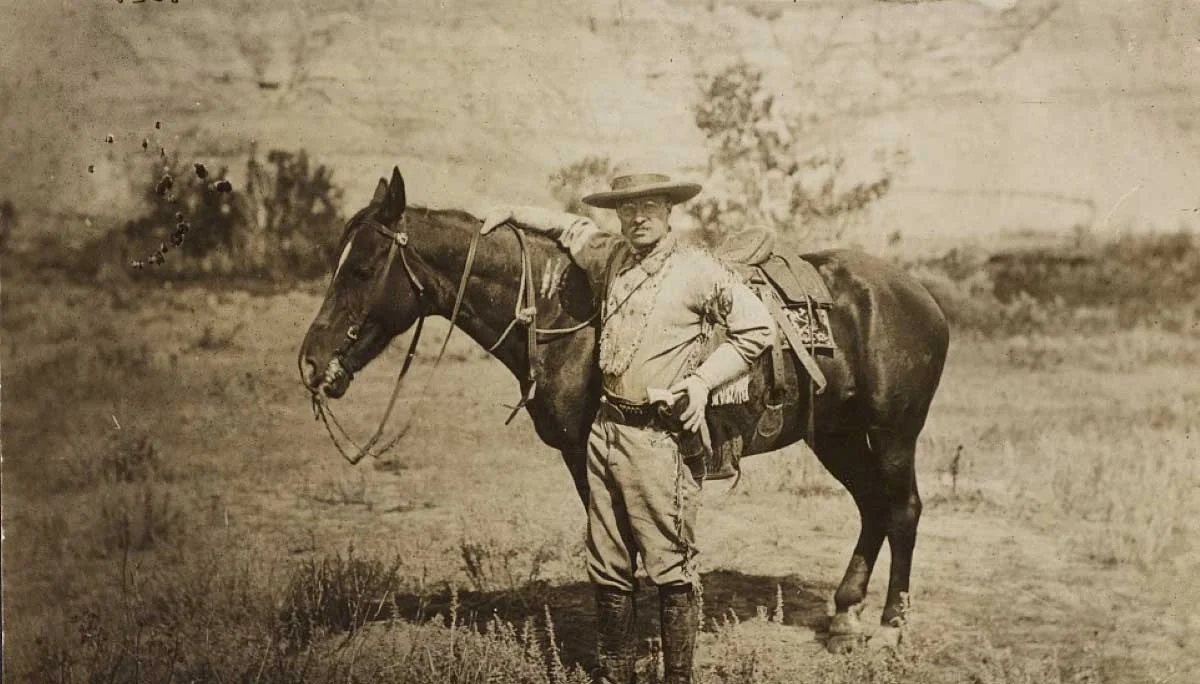
Teddy Roosevelt’s Expansive Spirit

Theodore Roosevelt embodied both the tensions and the resolute powers of the American landscape.
What does it mean to be an American? This question has been asked, in one form or another, since the founding of the United States. The answers are never entirely definitive, but this constant foray into the unknown adventure is precisely what defines an American character. American president Theodore Roosevelt embodied both the tensions and the resolute powers of the American landscape. He was in this landscape.
A new biography by David S. Brown, In the Arena: Theodore Roosevelt in War, Peace, and Revolution (2026), accomplishes a great feat in illuminating this larger-than-life figure of American history. With precise prose, Brown has woven together historical facts and a gift for storytelling (often reminiscent of David McCullough’s great biographies and histories of America), resulting in an evocative and objective biography. Brown retains biographer’s neutrality as much as possible, and his “judgments” (the few that are in the book) are borne out of evidence, and rarely speculation.
Teddy Roosevelt has always maintained a certain élan vital, especially when coupled with that distinctly American spirit. Although his story begins as a sickly child, Roosevelt managed to pick himself up by the proverbial bootstraps and succeed in most endeavors he pursued. He was an unusual child in every way. A constant fight with asthma was an unwelcome gift for the young Roosevelt. What Brown reveals, however, is that the entire Roosevelt family suffered from one ailment or another. This led the patriarch of the family to think there was something wrong with their home.
One thing is clear: young Teddy’s curiosity flourished even more under such difficult health circumstances. His family’s wealth allowed him to isolate himself from the rest of the world, yet he found a pleasing, peaceful refuge in nature. As Brown writes, “Early on he began to collect insect and animal specimens, his bedroom a menagerie of butterflies, ladybugs, and spiders.” We see, even in Roosevelt’s early childhood, a thirst for knowledge, perhaps even for possession of the world, figuratively and literally.
Young Teddy was tutored by the best teachers money could buy, and judging from Brown’s research, he was indeed a learned young man. He read the classics, and throughout his life in politics, he was often driven by the wisdom he had gathered over the years. But there was a bullheadedness in Roosevelt–that particular American, anti-elitist stubbornness. Remarking on a trip throughout Europe that the family would often take in order to cure themselves of mental and physical ailments, Roosevelt wrote in his memoir years later:
I cordially hated it, as did my younger brother and sister. Practically all the enjoyment we had was in exploring any ruins or mountains when we could get away from our elders, and in playing in the different hotels. Our one desire was to get back to America, and we regarded Europe with the most ignorant chauvinism and contempt.
Roosevelt certainly grew out of the immature feelings of his youth, but this self-admission points to a personality that he remained true to throughout his life. With great ease and perhaps even pleasure and glee, Roosevelt was not bound by societal proprieties. He was known for his bombastic style and calling out both friends and foes for their faults. We might say today that Teddy Roosevelt lacked a filter in social interactions.
This is not to say that Roosevelt did not still follow the social mores of his time. But he always pushed the boundaries, not because he was an affected revolutionary, but because he was driven by the excellence of the human spirit and mind. The body was also crucial. Following the social focus on masculinity, Roosevelt’s father pushed him to exercise his body, allegedly saying to his son: “Theodore, you have the mind but you have not the body, and without the help of the body the mind cannot go as far as it should. You must make your body.”
Indeed, he did. Young Teddy took to exercising, be it at home or wherever travel took him. Perhaps he had something to prove to himself and the world ,but judging from Brown’s analysis, Roosevelt’s decisions were not entirely driven by self-indulgence but rather by a constant striving, seeking, finding, and using the potential of the mind, spirit, and body.
Roosevelt wasn’t just one of the presidents of the United States. He was also a historian and an accomplished writer, who took this vocation rather seriously. He authored many historical books, which were quite popular with readers. Here, we see the seeds of romanticization of the American frontier and the West. Roosevelt found the American West to be where the real “Americanness” lies, but as Brown alludes, this romanticism may have been rooted in the fact that Roosevelt was a Manhattanite who wished to go beyond the city.
After a few attempts in politics, he became irritated with the GOP. As Brown reports, Roosevelt wrote to a friend in 1888: “I shall probably never be in politics again,” mostly because he could not deal anymore with the GOP as “a mere party of reaction.” Of course, history proved otherwise, and Roosevelt became one of the biggest “characters” in the history of his own party.
His gift for storytelling served him well in the ensuing years. He was an eloquent speaker, and even if the speech didn’t live up to high expectations, Roosevelt’s personality and charisma were so powerful that they overruled its shortcomings. This oversized personality also meant he was an independent thinker, a trait that can have both positive and negative consequences. He reluctantly joined the Republican Party but always portrayed himself as an outsider. This portrayal wasn’t just an image or what we may call a “brand” today. He genuinely hated the infighting among the Republicans, who did not particularly want to see Roosevelt in politics, let alone in power as president.
The Republicans were divided: those who did not support Roosevelt were seen as suppressive forces by the younger faction that wanted to move on from the old guard. But they had no choice. The American people loved Teddy Roosevelt, and wherever he went, he drew large crowds that eagerly waited and listened to his musings. He was indeed a “law and order Republican,” a populist fully against the elites of America that, he believed, held the people down to benefit themselves. (He expressed disdain against the elites during his time at Harvard University, accusing academics of mind-guarding knowledge from the people.)
The wealthy elites did not like it. J. P. Morgan donated large amounts of money to Roosevelt for his political campaign and was quite surprised that Roosevelt was “trust busting” all the business monopolies that were practically helmed by Morgan. Yet, Roosevelt was not against capitalism. He saw great potential in freedom to make, but human nature and thus, corruption, often takes over. Roosevelt became supportive of federal regulation, saying: “The Constitution was made for the people and not the people for the Constitution.”
As Brown notes, Roosevelt was one of the first American presidents who “understood, as few of his predecessors had, the potential of the presidency to affect public policy.” Many scholars place part of the growth of twentieth century presidential powers in his presidency. To be sure, he was “pushed along by the progressive tide,” but it would be foolish to conclude that Roosevelt was only driven by progressive ideology and its belief in the inevitability of the unfolding of time as a justification for state growth. Rather, he knew how to maneuver through the changing landscape, especially given the onset of the Industrial Revolution and the unfolding changes. Part of that maneuvering was to subject markets to increasing amounts of federal regulation.
It is impossible not to draw parallels between Roosevelt’s time and ours. In fact, at the very end of the book, Brown makes a quick comparison between Roosevelt and Donald Trump. Certainly, Trump “challenged the country’s democratic norms.” Just like in Roosevelt’s case and time, the Republican party was fractured, technological changes were afoot, and people were dissatisfied with the political status quo. But even Brown admits many of these comparisons are merely suggestive. He remains a historian and biographer, presenting us with a well-argued image of Theodore Roosevelt in many of his roles.
The essence of America can only be recognized through the people who represent this beautiful and often contradictory Republic. Theodore Roosevelt was one of those people. His mind and spirit were never fully satisfied. When he exhausted one endeavor, he moved on to another. It seemed impossible for this man to stand still or waste time.
Perhaps he was also running away from human imperfections, especially those found in his family. Brown includes a rather moving chapter on Roosevelt’s brother Elliott, who (unlike Teddy) could not organize his life and flourish. Plagued by addictions to alcohol, opium, and laudanum, Elliott “suffered a fatal seizure in his Manhattan apartment soon after a suicide attempt.”
Teddy wasn’t necessarily cold, but if he felt anything, it was not known. “I only need to have pleasant thoughts of Elliot now. He is just the gallant, generous, manly boy and young man whom everyone loved,” he wrote in a letter. Roosevelt was not plagued by the same psychological problems, but if he had allowed it, perhaps a latent addiction could have surfaced for him as well. In 1902, Henry Adams said, “Theodore is never sober, only he is drunk with himself and not with rum.”
This is where an existential contradiction enters the scene of Teddy Roosevelt’s life. A man whose self-regard cannot be seen as merely a vice but as the only way for the outward expansion of the mind and spirit. This human frontier, the vast landscape of the West, pregnant with possibilities, was embodied in Teddy Roosevelt’s life. He left a mark not only on the American presidency but also on the American imagination, affirming the necessity of the American myth. Without the myth and imagination, the Republic will be reduced to laws, but without laws, America will not be able to keep the myth alive. Whether he was aware of this or not, Roosevelt understood the importance of the relationship between the myth and the law, and what such a relationship means for the future of the United States.
Emina Melonic writes about culture, film, and books. Her work has been published in American Greatness, Claremont Review of Books, Los Angeles Review of Books, Modern Age, and The New Criterion, among others. She’s currently working on a biography of Edward G. Robinson and a book on Ronald Reagan’s Hollywood years.

Politics
%20Richard%20Samuelson%20%20-%20Is%20American%20Nationalism%20Still%20Creed-able_-1.jpg)
Is American Nationalism Still Creed-able?
We are not there now, but there is reason to worry that the United States is in danger, if we are not careful, of ceasing to be a nation with the principles of 1776 at its core.
National Civitas Institute Poll: Americans are Anxious and Frustrated, Creating a Challenging Environment for Leaders
The poll reveals a deeply pessimistic American electorate, with a majority convinced the nation is on the wrong track.
.webp)
%20(1).avif)


The G7 Is Failing To Address Global Imbalances
The G7 was not created to issue an endless procession of carefully calibrated communiqués.

Immigration Alone Won't Solve Canada's Population Decline
Rather than looking abroad for solutions, we should ensure young Canadians have a hopeful future


Can Britain’s Next Prime Minister Escape the Net Zero Trap?
Britain has burned through five Prime Ministers and is paying some of the highest electricity prices in the world.

The Scanner at the Gate: Europe’s China Policy Litmus Test
China’s industrial policy is entering Europe through public procurement—and reshaping sensitive markets from within.

Confronting the New Antisemitism
"The postwar effort 'to rebrand Judaism as a religion' has made it impossible for American Jews to understand what they are facing today, because what we are facing today is an attack on the idea of Jewish peoplehood.”

“Democratic” Socialism Is Undemocratic
By promoting class hatred, suppressing private initiative, and seeking enhanced control of our lives, today’s democratic socialists undermine patriotism and individual initiative—two qualities that have long distinguished the United States from other major nations.

