Trump Could Have a Strong Case to Revoke Harvard’s Tax-Exempt Status


Thanks to a 1983 opinion widely hailed by progressives at the time, the administration could be on solid ground.
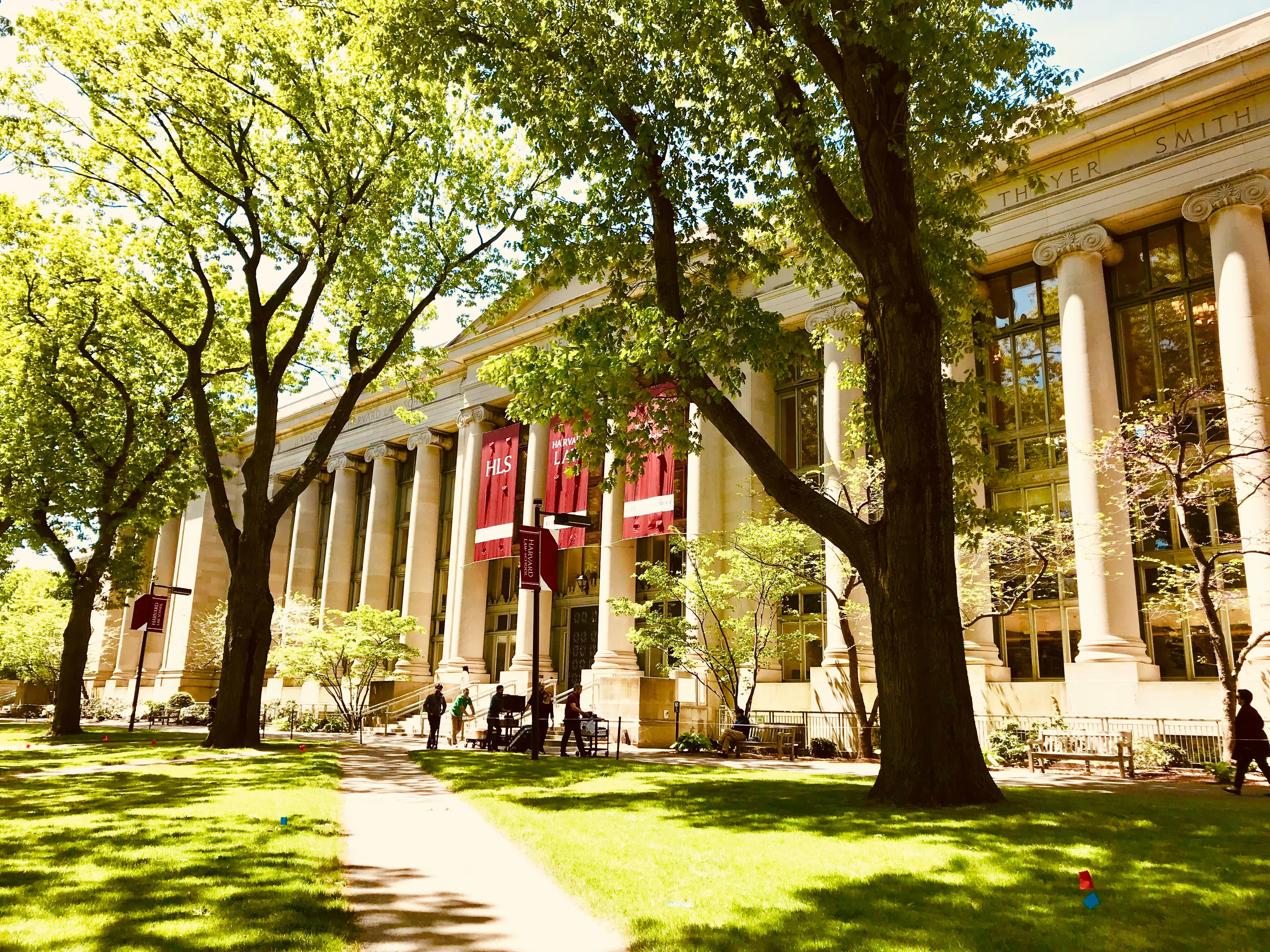
In a recent Truth Social post, President Trump wrote: “Perhaps Harvard should lose its Tax Exempt Status and be Taxed as a Political Entity if it keeps pushing its political, ideological, and terrorist inspired/supporting ‘Sickness?’” This followed an earlier threat to cut off $9 billion in federal funding unless Harvard agreed to a list of administration demands for reforms, including merit-based hiring, an end to preferences in admissions based on “race, color, national origin, or proxies thereof,” an outside audit of “programs and departments that most fuel antisemitic harassment,” and the discontinuation of DEI. Rejecting these demands, Harvard declared that “antisemitism and discrimination of any kind not only are abhorrent and antithetical to Harvard’s values but also threaten its academic mission.” Since that exchange, it has been reported that the Department of Justice has asked the IRS to review and revoke Harvard’s tax-exempt status.
Thanks to a 1983 Supreme Court opinion widely hailed by progressives at the time, the Trump administration may have stronger grounds than at first appears to reconsider Harvard’s tax status. Harvard is a tax-exempt organization as an educational institution under Section 501(c)(3) of the Internal Revenue Code. Section 501(c)(3) exempts organizations “operated exclusively for religious, charitable, scientific, testing for public safety, literary, or educational purposes.” Tax-exempt status carries great advantages, because it frees Harvard from federal income tax and its donors can make tax-deductible contributions. Loss of the exemption would cost Harvard an estimated $500 million annually.
But the IRS can remove 501(c)(3) designation if the organization engages in conduct that violates “established public policy.” The Supreme Court recognized this public policy doctrine in Bob Jones University v. United States (1983). Bob Jones was a private Christian university that prohibited interracial dating and marriage based on its understanding of biblical teachings. The IRS concluded that Bob Jones’s rule violated fundamental national policy. Agreeing with the IRS, the Supreme Court found that the institution’s purpose “must not be so at odds with the common community conscience as to undermine any public benefit that might otherwise be conferred.” It concluded, “it would be wholly incompatible with the concepts underlying tax exemption to grant the benefit of tax-exempt status to racially discriminatory educational entities.”

Politics
%20Richard%20Samuelson%20%20-%20Is%20American%20Nationalism%20Still%20Creed-able_-1.jpg)
Is American Nationalism Still Creed-able?
We are not there now, but there is reason to worry that the United States is in danger, if we are not careful, of ceasing to be a nation with the principles of 1776 at its core.

National Civitas Institute Poll: Americans are Anxious and Frustrated, Creating a Challenging Environment for Leaders
The poll reveals a deeply pessimistic American electorate, with a majority convinced the nation is on the wrong track.
.webp)
%20(1).avif)


Proxy Firms Don’t Have to Disclose Conflicts. That Should Change
The firms whose advice can move those votes bear no comparable duty for the advice itself. States can close that gap by applying an enduring standard from the Supreme Court.
Texas May Soon Have More People Than California — Here’s Why
California natives are voting with their feet.



.jpg)