Is There Anything New Under the AI Sun?
.avif)
Novel technologies do not call for the revival of an outdated New Deal Industrial Policy.
The major explosion in the use of Artificial Intelligence has not been without its social consequences: any technology that grows by leaps and bounds will necessarily produce both short- and long-term consequences that will hurt some people and help others. The central challenge is to devise a workable legal regime to improve the odds of correct choices on these vexing trade-offs. As a strong classical liberal, my answer here is to stress continuity and to favor those policies that have best addressed Joseph Schumpeter’s creative destruction and innovation in prior years. That approach does not mean adopting a crude version of laissez-faire that says, like Lola in Damn Yankees, whatever business wants, business gets. But it does mean that, in the first instance, it is best to start with the correct economic principles that govern stable situations and see how well they carry over to dynamic ones.
That position thus addresses key objections as follows. It is said that these operations consume too much water, but without any initial reference point. An informative letter by Sarah Montalban in the Wall Street Journal rightfully takes Senator Bernie Sanders to task for insisting that we hit the “pause” button on further AI development. She is on the mark in pointing out that AI uses less than a tenth of the water devoted to golf course irrigation, and less than the water lost nationwide to leakage. So the correct response is to ask whether any of AI’s activities have received public subsidies that should be removed, so that market prices can set the correct trade-offs across different uses. It is hard to think that any market mechanism would yield no water for AI uses, for that conclusion implies that the most valuable AI use is worth less than the least-valued non-AI use, which seems impossible to believe given the security implications that depend on AI growth, which we cannot purchase in an open market from China, Russia, or Iran.
Folks like Sanders also bewail the loss of jobs that arise from the widespread use of AI. And it has always been the case that new technologies lead to the loss of some positions that offer key firms and employees a privileged position in the market. But it is important to note that job instability is consistently high. Thus, when the government reports a net loss of 100,000 jobs in a given month, it has understated the amount of job turnover in the market, because that net number could easily be derived from a loss of 1,000,000 jobs coupled with a gain of 900,000 jobs. In any event, the Sanders’ formulation misses the overall dynamism, and also does not suggest any way to slow that transition without the overall loss of productivity that his position would imply. Nor is it wise to think that the government should institute programs to train laid-off workers to find new jobs. That task is too vital to be left to governments that have scant knowledge of patterns in emerging hot markets, e.g., health care. Entry by private firms to help people change jobs mid-career is a better idea, and it can be aided if the former employer offers a stipend or severance package to ease the pain. The aggregate net effects are thus captured by a general unemployment rate, and on this score, the current unemployment rate of around four percent does not spell any overall danger, and what harm there is cannot be attributed solely to the indirect losses from AI, especially when Trump tariffs and high state taxes both deserve a fair part of the blame.
No one can give major credit to the public anxieties cultivated by figures like Sanders. Yet the mercurial President Trump may have listened too much to his favored industrial advisors who continue to insist that “U.S. AI policy Is Full Steam Ahead.” But again, the only choice cannot be between total prohibition and complete support if the latter includes public subsidies for private gain, which have the same vices here as they do in traditional markets.
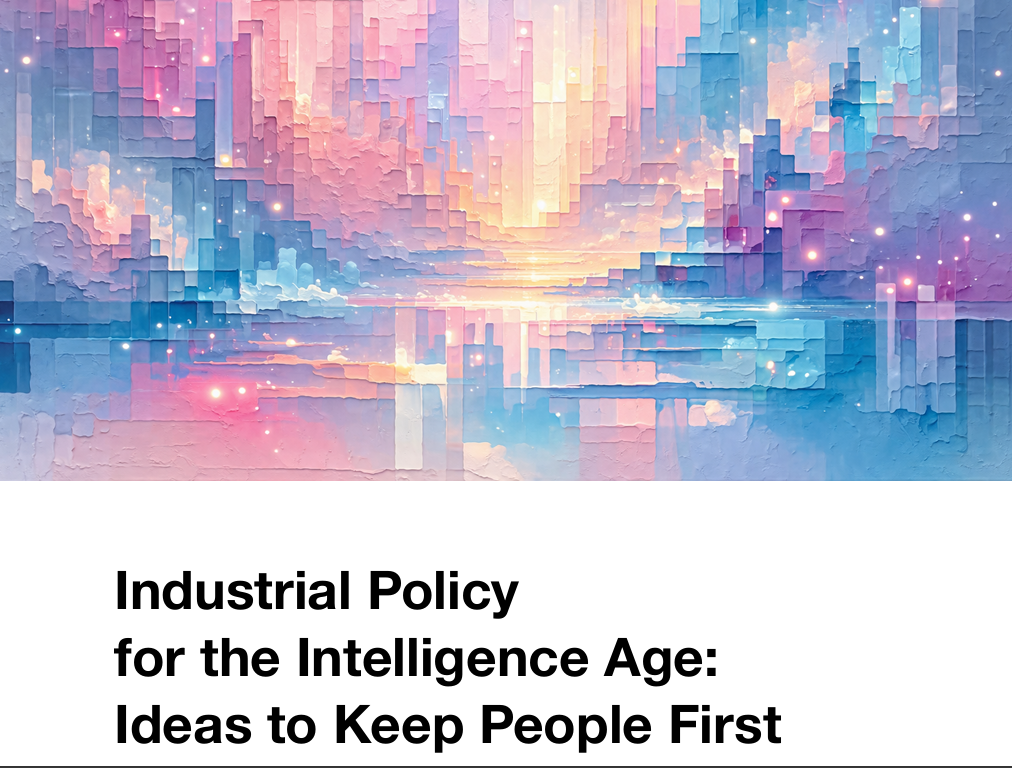
Yet another traditional principle that applies is never cross redistribution with production when both are sure to suffer, which is the misguided sin championed within the industry by OpenAI, whose stated “mission is to ensure artificial general intelligence benefits all of humanity.” It is a rare occasion on which a pamphlet can be vigorously condemned solely on the strength of its title, but this publication—“Industrial Policy for the Intelligence ACT: Ideas to Keep People First” more than meets that standard of well-deserved condemnation. Thus, the grandiose way that OpenAI headlines its activities carries with it the obvious implication that the OpenAI crew, headed by Sam Altman, know best what the world wants, and so that its mission is not to prevent excessive subsidies for the industry but to develop a comprehensive social plan that organizes a wide range of institutions a practices along the lines that socialist planners adopted with such false optimism during the progressive politics that dominated the New Deal Period.
Sadly, bad ideas never die; they just morph into new nostrums. So here the OpenAI statement begins with the assertion that “a democratic process” should give people “real power to shape the AI future they really want”— as if OpenAI, or any other privileged group, might know just that. Yet this thin think-piece pays not the slightest attention to the difficult question of what system should be used to aggregate these unruly individual preferences in a way that could lead to any stable set of collective preferences at the city, state, national, or global level.
However, OpenAI’s losing hand is quickly tipped by its articulation of two goals: The first is to “share prosperity broadly.” But if this means a commitment to progressive, high taxation, which will stifle innovation and keep new firms in chronic backwaters like California and New York, it will fail. Old and new firms alike will move to set up shop in more receptive places like Florida and Texas. The last thing this OpenAI proposal suggests is the usual route for technology diffusion, whereby lowering prices for various goods and services will allow people to enter the market more readily as either producers or consumers. Instead, its prose hints at some kind of end state “pattern principle” of the sort that was attacked so effectively by Robert Nozick in the best bits of his Anarchy, State, and Utopia (1974). So the public choice nightmare looms over this entire enterprise because this position paper contains not the slightest suggestion of what voting or deliberative procedures need to be put into place to avoid the institutional capture by adroit factions of which public choice theorists have warned since they were spelled out most vividly by James Buchanan and Gordon Tullock in their classic 1962 book, the Calculus of Consent.
Nor is there in the study’s game plan any awareness of the inevitable tradeoff between risk of enabling small groups that can, by hook or crook, keep the lion’s share of the benefits while dumping the losses on the public. That problem is as old as the corporation and partnership, which concentrates business authority in the hands of a few but then develops no theory of limited liability that gives shareholders protection against bad faith actions under a rule that requires the insiders to show the entire fairness of transactions, and the business judgment rule that protects those same insiders who carry the duties of care and loyalty. So any familiar tools that might address these difficulties are left off the table.
That small error then leads to a larger one, stemming from its explicit embrace of yet another “new” industrial policy to replace the bad industrial policies that have tanked in the past. Thus, the report harkens back to the Progressive Era and the New Deal in addressing the automobile and mass production. But someone who makes that claim should identify which of those historical programs turned the tide. But instead, we are told that “history shows” that we can “redesign the social contract “by “reimagining the social contract, mediating between capital and labor, and encouraging broad distribution” of social goods. But it never identifies one program that led to those successes. Unions have often used their monopoly position to stifle innovation and to use high minimum wage laws to prevent new competitors from entering the market. Similar actions to cartelize industries were all too evident in the regulation of motor vehicles and airlines, and in widespread zoning laws. What is needed in this space is a careful assessment of which programs to imitate and which to drop. For that, OpenAI needs to build on the successes of open markets and turn away from regulation, taxation, and cartelization as the key pillars of the new industrial policy. Sam Altman should forswear designing industry policy just as I should forswear any ill-advised foray into AI. OpenAI’s unfortunate essay shows why just that division of labor is needed in all intellectual markets.
Richard Epstein is a senior research fellow at the Civitas Institute at the University of Texas at Austin.

Economic Dynamism

.jpg)

.jpg)




.jpg)


Social Mobility Wins
When people live within an environment offering good jobs, good education, social networks, and a culture of self-improvement and hard work, they experience progress in a way that undercuts the philosophical rationale that socialists need to justify the policies they advocate.
Kevin Warsh and the Future of Fed Communication
Warsh is right that the Federal Reserve should not speak so loudly that it hears only its own echo.