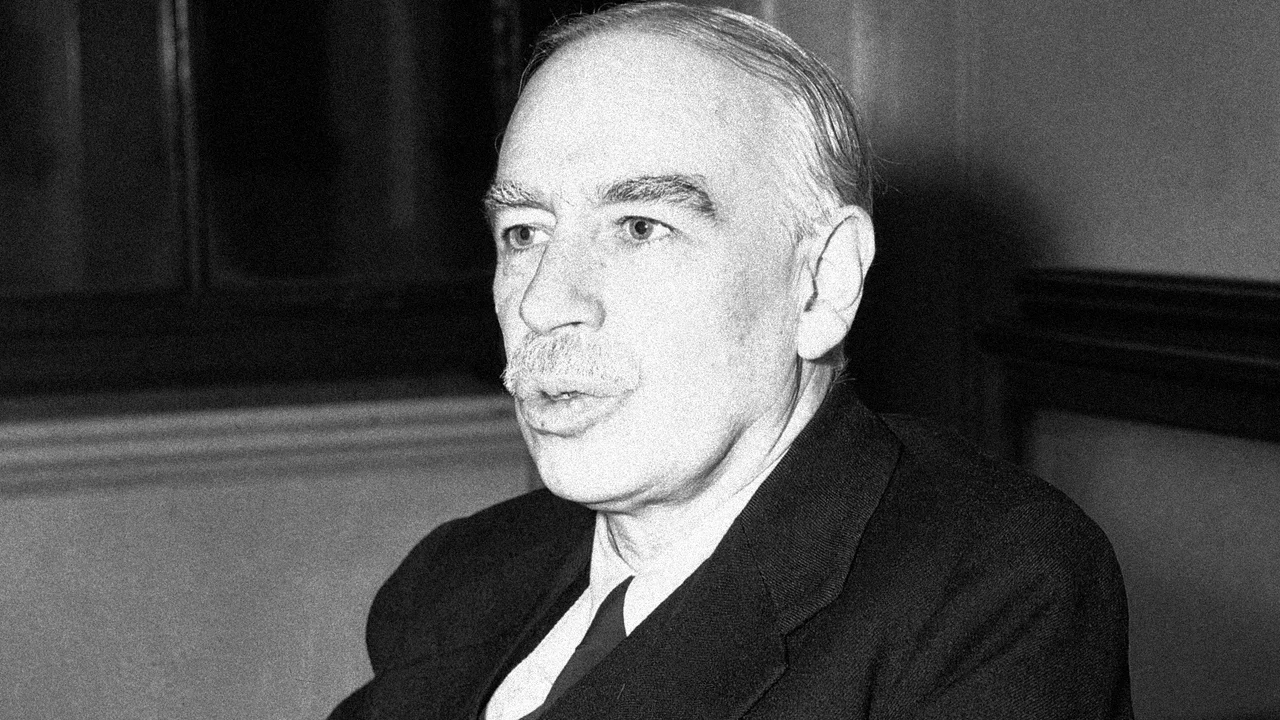
The Contested Legacy of Keynes’ 'General Theory'

The conflict between mainstream and radical interpretations of Keynes' magnum opus reflects enduring disagreements about the nature of capitalism itself.
Keynesian economics is often treated as a single, unified doctrine. The ideas associated with John Maynard Keynes gave rise to competing schools of thought that profoundly disagreed over how capitalist economies function and what governments should do when markets fail. These disagreements were not merely academic disputes. Different interpretations of Keynes led to different diagnoses of economic instability and sharply contrasting policy prescriptions.
The divide became especially visible after the Second World War. On one side stood the mainstream “Neoclassical Keynesians,” who dominated universities and policy circles from the late 1940s to the 1970s. Their ranks included many of the era’s most influential economists, such as Paul Samuelson, James Meade, Robert Solow, and Lawrence Klein. Opposing them were the so-called “Cambridge Keynesians,” later known as Post-Keynesians, who were centered largely at the University of Cambridge in Britain. This group included figures such as Joan Robinson, Nicholas Kaldor, Piero Sraffa, and Michal Kalecki.
The hostility between the two camps could be intense. In 1962, Joan Robinson famously referred to the mainstream economists as “bastard Keynesians,” accusing them of caricaturing and ventriloquizing Keynes while abandoning the radical spirit of his work. Her criticism reflected a deeper disagreement about whether Keynes had merely amended classical economics to address the peculiar circumstances of a very deep slump, or had fundamentally overturned it.
The mainstream Keynesians believed Keynes had identified important weaknesses in market economies, particularly the possibility of prolonged unemployment caused by insufficient demand. However, they did not see this as a complete rejection of classical economics. Instead, they attempted to combine Keynes’ insights with the traditional belief that markets generally allocate resources efficiently over the long run.
One of the key figures in this effort was the London School of Economics Professor Sir John Hicks, whose famous IS-LM model translated Keynes’ arguments into a simplified framework that could be incorporated into orthodox economic analysis. In practice, this version of Keynesianism accepted government intervention during recessions but retained considerable faith in markets’ ability to function effectively once crises had passed. The state’s role was largely to stabilize the economy when demand collapsed, not to permanently direct economic activity.
This interpretation could plausibly be supported by Keynes himself. In The General Theory, Keynes argued that once the problem of mass unemployment had been resolved, “the classical theory comes into its own again”. He explicitly acknowledged that markets would efficiently determine production and allocation under normal circumstances.
The Cambridge Keynesians rejected this reading entirely, arguing that so much of Keynes’ novel insights are lost amidst a futile attempt to shoehorn them into the very neoclassical framework he set out to destroy. To them, Keynes had exposed fundamental flaws in the belief that capitalist economies naturally move toward full employment and stability.
They frequently pointed to Keynes’ own words in defense of this interpretation. Keynes described himself as siding with the “heretics” against nineteenth-century orthodoxy and argued that critics of classical economics needed to “attack them in their citadel.” For Robinson and her colleagues, these statements demonstrated that Keynes intended a far more radical break with conventional economic thinking than the mainstream would ever admit.
The practical consequences of these competing interpretations were substantial. Neoclassical Keynesians generally believed capitalist economies were basically stable but occasionally vulnerable to recessions or periods of weak demand. Government intervention was therefore necessary at times, but mainly as a temporary corrective measure.
The Cambridge Keynesians saw matters very differently. They viewed unemployment, stagnation, and underused productive capacity as chronic features of capitalism rather than as temporary deviations from some well-defined equilibrium. In their view, there was little reason to believe that market economies would naturally return to full employment. As a result, they favored much more extensive and sustained government intervention.
The Cambridge school also attached far greater importance to issues of power, inequality, and class conflict. Whilst Neoclassical Keynesianism typically presented itself as a largely technocratic and normatively neutral framework for managing economic fluctuations, Cambridge Keynesians argued that economic outcomes were deeply shaped by social relations and competing interests. Questions of income distribution and political power, therefore, occupied a central place in their analysis.
During the 1950s and 1960s, the conflict between these schools produced a series of fierce intellectual battles, known as the “capital theory controversies.” Critics have often dismissed these debates as excessively abstract at best, or self-indulgent academic grandstanding at worst. Nevertheless, a minority of proponents continue to regard them as fundamental disputes that exposed major shortcomings in mainstream neoclassical analysis.
Internecine warfare among the various strands of Keynesian thought contributed to blind spots in their broader intellectual project. Considerable attention was devoted to managing the consequences of insufficient private investment and weak aggregate demand, yet comparatively less effort was directed toward explaining why supply-side weaknesses and structural rigidities emerged in the first place. All too often, the state came to be viewed primarily as a corrective instrument for market failures, rather than as a potential source of distortions and inefficiencies itself. Certain elements of Keynesian thought hardened their position into a broader presumption of state intervention and exhibited outright hostility to the adaptive and innovative capacities of markets.
The question of what Keynes himself would have thought about these disputes remains unresolved. An intriguing anecdote comes from Friedrich Hayek, who later recalled that shortly before his death, Keynes intended to devote his energies to fighting inflation and restraining followers who had taken up the interventionist mantra with excessive zeal. Whether Keynes possessed sufficient intellectual and personal authority to shape how his ideas were interpreted and implemented after WWII must surely rank as one of the greatest counterfactuals in the history of twentieth century economic thought. What is clear, however, is that nearly a century after the publication of The General Theory, debates over Keynes’ legacy continue to influence modern economic debate. The conflict between mainstream and radical interpretations of his magnum opus reflects enduring disagreements about the nature of capitalism itself, particularly over whether market economies exhibit a strong tendency toward stability or remain inherently vulnerable to crisis, stagnation, and persistent unemployment.
Joshua Banerjee is an assistant professor of intellectual history and economics at the School of Civic Leadership at the University of Texas at Austin.

Economic Dynamism


.jpg)


.jpg)



.jpg)

Kevin Warsh and the Future of Fed Communication
Warsh is right that the Federal Reserve should not speak so loudly that it hears only its own echo.

An AI Commencement Address That Might Not Elicit Boos
Someone has to dare to point the path forward in those communities. We need many more Nehemiahs.