AI Governance by Phone Call

An executive order so deferential to the AI industry that it disclaimed any mandatory authority still couldn't survive a few last-minute calls.
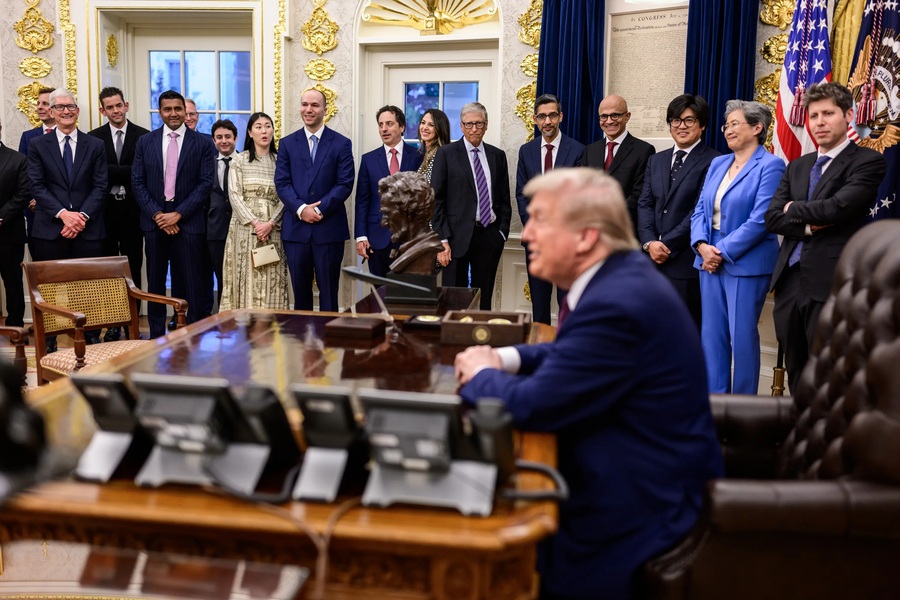
On Wednesday, the White House invited leaders of OpenAI, Google, Anthropic, Meta, and Microsoft to the Oval Office for a signing ceremony the following afternoon. President Trump was to sign an executive order on AI and cybersecurity—the administration's most formal effort yet to establish a voluntary process for reviewing frontier models before their release. But roughly three hours before the ceremony, when some company executives were already in the air to Washington, the White House called it off.
Trump told reporters he had "postponed" the order because he "didn't like certain aspects of it," adding: "I think it gets in the way of—you know, we're leading China, we're leading everybody, and I don't want to do anything that's going to get in the way of that lead." Former White House AI and crypto czar David Sacks called the president that morning—"unbeknownst to anybody," one official said, and "derailed it." Sacks purportedly raised concerns held by some in the AI industry that a "voluntary" review system could harden into a de facto licensing regime, slow the pace of American AI development, and hand China the lead. One source offered a blunter explanation for the president’s decision: Trump "just hates regulation," and the order was "just something doomers wanted."
There’s a line among public policy watchers that policy is personnel. This latest episode adds support to the idea that policy is also personal. However, it would be wrong to treat all of this as just another episode of disorganized personalism in the White House. Two additional elements of this story are worth emphasizing. The first is the substance of what was killed—about as mild an intervention as a serious government response to frontier-model risk could be. The second is the absence of any reliable process for working through frontier-AI disagreements, which matters more right now than it would in most periods: The next three years are likely the inflection point for the technology, and the United States cannot afford to govern them by impulse.

Politics
%20Richard%20Samuelson%20%20-%20Is%20American%20Nationalism%20Still%20Creed-able_-1.jpg)
Is American Nationalism Still Creed-able?
We are not there now, but there is reason to worry that the United States is in danger, if we are not careful, of ceasing to be a nation with the principles of 1776 at its core.
National Civitas Institute Poll: Americans are Anxious and Frustrated, Creating a Challenging Environment for Leaders
The poll reveals a deeply pessimistic American electorate, with a majority convinced the nation is on the wrong track.
.webp)
%20(1).avif)




Can Britain’s Next Prime Minister Escape the Net Zero Trap?
Britain has burned through five Prime Ministers and is paying some of the highest electricity prices in the world.
The Scanner at the Gate: Europe’s China Policy Litmus Test
China’s industrial policy is entering Europe through public procurement—and reshaping sensitive markets from within.

Confronting the New Antisemitism
"The postwar effort 'to rebrand Judaism as a religion' has made it impossible for American Jews to understand what they are facing today, because what we are facing today is an attack on the idea of Jewish peoplehood.”
“Democratic” Socialism Is Undemocratic
By promoting class hatred, suppressing private initiative, and seeking enhanced control of our lives, today’s democratic socialists undermine patriotism and individual initiative—two qualities that have long distinguished the United States from other major nations.

