Upending American Immigration
.avif)
The senseless killing of Sarah Beckstrom does not justify suspending our immigration system.
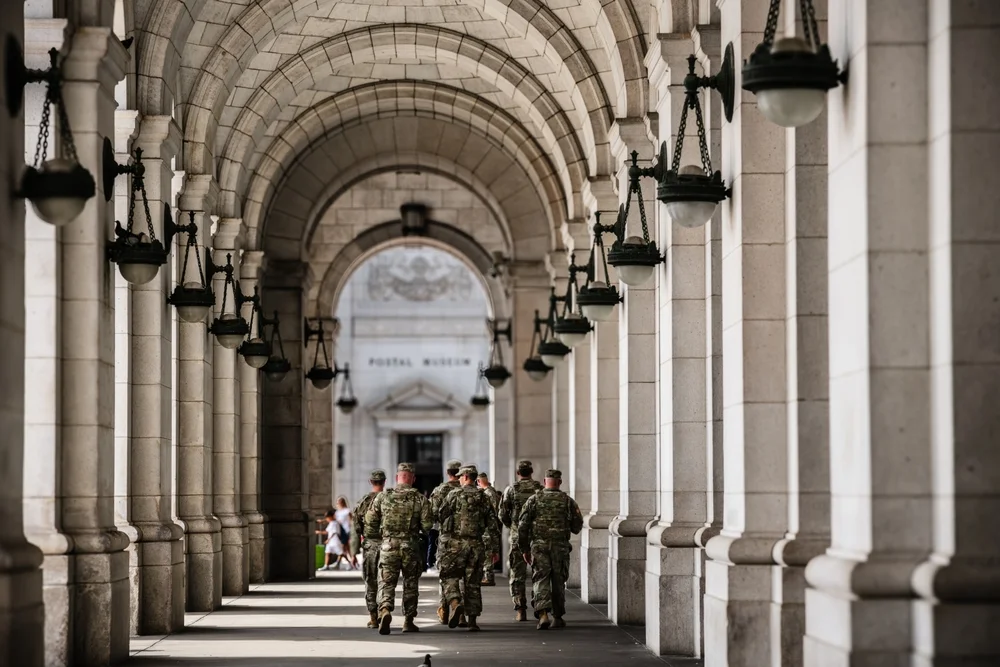
In one of the most senseless tragedies of our times, West Virginia National Guard member Sarah Beckstrom, aged 20, was murdered by Afghan national Rahmanullah Lakanwal. The perpetrator had been allowed into the United States under a program that resettled some 80,000 Afghans who had aided the U.S. during the long Afghan war. Her colleague, Andrew Wolfe, aged 24, as of this writing, still lies in critical condition.
There is a long backstory to this tragedy. The war in Afghanistan ended precipitously with the massive and chaotic withdrawal in August 2021, which was horribly managed by Joseph Biden, who then sought to place the blame squarely on a tricky deal negotiation before leaving office in January 2021. However wise or foolish Biden’s management of the end of the Afghan war was, the Trump administration apparently made the ultimate decision to grant Lakanwal asylum.
Today, however, it is pointless to play the blame game on that tragic choice. There are now in process some million or so applications for political asylum, and no program screening can get even close to 100 percent correct on these candidates. Indeed, even if government agents made the correct decision on intake, Lakanwal may have been in it only for the money from the beginning, or he may have had strong patriotic motives; either way, he took major risks. So it is possible that he only turned hostile toward America after his arrival for all sorts of reasons, including a deep sense of betrayal, given that the United States has reneged on its promise to take care of those persons in mortal danger from the Taliban. To their great credit, many veterans and civilians who had served in the Afghanistan theater took extreme personal risks after the United States government under both administrations refused to discharge them. One such scheme was staging a mass wedding to avoid what might otherwise have been a mass funeral.
This backstory is irrelevant to the punishment that should be meted out to Lakanwal and his confederates, if any. They should be punished to the fullest extent of the law; the government’s first-degree murder charge is fully justified, as is any death penalty that the court decides to impose. But then matters get much murkier. Given the very complex U.S. – Afghan relationship, the reckless statements of Donald Trump could well backfire by inducing other persons, either domestic or foreign, to inflict unnecessary harm to other Americans and friendly citizens of other nations who have as of yet committed no offenses, but might be induced to do so by his stern rant — no lesser word will do — on Truth Social. We have had other such tragedies in the past, but no president has authored a response so disproportionate that it talks about everything except how to reduce the likelihood of the event's recurrence.
Let us assume, with Trump, that there are some 53 million foreign-born individuals in the United States. It is undoubtedly the case that similar acts of senseless violence are often committed by natural-born citizens of the United States who are not subject to deportation for the commissions of their acts of terrorism, so that that even there is a greater risk of these actions by Afghans — which is hardly warranted by the record, it is also the case that many natural-born American citizens of all races, creeds, and religions often commit acts of violence. Given this complex history, it is downright irresponsible to claim that “most of [the foreign-born population] are on welfare, from failed nations, or from prisons, mental institutions, gangs, or drug cartels.” I have, in other contexts, had much to say against both Governor Tim Walz and Congresswoman Ilhan Omar, neither of whom had anything to do with this particular killing. Nor is there any known link between any Somali organization and these killings. But if there were such activities, the proper response is to punish the individuals responsible in accordance with the applicable laws, and not to make an overbroad condemnation of an entire immigrant population.
This Trump tirade is not without collateral consequences, because his disproportionate response followed the initial rant:
I will permanently pause migration from all Third World Countries to allow the U.S. system to fully recover, terminate all of the millions of Biden illegal admissions, including those signed by Sleepy Joe Biden’s Autopen, and remove anyone who is not a net asset to the United States, or is incapable of loving our Country, end all Federal benefits and subsidies to noncitizens of our Country, Only REVERSE MIGRATION can fully cure this situation.
Take these assertions one at a time. Any effort to impose a unilateral pause must, at a minimum, be treated as an attempt to treat all these programs as lying solely within the President's jurisdiction, under a theory of the unitary executive that assumes Congress has no authority to weigh in on particular cases. There are complex constitutional issues at play here, given that the initial decision on constitutional design was to give the United States the exclusive power of naturalization, while, in 1789, leaving the entire power over immigration to the states. That is where matters stood until the Chinese Exclusion Case of 1889, when the Supreme Court decreed, principles of enumerated powers be damned, that “[j]urisdiction over its own territory to that extent is an incident of every independent nation.” But once the leap was made to federal power, the next round of decisions held:
Long-standing Supreme Court precedent recognizes Congress as having plenary power over immigration, giving it almost complete authority to decide whether foreign nationals (aliens, under governing statutes and case law) may enter or remain in the United States.
At this point, President Trump is likely to claim that his emergency powers allow him to take whatever measures he deems necessary under the circumstances. But that cannot be the law. The killing of two people by what appears to be a lone actor is a human tragedy, but it is no more so than any other wanton killing, a national emergency that begins to justify the broad steps that Trump proposes to take. A unilateral decision of Joseph B. Edlow, the head of Citizenship and Immigration Services (USCIS), states that it “has halted all asylum decisions until we can ensure that every alien is vetted and screened to the maximum degree possible. The safety of the American people always comes first.” That broad statement presupposes that there is no constitutional limit on how to respond to individual acts of violence, and no awareness that the disrupting of the lives of untold thousands of people may yet spark the very kind of violence that we are trying to avoid. The Trump administration has not yet learned that, often, the best response to an emergency is to follow the standard enforcement procedures to avoid the caprice and bad judgment of the moment, something that the Biden administration was often loath to do.
But the Trump administration's overresponse goes further. It is undoubtedly the case that naturalized citizens labor under unquestioned statutory disabilities that ordinary citizens do not face. That fact allows for their deportation when their citizenship is revoked because they have made material misrepresentations on their naturalization applications about their activities prior to naturalization. They can also be deported if they are convicted of major crimes, including aggravated felonies, which are subject to an elastic definition that leads to many controversial decisions; a similar fate could await someone who is found to be a member of a subversive group within five years of naturalization. These powers follow from Congress's plenary power over naturalization, which is not without limits when delegated to the president and his administration.
Yet now Trump is after greater power, given his apparent willingness from the first day of his administration to “denaturalize,” which had sparked fears of these actions even before the senseless killing of Sarah Beckstrom. That issue has significant implications, as there are now about 25 million naturalized citizens in the United States. A protracted effort to seek to denaturalize citizens without going through the proper hoops could lead to far, far more than the 22,000 Americans who lost their citizenship between 1907 and 1967, when international tension ran at full tilt. But that aggressive style is found in Trump’s latest announcement: that his government would “remove anyone who is not a net asset to the United States, or is incapable of loving our Country,” “end all Federal benefits and subsidies to noncitizens of our Country,” “denaturalize migrants who undermine domestic tranquility,” and “deport any Foreign National who is a public charge, security risk, or non-compatible with Western Civilization.
Sheer hyperbole. There must be millions of citizens, whether natural-born or naturalized, who are not “net assets” — whatever that means — to this country, and so all persons with disabilities must go now. No one knows how many benefits in this country go to legal permanent aliens. Adding in public charges, security risks, and persons disrespectful of Western Civilization could lead to the deportations of millions of individuals. Clearly, Trump will backtrack from these mindless excesses that far exceed anything he did or said during his first term in office. But by then the damage will be done. Whatever respect that this nation has under Trump will be severely compromised, and a nation that loses respect and influence around the world is far more dangerous than the situation today.
Richard A. Epstein is a senior research fellow at the Civitas Institute. He is also the inaugural Laurence A. Tisch Professor of Law at NYU School of Law, where he serves as a Director of the Classical Liberal Institute, which he helped found in 2013. Epstein is also the James Parker Hall Distinguished Service Professor of Law Emeritus and a senior lecturer at the University of Chicago.

Politics
%20Richard%20Samuelson%20%20-%20Is%20American%20Nationalism%20Still%20Creed-able_-1.jpg)
Is American Nationalism Still Creed-able?
We are not there now, but there is reason to worry that the United States is in danger, if we are not careful, of ceasing to be a nation with the principles of 1776 at its core.
National Civitas Institute Poll: Americans are Anxious and Frustrated, Creating a Challenging Environment for Leaders
The poll reveals a deeply pessimistic American electorate, with a majority convinced the nation is on the wrong track.
.webp)
%20(1).avif)


.jpg)

Can Britain’s Next Prime Minister Escape the Net Zero Trap?
Britain has burned through five Prime Ministers and is paying some of the highest electricity prices in the world.

The Scanner at the Gate: Europe’s China Policy Litmus Test
China’s industrial policy is entering Europe through public procurement—and reshaping sensitive markets from within.

Confronting the New Antisemitism
"The postwar effort 'to rebrand Judaism as a religion' has made it impossible for American Jews to understand what they are facing today, because what we are facing today is an attack on the idea of Jewish peoplehood.”
“Democratic” Socialism Is Undemocratic
By promoting class hatred, suppressing private initiative, and seeking enhanced control of our lives, today’s democratic socialists undermine patriotism and individual initiative—two qualities that have long distinguished the United States from other major nations.

