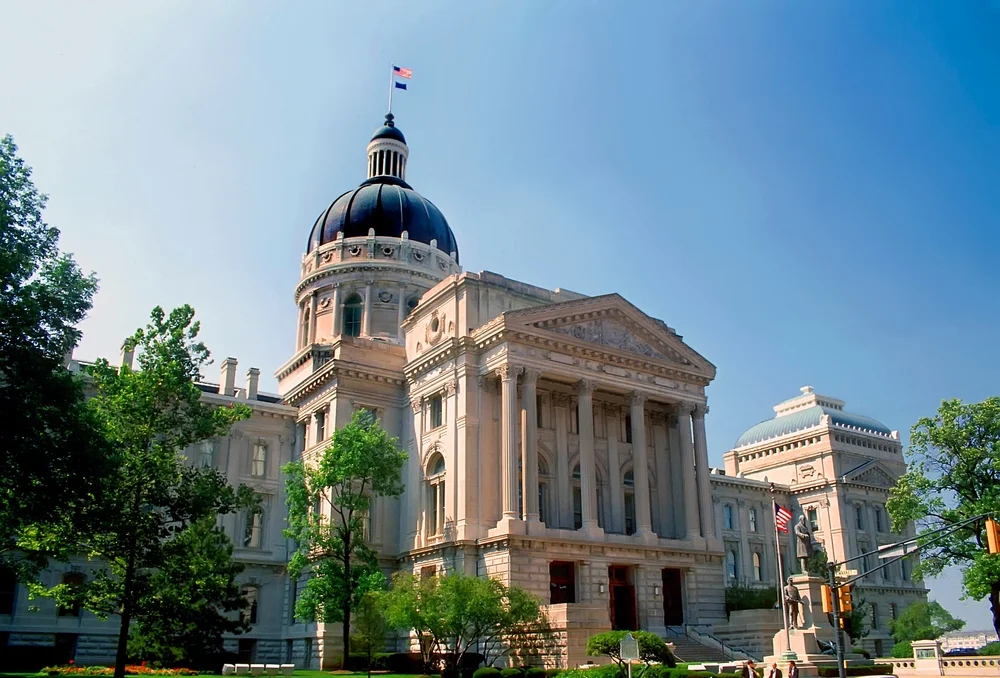
Indiana, D.C., and Purchased Submission

The goal for policymakers should be to decrease dependence on transfers to the point where any demands from DC can be responded to with, “Thank you for your suggestion. We will take it into consideration.”
The recent contentious redistricting vote in the Indiana State Legislature has drawn considerable controversy and commentary as 2025 ends. This recent event highlighted a much deeper issue for Hoosiers: dependence on federal transfers.
On the morning of December 11, 2025, Heritage Action (a 501c4 non-profit organization that is not a part of the U.S. government) posted this warning on X:
President Trump has made it clear to Indiana leaders: if the Indiana Senate fails to pass the map, all federal funding will be stripped from the state. Roads will not be paved. Guard bases will close. Major projects will stop. These are the stakes and every NO vote will be to blame. #PassTheMap
That warning about pulling federal funding, however, could not be traced back to the president (who makes his views clear on social media). So why would an unsubstantiated claim from a private entity be so concerning? Unfortunately, Indiana is heavily reliant on federal funds. Withholding those funds threatens to strain the state’s financial health, which will ultimately hurt hardworking Hoosiers with tax hikes.
Regardless of how one feels about the recent redistricting issue, the clear lesson for all Americans is this: Allowing federal transfers into your state also means giving DC a say in state and local issues. The best path forward for Indiana is to reduce its dependence on federal transfers as much as possible.
The Control That Comes from “Terms & Conditions”
Philip Hamburger clearly outlined the relationship between the federal government and recipients of federal transfers in his book Purchasing Submission, which discusses the “transactional mode of control.” This is where the federal government uses bureaucracy to push through unconstitutional policies by promising government assistance. The assistance is subject to terms and conditions that recipients must accept. “The Constitution,” he writes, “is a law publicly enacted by the people. It therefore cannot be altered or excused by the consent of states or private persons.”
In an interview for The Law & Liberty Podcast, Hamburger elaborates, “It’s not just the threat to rights. There’s a purchase of consent to a whole new mode of governance, an alternative mode of control. And so when you step back and see that, conditions are no longer a technical problem, that’s actually a profound question of political theory and law.”
Federal transfer payments also allow state and local governments to increase spending at the cost of federal taxpayers living in other states. This takes the form of direct grants to the states, as well as tax carve-outs such as the State and Local Tax (SALT) Deduction. This creates a tragedy of the fiscal commons. As state policymakers seek to maximize transfers from federal taxpayers to their state budgets, they risk federal financial insolvency as federal policymakers have an incentive to use debt-financed spending to maintain current spending levels. When tough budget cuts must be made, federal policymakers are likely to alter or cut transfers to state and local governments, requiring state policymakers to make the difficult decision of either raising taxes, cutting spending, and/or taking on additional debt to cover the spending gap.
As total public debt remains unsustainably high, the threat of a federal budget crisis looms large. Any hopes of reform will have to contend with concentrated interests that seek to keep the federal transfer stream open, even at the expense of federal and state solvency.
Where Indiana Stands with Federal Funds
According to the National Association of State Budget Officers (NASBO) State Expenditure Report, in FY 2024, just under 43.81 percent (over $22 billion) of Indiana’s total spending (capital inclusive) was funded by federal funds. Only Louisiana (50.1 percent) and Mississippi (45.84 percent) had higher shares of state spending financed by federal transfers. For FY 2025, (July 1, 2024, to June 30, 2025), the Indiana Transparency Portal reports that 43.48 percent ($31 billion) of expenditures came from federal funds.
Part of this large percentage is the result of the Indiana state budget running leaner in other areas relative to similar budget categories in other states. However, with nearly half of the budget relying on federal transfers, it is easy to see how DC can impose its views on Hoosiers by both purchasing compliance and threatening to withhold funds through these transfers.
In Indiana, most FY 2025 federal transfers went to Medicaid ($16.1 billion of the $31 billion), followed by the Healthy Indiana Plan ($4 billion). The Healthy Indiana Plan was created under the Affordable Care Act’s Section 1115 Medicaid Demonstration waivers, which allow the state to use funds designated for Medicaid Expansion Group Enrollees but offer consumer-directed coverage instead of the traditional Medicaid model. This, however, means that $20.1 billion of the $31 billion (64.83 percent) of federal transfers pertain to Medicaid. When most federal transfers cover healthcare (literally a matter of life and death), one can see why any policymaker would ensure that such transfers continue unabated.
Building a Solid Foundation
Ideally, the relationship between the states would be what legal scholar Michael Greve calls “Competitive Federalism.” In the AIER Explainer “The State of Competitive Federalism,” Greve outlines the dangers of “cooperative” or “cartel” federalism in which the federal and state governments act as “partners in a collective enterprise.” This partnership gives the federal government influence over state and local affairs by use of “the production and distribution of rents among politicians, bureaucrats, and concentrated industry sectors.”
Fortunately, Indiana is in a better position than most states to end that dependence. Indiana’s constitutional balanced-budget requirements and strict debt limits help maintain the state's relatively strong fiscal health. Additionally, state legislators have already taken to reforming Medicaid to control costs and reduce waste and fraud.
The next step for Hoosiers is to implement a program similar to Utah’s “Financial Ready Utah” program. This initiative helped Utah quantify the amount of federal funding used by state agencies and create contingency plans in the event of a significant cutback in federal funding.
Conclusion
Ending dependence on transfers will give Hoosiers greater control over their own destiny. The goal for policymakers should be to decrease dependence on transfers to the point where any demands from DC can be responded to with, “Thank you for your suggestion. We will take it into consideration.”
Thomas Savidge is a Research Fellow at the American Institute for Economic Research. Follow him on X: @thomas_savidge.

Politics
%20Richard%20Samuelson%20%20-%20Is%20American%20Nationalism%20Still%20Creed-able_-1.jpg)
Is American Nationalism Still Creed-able?
We are not there now, but there is reason to worry that the United States is in danger, if we are not careful, of ceasing to be a nation with the principles of 1776 at its core.

National Civitas Institute Poll: Americans are Anxious and Frustrated, Creating a Challenging Environment for Leaders
The poll reveals a deeply pessimistic American electorate, with a majority convinced the nation is on the wrong track.
.webp)
%20(1).avif)


Proxy Firms Don’t Have to Disclose Conflicts. That Should Change
The firms whose advice can move those votes bear no comparable duty for the advice itself. States can close that gap by applying an enduring standard from the Supreme Court.

Texas May Soon Have More People Than California — Here’s Why
California natives are voting with their feet.



.jpg)