Jimmy Lai: Apostle for Freedom

Time is running out — for Trump and Jimmy Lai.
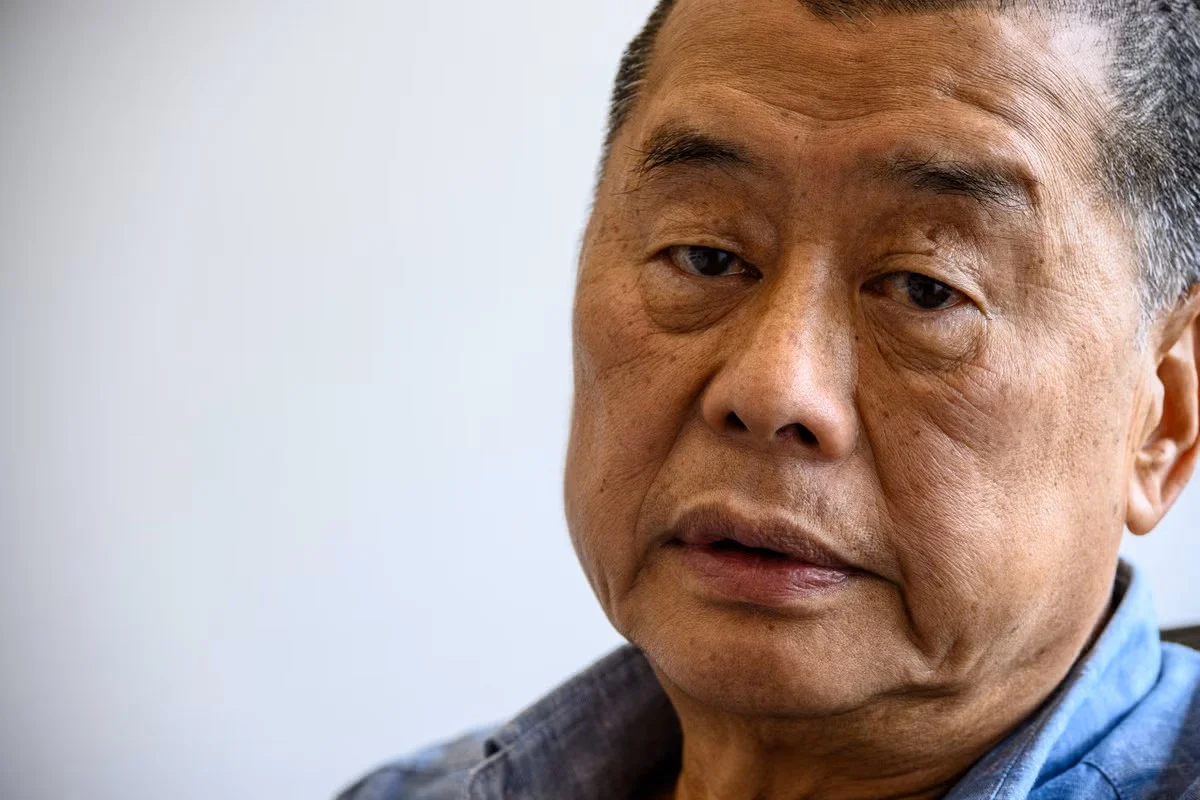
In May, Sebastian Lai spoke about the deteriorating condition of his father, Jimmy Lai. For more than 2,000 days, the Hong Kong freedom fighter has been a prisoner of communist authorities. For much of that time, Lai has lived in solitary confinement in a six-foot cell without ventilation. Sebastian Lai said his father, who turns 79 in December, is beginning to lose his teeth and fingernails and is suffering from a heart ailment.
“This is an elderly man,” Sebastian Lai said. “If he’s not saved now, he’ll die in prison.”
Days after Sebastian Lai spoke to CBS News, Donald Trump traveled to Beijing to meet with Chinese President Xi Jinping, marking the president’s first trip to China since 2017. In the Great Hall of the People, the two leaders discussed trade, Taiwan, AI, regional security, and the future of US-China relations.
Jimmy Lai was not mentioned, but Trump later said his case came up during a private conversation at Zhongnanhai, the Chinese leadership compound.
“I would say the response to that was not positive,” Trump told Fox News, later adding, “I did not feel optimistic.”
‘He’ll Be Easy to Get Out’
Whether Jimmy Lai is freed or dies in a Chinese prison remains uncertain.
The pro-democracy media tycoon received a 20-year prison sentence in February after being convicted under Hong Kong’s National Security Law, which effectively made it a crime to argue that Hong Kong is a separate, democratic system from mainland China.
Lai’s conviction is purely motivated by the totalitarian demands of China’s Stalinist-style government.. He is likely to die in prison if Trump cannot convince Xi to release the former publisher of the Apple Daily. And Trump’s May visit to China appears to have been a missed opportunity.
While in Beijing, Trump secured what the White House described as a “historic” trade breakthrough. Yet the author of The Art of the Deal apparently left without any assurances from Xi regarding Lai’s fate.
In fact, the visit may have been a setback. Trump’s pessimistic assessment marked a sharp turn from statements he made before the 2024 presidential election, when he suggested that securing Lai’s freedom would be a breeze.
“I’ll get him out,” Trump told radio host Hugh Hewitt. “He’ll be easy to get out.”
Many would not be surprised that securing Lai’s release has proven more difficult than Trump suggested on the campaign trail. The more troubling question is whether Trump remains committed to freeing the Hong Kong publisher, whose only “crime” was insisting that the Chinese government honor its “one country, two systems” pledge when sovereignty over Hong Kong was transferred from the United Kingdom in 1997.
Causing ‘Bedlam’?
Securing Lai’s release was always going to be more difficult than Trump suggested on the campaign trail. But now the question is whether the president remains committed to winning Lai’s freedom.
It’s not just that Trump’s optimistic tone vanished. Observers noted that after his Beijing trip, the president adopted CCP talking points, saying Lai’s release would be “tough” because he had caused “bedlam” in Hong Kong.
As scholar George Weigel observed in First Things, causing “bedlam” apparently means “encouraging and participating in peaceful demonstrations demanding that the Beijing regime honor the commitments to freedom it made when Hong Kong reverted to Chinese sovereignty in 1997.”
Politics requires tact, of course, but it is difficult to see how portraying Lai as a rabble-rouser rather than a peaceful Christian dissident resisting communist repression helps Lai or advances the cause of freedom, for which Lai is in prison .
Having grown up on the streets of Canton before fleeing to Hong Kong at age 12, Lai saw firsthand the value of liberty and the prosperity it made possible. He rose from utter poverty to become a billionaire, prospering in the clothing business before launching his pro-democracy newspaper. The only “bedlam” Lai caused stemmed from his resistance to China’s authoritarian regime as it stripped rights from Hong Kong.
In 2012, shortly after Xi Jinping’s rise, Communist officials quietly circulated a directive calling for an ideological campaign against “Western values,” including free speech, media freedom, and judicial independence. Over the next decade, the CCP would slowly tighten its grip on power in Hong Kong, destroying both economic and political freedom in the process.
The billionaire Lai could have simply fled Hong Kong. Instead, he opted to stay in his adopted country and peacefully resist CCP oppression.
“I don’t have a sense of fear,” Lai said shortly before his 2020 arrest. “Especially if I’m doing the right thing.”
The Art of the Deal?
Trump undoubtedly knows all this, which makes one wonder why he has echoed CCP talking points that portray Lai as some kind of political agitator.
It is not as if Trump lacks leverage. He has repeatedly shown a willingness to use executive power to extract concessions in negotiations with allies and adversaries alike. Yet when it comes to China—and Jimmy Lai in particular—he has shown little inclination to use that leverage.
Worse, recent events suggest the Chinese may be playing the game better.
The Wall Street Journal recently reported that Trump allowed a 2020 emergency order sanctioning nine Hong Kong and mainland Chinese officials to expire. The CCP-controlled Hong Kong government welcomed the decision as a “positive shift” in American policy, but it’s unclear what the US got in return.
Trump has long portrayed himself as a master negotiator willing to confront powerful world leaders.
Whatever the reasons for the delay, Trump’s reputation may be more intertwined with Lai’s fate than he realizes.
Lai is, in the words of the Wall Street Journal, “the world’s most famous political prisoner.” He is a Solzhenitsyn for our time. A devout Christian who spends much of his time in prison sketching scenes from Christ’s crucifixion.
If Jimmy Lai dies in prison, it will be a human tragedy and a profound injustice. Yet Lai seems to understand that his death and suffering would have a greater purpose.
For Trump, however, Lai’s death would represent something starkly different. The president has long scorned weakness. And though it would be unfair to hold Trump personally responsible for Lai’s imprisonment—the responsibility lies with Xi Jinping and the Chinese Communist Party—if Lai dies in captivity, it would signal a kind of political impotence.
Fortunately for Trump, he’s not the only world leader whose reputation is at stake. If Lai were to die in a communist cell, it would be an even greater stain on Xi and the Chinese government. Indeed, Weigel has reported that some Chinese officials may recognize the danger: according to sources, officials in the foreign ministry have favored a “convict and expel” strategy to remove a diplomatic headache for Beijing.
Sebastian Lai also appears to understand this. In May, he was asked what he’d like to hear Trump tell Xi.
“It’s just telling President Xi that it’s not to his benefit that my father dies in prison,” Sebastian Lai said. “My father symbolically is a hero to many people around the world. He’s a man who’s given up everything he has for freedom and democracy.”
President Trump is in a unique position to help Xi see this, especially with the Chinese premier expected to visit the US next month. The primary focus of the summit is expected to be trade. Trump should make it clear that any trade deal includes freedom for Lai, the man who represents the best of what Hong Kong was, a man who has proven himself an apostle of freedom and virtue.
But the president better find the courage soon. Time is running out — for Trump and Jimmy Lai.
Jonathan Miltimore is editor-in-chief of The Daily Economy, an online journal published by the American Institute for Economic Research.

Politics
%20Richard%20Samuelson%20%20-%20Is%20American%20Nationalism%20Still%20Creed-able_-1.jpg)
Is American Nationalism Still Creed-able?
We are not there now, but there is reason to worry that the United States is in danger, if we are not careful, of ceasing to be a nation with the principles of 1776 at its core.
National Civitas Institute Poll: Americans are Anxious and Frustrated, Creating a Challenging Environment for Leaders
The poll reveals a deeply pessimistic American electorate, with a majority convinced the nation is on the wrong track.
.webp)
%20(1).avif)

How Occupational Licensing Hurts the Poor and Holds Back Growth in America and Around the World
Occupational licensing hurts the poor and holds back growth in America and around the world.
Why Gloria Romero’s Campaign for Obscure Office Will Change CA GOP
Gloria Romero is California’s 'basta ya' candidate.

The Uses and Abuses of the Pardon Power
The recent flood of pardon controversies shows no signs of abating.
.jpg)
The Fall of Fauci
The greater the scope of authority granted to a single individual, by circumstance or deliberate action, the more important scrutiny and accountability become.