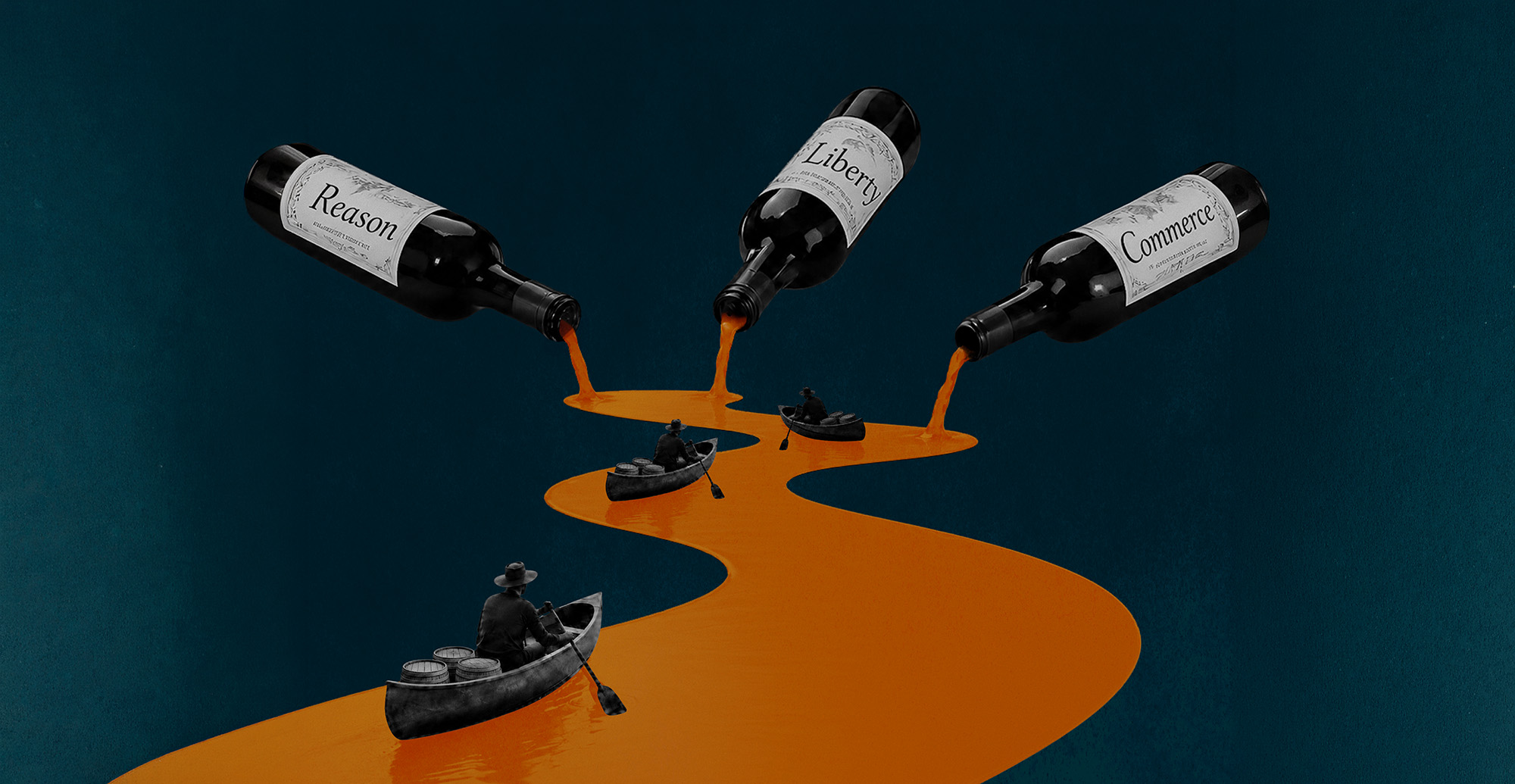
The Wine and Commerce Symposium

Wine remains as good a commodity as any other to examine as a microcosm of current-day economics.
Wine and the Making of Liberal Modernity: How Market Knowledge Enlarges our Constitutional Self-Understanding
I.
The essays in this special feature show that understanding liberalism requires understanding how markets work, at both the macro and the micro level. They also show how wine remains as good a commodity as any other to examine as a microcosm of current-day economics. Collectively, the essays present us with three propositions: that wine may enlighten and ground us; that wine may beguile and corrupt us; and that, if properly understood, wine may point the way towards benevolent, free economic development—that is, liberalism well-understood. The authors showcase how enlightened reason never exists in a vacuum; it is always encoded and embodied in sensory experience. Since Plato’s Symposium, the Western tradition’s great thinkers recognized wine as a symbol for the beguilement of reason. But if wine warps reason, they recognized how it can also enable reliable reason in our analysis of regimes.
II.
Montesquieu, David Hume, and their Enlightenment contemporaries’ involvement in the wine industry shaped their ideas about early capitalism and modern liberty. They were not simply adjudicating the liberal commercial world in the abstract. Their industry experience enabled them to occupy a privileged epistemic position from which to criticize commercial modernity’s challenges, leading them to develop important adjuncts to their respective proto-liberal projects.
The first essay by Charlie Leary showcases the vital role wine played in shaping outcomes in ideas. More specifically, his analysis of Montesquieu’s manifesto on vineyard planting rights and Hume’s essays on the “Jealousy of Trade” and “Taste” illustrate how cross-Channel wine trade networks helped “circulate Enlightenment” while informing foundational theories in classical liberal and economic thought related to commercial liberty, taxation, and mercantilism.
If wine serves as a heuristic for understanding the relationship between freedom and the materiality of the economy in Enlightenment political philosophy, Donald Drakeman’s essay shows us how a complex bouquet of claret sometimes proves more enlivening than the odorless aura of constitutional democracy. His account of how Jefferson’s engagement in the wine trade ultimately influenced the Supreme Court’s religion decisions adds to our understanding of how the “wall of separation” crystallized as the authoritative interpretation of the First Amendment’s religious clauses, thus introducing a fresh vantage point for tracing American freedom’s historical trajectory.
Just as the product may beguile us, the third essay by Seth Porter shows us how insights into its manufacturing may illuminate our understanding of the inextricable relationship between culture, economics, and politics. He explains how emerging wine regions in the United States succeeded not just through good terroir, but by building strong ecosystems of policy, education, collaboration, and branding. Sustainable success in the wine trade is ultimately about aligning systems, not merely producing good bottles. More broadly, his analysis of the U.S. wine industry demonstrates how it can become economically empowering in rural America.
III.
What is the relationship between wine and freedom? These essays show us how wine commerce may be a rehearsal of freedom, as it led Montesquieu and his Enlightenment contemporaries to recognize how there are more and less salubrious forms of economic activity in a free, commercial republic. Wine commerce may provide insights into freedom’s nature and function; it may conduce toward actual freedom, but we learn that through political influence, it can also conduce toward an unhelpful modulation of freedom. As we shall see, the commodity itself functions as a double-edged sword in a commercial republic, whereby it can inspire excellence and discipline through its beauty and utility but can also corrupt through avarice.
Collectively, the following essays will provoke us to consider the effect of any commodity relationship in the economy and how this relationship conduces towards specific understandings of freedom. Moreover, they invite us to ask: are there other commodities or resources today that might be equally inspiring in public policy and consensus-building as it is corrupting? We need not look further back than the current AI economy to recognize the germaneness of this question. Is the drive to produce and power massive quantities of data centers an epic act of nation-building that will enlarge freedom and enable individual flourishing at home while securing America’s geopolitical advantage, or will it prove to be the mechanism by which commercial power corrupts political power in the United States?
One might argue that the confidence with which we today debate the future of data and AI, relative to our actual understanding of the algorithms and machines underlying them, is comparable to the splendor and indulgence with which people discussed wine while scarcely understanding the mechanics of winemaking. Indeed, data is the new oil, but every age fetishizes the object it believes will crown human flourishing. In the early commercial republic, that unifying object was wine.
The core insight we can draw from our historical examination of the wine industry testifies to the importance of understanding markets today: to be connected to the materiality of the local economy gives one a privileged position from which to understand what otherwise appears abstract and overarching. We assume today that free markets exist in unproblematic harmony with the free state; but in approaching the wine industry as the palimpsest beneath that assumption, these essays help us realize that thinkers who reconciled their liberal ideals with commercial exigencies carefully negotiated this harmony. If yesterday’s wine merchant could anticipate today’s liberalism, then perhaps today’s A.I. merchant may help us see tomorrow’s.
Commerce, Claret, and the Republic of Letters: Enlightenment Thought and the Wine Trade
Charlie Leary, Ph.D.
Wine may seem peripheral to Enlightenment thought, often reduced to the Champagne flowing in Paris salons or the claret favored in London’s Rainbow Coffee House and Edinburgh’s taverns. Yet by viewing key thinkers as empirical observers shaped by the wine trade, we find that commerce in wine—particularly between France and Britain—deeply influenced their views on human nature, economy, and political liberty.
This article explores three philosophers—Richard Cantillon, Montesquieu, and David Hume—whose direct involvement with the wine trade reveals how international commerce circulated Enlightenment ideas, materially and intellectually.
Richard Cantillon (d. 1734)
A committed Irish-born Jacobite, Cantillon grew wealthy as a banker and stock speculator who made his fortune in early 18th-century Paris. The Jacobites supported the restoration of the Stuart dynasty in Britain, at times through violent insurrection. Best known for his Essai sur la nature du commerce en general (c. 1730), Cantillon laid foundational concepts for modern economic theory that influenced later thinkers like Adam Smith and the physiocrats. A detailed empirical observer like John Locke, he also engaged in French wine commerce throughout his adult life. So closely tied was he to the wine trade that when he died under mysterious circumstances in 1734, he was identified only as “a French Wine-Merchant in Albemarle Street,” London.
Cantillon’s deep experience in selling Champagne and fine claret to English elites, such as the fabulously wealthy oenophile James Brydges, 1st Duke of Chandos, informed his economic theory, including the place of luxury production (exchanging Champagne for Brabant lace) in the international balance of trade and the use of credit instruments. He carefully distinguished between cheap commodity wines (those from Languedoc, and, perhaps surprisingly, Burgundy) and the expensive sparkling wine. Notably, Champagne resulted from the recently developed méthode champenoise, showing Cantillon recognized the economic consequences of technological innovation.
Cantillon championed international trade, especially in value-added goods like fine wine, and emphasized the structural benefits of exporting manufactured products. “Cantillon was the first writer to describe at so great length the supposedly self-adjusting and essentially autonomous character of the economic system and to suggest the inadvisability (if not the impossibility) of attempting, by legislative action, to modify the behavior of that system,” observed the economist Jospeh Spengler.
His references to wine started with his observations about how land ultimately determined the intrinsic value of goods.
As for the use to which the land should be put, the first necessity is to employ part of it for the maintenance and food of those who work the land and make it productive. The rest depends mainly upon the desires and lifestyle of the prince, the lords of the State, and the property owner. If they are fond of wine, vineyards must be cultivated.
He also introduced the concept of the modern “entrepreneur”—someone who took on risk—of which he, as an international wine merchant, formed a perfect example. He provided a very telling picture of how a city like eighteenth century Bordeaux developed:
The city in question will grow larger if the king, or the government, establishes law courts to which the people of the market towns and villages of the province must have recourse. An increased number of entrepreneurs and artisans of every sort will be needed for the maintenance of the judges and lawyers. If in this same city workshops and factories are established to manufacture beyond home consumption, for export and sale abroad, the city will be large in proportion to the workmen and artisans who live there at the expense of foreigners.
Cantillon’s Essai described a self-adjusting international economy powered by entrepreneurial risk and reciprocal exchange, what Spengler called a “network of reciprocity” governed by the pursuit of self-interest. Cantillon maintained a friendship with the influential vigneron philosophe in Chalons-sur-Marne, Jean-Louis Levesque de Pouilly (1691-1750), and he likely met another such winegrower, Charles de Montesquieu.
Montesquieu (1689-1755)
Although he believed that French nobles should not engage in commerce in the same way as merchants, this never stopped Montesquieu from forcefully promoting the sale of wine from his various Gascon vineyards. Another keen empirical observer, Montesquieu’s richest insights about wine commerce came from a public dispute with King Louis XV’s representative in Bordeaux, the Intendant Claude Boucher, over royal restrictions on vineyard planting rights. This incident prefigured Montesquieu’s later thought on the balance of power.
Montesquieu strenuously supported the rights of winegrowers to freely plant what, where, and when they desired based on international market demand. He was, in fact, consciously emulating the success of the de Pontac family’s vineyards at Chateau Haut-Brion, which Boucher had forbidden, by buying nearby the same kind of gravelly “terroir.” In his protests, he essentially promoted the importance of entrepreneurial wisdom—risk taking in an open market—like that Cantillon described. He wrote in 1726:
The prohibition on planting vines is useless because the owner knows, much better than the Minister, if the vines suffer economic losses; he calculates accurately . . . [The Bordeaux wine region] must provide different kinds of wines to the foreign market, depending on the diversity of its soils. However, the taste of foreigners varies continuously . . . We must therefore follow this inconsistent taste, planting or uprooting accordingly.
Montesquieu went on to describe in detail the kind of product and international market differentiation essential to sales success.
Finally, to market his wine, Montesquieu showed a clear preference for working with those who valued free international trade—notably Jacobites and Huguenots. In his final years, he sold directly to British nobles such as Lords Elibank and Morton, effectively creating a “Montesquieu brand” of fine, single-estate and single-vintage wine. Among his most trusted intermediaries was John Stewart of Allanbank, a well-connected Berwickshire lawyer and businessman. A committed Jacobite, Stewart understood the significance of L’Esprit des lois and helped forge a consequential new relationship between the Bordeaux vigneron and his lifelong friend—and fellow claret enthusiast—David Hume. Hume’s own involvement with wine commerce—both as a young apprentice and later as a diplomatic go-between—offers a Scottish counterpart to Montesquieu’s Gascon entrepreneurship.
David Hume (1711-1776)
Hume was a Scottish philosopher, historian, and essayist, best known for his empiricist philosophy and skeptical critiques. A central figure of the Scottish Enlightenment, he made important contributions to political economy and held diplomatic posts in France. He developed a deep appreciation for French culture.
From an early age, Hume developed a typical Scot’s love of Bordeaux claret, and, at times even dipped his toe into wine commerce. In 1734, he apprenticed in the counting house of the Bristol wine and sugar trader Michael Miller, before he headed to France and lived in two important wine regions: Champagne and Anjou. In Reims, he studied in the library of Cantillon’s friend, the noble vigneron Levesque de Pouilly, probably finding the manuscript Essai there, and he compared the qualities of Bordeaux claret and Champagne in his 1739 Treatise on Human Nature. Then, in 1763, we find Hume attempting to broker sales of Burgundy wine between a M. Maltête of Dijon and his friend John Stewart.
The role of Stewart and his father-in-law, the Jacobite agent Charles Smith, in simultaneously engaging in “fair trading” wine commerce and smuggling intellectual correspondence between France and Britain exemplifies Montesquieu’s and Hume’s shared view of the benefits of liberal international exchange. In Chapter XX of L’Esprit des lois, Montesquieu wrote that “the history of commerce is that of the communication of peoples.” “Here is Montesquieu,” notes Randall Hendrickson, “defining commerce not first as trade, but as communication.” Stewart and Smith literally brokered Hume’s communication with not only Montesquieu but also other French philosophes including Claude-Adrien Helvetius, Jean-Bernard LeBlanc, Daniel-Charles Trudaine, and the French physiocrats, resulting in transnational intercommunication of values and ideas during the Enlightenment.
The output of these relationships included the publication in 1749 of a corrected edition of Montesquieu’s L’Esprit in Edinburgh (the first in Britain) plus a very important pamphlet, at a cheap price, entitled Two Chapters of a Celebrated French Work, Intitled, De L'esprit Des Loix (1750). Hume selected these chapters because they offered Montesquieu’s incisive analysis of Britain, including descriptions of “great commerce”: “This nation, which peace and liberty will render easy, free’d from destructive prejudices, will be led to merchandize.” Hume also sent, via Stewart and Smith, his book Political Discourses to Montesquieu, where he complained of prohibitive British tariffs on his beloved French wine and promoted the idea of free markets:
We lost the French market for our woollen manufactures, and transferred the commerce of wine to Spain and Portugal, where we buy worse liquor at a higher price…. Would we lay aside prejudice, it would not be difficult to prove, that nothing could be more innocent, perhaps advantageous. (“Of the Balance of Trade”)
Charles Smith transmitted manuscripts of the Political Discourses to LeBlanc in 1754, resulting in the book’s eventful translation and publication in France.
Wine commerce did more than lubricate Enlightenment sociability: it shaped empirical habits, economic theory, and political ideals across borders. By tracing how thinkers like Cantillon, Montesquieu, and Hume engaged materially and intellectually in the international wine trade, we see how commerce structured and enhanced Enlightenment exchange. Further research must explore how figures like the Jacobites, whom scholars often dismiss as intellectually retrograde, helped transmit liberal, cosmopolitan ideas through the very markets they navigated.
The Vineyard Wall of Separation Between Church and State
Donald L. Drakeman
We have long known that Thomas Jefferson was our most wine-loving statesman, and that he also had strong views about church-state issues. But, until now, we haven’t realized just how big a role Jefferson’s oenophilia played in building the wall of separation between church and state. Here is how it happened.
The Supreme Court first highlighted the wall-of-separation concept in Reynolds v. United States, a late 19th century opinion by Chief Justice Morison Waite. That case involved a Mormon leader named George Reynolds who had been convicted of violating a federal anti-polygamy law.
Mr. Reynolds asserted a religious freedom defense under the First Amendment’s religion clauses, which say that “Congress shall make no law respecting an establishment of religion, or prohibiting the free exercise thereof.” That is, Reynolds was asking for an exemption from being punished because his faith required him to be polygamous.
In this first opportunity for the Supreme Court to interpret the religion clauses, the Chief Justice wanted to learn about their history. There weren’t yet Supreme Court clerks to do that kind of research, so Waite asked for guidance from George Bancroft, America’s most famous historian. Bancroft pointed Waite towards Thomas Jefferson and Virginia’s church-state history.
Waite didn’t stop there. He turned to the history books, where he discovered a problem. Jefferson was serving as minister to France when the Constitution was ratified, which was when the states were discussing the possibility of constitutional amendments. How could Waite follow the great historian’s Jeffersonian clue if Jefferson was out of the country at the relevant time?
In searching for a way to put Jefferson at the center of constitutional action that was at least a month’s sea voyage away from his Paris posting, Waite dug into a recently published collection of Jefferson’s works. He found the link he was looking for in a 1788 letter from Jefferson to fellow Virginian Alexander Donald.
Jefferson’s 1788 letter to Donald said, “I wish with all my soul that the nine first conventions may accept the new constitution, because this will secure to us the good it contains…. But I equally wish, that the four latest conventions … may refuse to accede to it, till a declaration of rights be annexed. … By a declaration of rights, I mean one which shall stipulate freedom of religion, freedom of the press,” and so on.
Waite’s opinion in the Reynolds case summarizes Jefferson’s comments in a way that specifically points them towards the religion clauses. It read, “As soon as [Jefferson] saw the draft of the Constitution proposed for adoption, he, in a letter to a friend, expressed his disappointment at the absence of an express declaration insuring the freedom of religion, but was willing to accept it as it was, trusting that the good sense and honest intentions of the people would bring about the necessary alterations.”
Alexander Donald passed the letter along to his friend Patrick Henry, and, as a result, it was one of the many things discussed during the debates at the Virginia ratifying convention. Ultimately, Virginia and several other states asked for amendments relating to religion, and the first federal Congress adopted the religion clauses as part of the Bill of Rights.
Having found this quite tenuous epistolary link between Jefferson and the First Amendment’s religion clauses, Waite searched further in Jefferson’s papers to learn more about the third president’s views on the rights of conscience. The index contained a highly promising entry: “Religion Should Be Free.” That entry took him to what was then a long-overlooked 1803 letter Jefferson had written to a group of Baptists in Danbury, Connecticut. Jefferson wrote that the American people “declared that their legislature should 'make no law respecting an establishment of religion or prohibiting the free exercise thereof,' thus building a wall of separation between church and State.”
Then, the chief justice put the 1788 letter to Donald together with the Danbury letter from fifteen years later to explain why Jefferson’s wall of separation concept should have a profound influence on the interpretation of the religion clauses: “Coming as this [Danbury letter] does from an acknowledged leader of the advocates of the measure, it may be accepted almost as an authoritative declaration of the scope and effect of the amendment....”
Since the only evidence of Jefferson’s “acknowledged” advocacy of the religion clauses is the fact that he wrote a letter to Alexander Donald, let’s explore who that important friend was, and why Jefferson was writing. The answer, of course, has to do with wine.
Donald was in the import/export business in Virginia. Among other items, he imported wine from France and Jefferson helped him pick the wines. The year before his letter about constitutional amendments, Jefferson had written to Donald, saying, “I can … procure for you in the cellars of the persons who make it, any [French] wines you may desire. I have visited all the most celebrated [winemakers], and can assure you that it is from them alone that genuine wine is to be got, and not from any wine merchant.”
At the same time he wrote the letter to Donald about freedom of religion and the Constitution, Jefferson was pitching him on the quality of the wines he had recently shipped from Bordeaux. The wines were from the famous-even-then Château Margaux. Jefferson sung the 1784 vintage’s praises, calling it “the best vintage … in nine years,” and he hailed Château Margaux as “one of the four vineyards which are admitted to possess exclusively the first reputation.” In fact, several decades later, in France’s official classification of Bordeaux Wine in 1855, only four châteaux would obtain “first growth” status—Margaux, along with Latour, Lafite-Rothschild and Haut-Brion.
So, if you think about it, Chief Justice Waite could only invoke Jefferson as an “acknowledged advocate” of the religion clauses because of the 1788 letter to Donald. Meanwhile, Jefferson would not have been writing to Alexander Donald at all if it weren’t for their joint efforts to import quality French wines to America.
Wine experts agree that Jefferson knew his wine. Château Margaux is still hailed as one of the world’s greatest wines. As recently as last year, it was the seventh most valuable of all the wines traded on the international wine exchange LIV-EX.
Was he also right about the wall of separation between church and state? Constitutional experts have been divided over that issue for a long time. Based on my research into both wine and the history of the religion clauses, Jefferson was much closer to the mark on Margaux than the First Amendment. Either way, there is no doubt that Jefferson’s involvement in international wine commerce has had considerable constitutional consequences.
Protocols for Success: How Emerging Wine Regions Break Through
Seth M. Porter, Ph.D.
Introduction
How does a wine region go from being unknown or having a bad reputation to being celebrated and successful? Luck, terroir, and wine quality are vital, but only tell part of the story. Wine is more than a product; it expresses place, tradition, culture, and community, and because it is anchored in the land, it can drive long-term rural economic development.
Emerging wine regions succeed through a complex interplay of strategy, infrastructure, aligned action, or non-action, from the state, private markets, higher education, and related non-profits. The wine quality matters, but it is only part of the story. The quality of the terroir and the strength of this integrated ecosystem separate regions that break into the market. The Uco Valley in Argentina, for example, now one of the New World’s most acclaimed wine regions, was not always on the map. Its evolution followed major economic reforms in Argentina during the 1990s, when protectionist policies were lifted, quality assurance programs were implemented, foreign investment flowed in, and workforce development and modern winemaking techniques and technology were introduced. This policy shift along with the high-altitude terroir, which created a unique brand and coordinated marketing efforts, helped transform Uco into a global wine powerhouse. Similarly, within the U.S., Pennsylvania highlights how state interference and restricted distribution can constrain regional growth even with strong boutique producers and terroir. Oregon demonstrates how aligning government policy, private investment, and academic and nonprofit support—the triple helix—can drive a region to international recognition.
This piece discusses the main forces that help wine regions evolve from emerging to established. These include collective reputation, quality assurance programs (QAPs), policy alignment and support, higher education and extension service, urban-rural connectivity, coherent marketing and branding, agritourism infrastructure, and eventually external capital. These are not the only forces that lead to success, but they are consistently those foundational for it. This piece analyzes the primary drivers affecting emerging wine industries to deepen our understanding of their potential and the challenges they face across rural America.
The Drivers
The first question is, why does any of this matter? It matters because wine is not just an agricultural product or a luxury good; it is an anchored industry that supports rural economies, sustains cultural and agricultural identity and land, and builds long-term economic value. When it works, a wine region does not just produce a product, it creates community, stability, tourism, and place-based growth, which cannot be recruited to another city or region by tax incentives and an aggressive chamber of commerce. The Texas Hill Country illustrates how investment, policy support, coordination, urban-rural connectivity, and regional higher education partnerships can drive growth. The Texas Hill Country has succeeded, even while other regions have struggled due to limited policy support, excessive regulations, and a lack of coordinated action.
The largest and most prominent challenge is Collective Reputation. Wine regions rise or fall based on individual firms’ collective performance, which must remain in a state of ongoing coopetition to drive regional growth. A few subpar producers can and do undermine the credibility of an entire state or American Viticultural Area (AVA). Consumers often make long-term consumption decisions based on whether one wine is bad; if it is, they assume the region is, too. And as wine is an experience good, pre-consumption assumptions drive retail success. This has been a persistent challenge in New Jersey, where high-quality fine wine producers have struggled to overcome outdated perceptions shaped by weaker entrants, inconsistent quality standards, and a brand equity drag from the reputation perception of the state writ large.
Boutique producers often make the highest-quality wines in emerging regions, but their limited distribution and production volume prevent them from anchoring a region independently. Consumers are more likely to encounter lower-quality, mass-produced wines, which can damage regional reputation. A rising tide lifts all boats, but only if everyone rows in the same direction toward a clear quality threshold to raise their reputation. Bad producers must remain rare, or the entire region cannot thrive. Individual firms can build firm-level reputation, but scaled success depends on a thriving collective regional reputation.
Quality Assurance Programs (QAPs) are key to this. They set minimum standards, enforce consistency, and protect the region’s brand. QAPs can emerge through informal networks among top producers or formal efforts by nonprofits or governments. A strong example is the Black Rooster seal in Chianti Classico, which is reserved for wines that meet strict quality criteria.
Policy support is vital, or at least public policy that does not impede growth. In detail, sound public policy support builds infrastructure, expands education in enology and viticulture, and improves market access. New Mexico, for example, offers vineyard grants, New York provides tax credits and research funding, and Virginia supports wineries through its Wine Board and state-backed distribution system. Even small-scale actions, like the Governor of New Jersey serving only local wine at official state events, can illustrate branding and support.
Higher education and extension services are foundational in every successful wine region. Penn State, Cornell, UC Davis, Oregon State, and Virginia Tech have proven vital economic and workforce development engines in the U.S. wine industry. Their extension offices diffuse research into practice by making sure growers are trained in the latest enology and viticulture. Extension officers are often constantly on call and in the fields with farmers and winemakers. They are especially vital in emerging regions with little intergenerational knowledge and skill transfer. No emerging wine region succeeds without this kind of applied education and expertise that universities provide. Take, for instance, Napa’s success, which can be traced back to its relationship with UC Davis.
Urban-rural connectivity is often a big part of success, and one that is a result of geographic luck. Proximity to urban areas helps with distribution, media attention, and tasting room traffic. It also drives eno-tourism and shapes brand perception through restaurant access and distribution networks.
Marketing and branding drive regional identity, growth, and reputation. Emerging regions must align with strong, consistent stories such as terroir, history, and winemaking style, highlighting top producers and high scores. Signature “lighthouse” wines should anchor the region’s identity and lead in the market. These clear, consistent stories center on a signature varietal or style—Oregon Pinot, Napa Cab, or Finger Lakes Riesling. Such regions produce a range of excellent wines, but focused branding around a lighthouse product creates a strong identity that cuts through the noise.
Agritourism fuels growth. Wine trails, clear signage, festivals, and city and private partnerships help attract visitors and increase visibility. Clusters of wineries, restaurants, hotels, and local businesses create complete hospitality ecosystems, which expand wine’s economic effects.
When the previously mentioned drivers align, outside capital generally follows. Drouhin’s investment in Oregon, for example, signaled confidence and helped elevate the region. In Uco Valley, French firms brought capital, technology, expertise, and global distribution. This kind of market validation supports collective reputation, expands distribution, and quickens growth.
Effects
Emerging wine industries rise or fall on how they manage important drivers and frictions. Some examples are Pennsylvania's struggles with poor public policy, state-run liquor control (PLCB), and a poor collective reputation. Despite these limitations, it has strong boutique producers, ideal conditions for Gruner Veltliner and more, and a thriving and growing industry. Colorado faces extreme climatic variation, high costs, limited grocery presence, and weak urban links. The thriving ski and mountain town tourism sector, however, makes up for part of the geographic isolation. Its wines are improving, agritourism is thriving, and its high-altitude terroir adds real branding opportunities. Virginia is a real model, with aligned policy, university support, streamlined regulation, distribution infrastructure, and cohesive branding. In this industry, success is in the soil and the sun, but it is also designed and built deliberately.
Again, what's the significance and importance of all this? Wine is more than a product. It deeply expresses place, tradition, community, and connection. It is one of the few industries that cannot relocate for better tax incentives or cheaper labor. Wine is anchored, and that builds long-term economic development. From field workers to hospitality staff to chemists, a strong wine region supports an entire spectrum of the workforce.
Wine is part of human history and culture. I have been making the case for its economic value, specifically rural economic development, but it also brings people together. And let’s be honest, it gets you a little buzzed, too.
Downlead the Paper
Click here to download the print-friendly version

Economic Dynamism


.jpg)


.jpg)





.jpg)


Social Mobility Wins
When people live within an environment offering good jobs, good education, social networks, and a culture of self-improvement and hard work, they experience progress in a way that undercuts the philosophical rationale that socialists need to justify the policies they advocate.
Kevin Warsh and the Future of Fed Communication
Warsh is right that the Federal Reserve should not speak so loudly that it hears only its own echo.