
Will State Attorneys General Allow Their Cities to Make Energy Policy?
States would undoubtedly benefit if their leaders responsible for setting the regulatory agenda within their jurisdictions went public with their views and stopped outsourcing them to NGOs and private plaintiffs’ firms.
Preemption cases are nothing new, yet there’s something novel about how the familiar tug-of-war between federal and state law has played out in the realm of climate litigation.
The effort to apply state law to redress climate injuries has been spearheaded not by state officials eager to protect their home turf, but by international non-profits, NGOs, and out-of-state private law firms frequently representing local governments. The United States Supreme Court and state supreme courts should request the views of the states whose laws are being invoked in the climate cases they review.
The climate case argued this fall at the Maryland Supreme Court is illustrative. Several local governments argued that state law could be used against energy companies, who protested that the federal Clean Air Act overrode these provisions. Where was the state of Maryland during the high court showdown over the applicability of its law? Nowhere to be found.
Although the attorney general’s office filed a friend of the court brief, the state didn’t intervene as a party in the case and played no part in the hearing. Instead, a lawyer from Sher Edling, a San Francisco-based private law firm representing the local governments, led the charge to apply Maryland law.
A regular presence in climate litigation across the United States, Sher Edling has received $11 million from the New Venture Fund (NVF) since 2021. Managed by Arabella Advisors, NVF is one of a network of “dark money” funds that funnel “billions of dollars . . . into progressive causes.” This description comes from the New York Times, which reported this summer that the Gates Foundation was no longer writing checks to Arabella-backed funds amid speculation that the nonprofit network’s left-wing slant influenced the decision.
A similar dynamic to the one from Maryland was on display at the Colorado Supreme Court in another high-profile climate case argued earlier this year. An attorney from EarthRights International, a non-profit human rights and environmental advocacy group with offices in Washington, D.C., Peru, and Thailand, argued on behalf of the City of Boulder for the application of state law to redress carbon emissions.
Although the Colorado attorney general’s office filed a brief, the submission was required by the procedural posture of the case. None of the parties or the court relied on the filing, and the state had no visible role at oral argument. Hawaii was likewise absent when the City of Honolulu, through private counsel, argued at the state’s supreme court for the use of Hawaii law in another blockbuster climate case.
The state is a party, to be sure, in several climate cases, but that doesn’t mean that purely local concerns near-and-dear to a broad swath of the state’s populace are the driving factor behind the cases. Instead, the state cases are connected with the same national and transnational interest groups behind the local cases. Sher Edling, which has donated to the Democratic Attorneys General Association, has been hired by the Democratic AGs from nine states and the District of Columbia to represent these jurisdictions in climate cases.
The energy companies sued by Boulder are asking the United States Supreme Court to review the Colorado Supreme Court’s decision to give Colorado municipalities “the green light to act as [their] own republic,” to quote the dissenting opinion from two justices, by allowing them to regulate interstate and international carbon emissions. The federal government has filed a brief arguing that the Clean Air Act preempts the state law claims. The justices should take an additional step and request the state of Colorado to weigh in on the case.
While the Supreme Court invites the views of the United States Solicitor General in many cases where the federal government is not a party, it’s much less common for the justices to request briefing from other non-parties. But it’s not unprecedented. In 2008, the Supreme Court called for the views of the Texas Solicitor General in a family law dispute over whether a state law was consistent with federal due process and equal protection guarantees. Fifth Circuit Judge James Ho, then Texas Solicitor General, filed the brief.
Getting the state’s views in climate cases would promote accountability currently missing in municipal cases. By remaining passive as local governments take the lead, the state’s governor and attorney general, both moderate Democrats, have insulated themselves from political fallout. The more than 300,000 Coloradans whose jobs rely on the state’s oil and gas industry should know where their state leaders stand on climate lawfare.
State attorneys general (AGs) should also intervene in cases where local governments get over their jurisdictional skis. Kansas Attorney General Kris Kobach joined a federal lawsuit this year in which a Kansas county is trying to usurp the AG’s role by seeking statewide relief under Kansas law for public health harms related to the recyclability of plastics. If the state stays on the sidelines in high-profile municipal cases invoking state law, the state supreme courts should invite the state to participate. The Texas Supreme Court has adopted the United States Supreme Court's practice and frequently requests the views of the Texas Solicitor General. Other state supreme courts should follow this trend and begin asking for the views of the state AG, particularly in cases where state interests in significant economic and policy areas are articulated without the state’s supervision.
The key to “dual sovereignty” is allowing the federal and state governments to compete by regulating citizens directly within their separate spheres. For interstate and international emissions, regulatory authority lies with Washington. But it would be helpful, for transparency’s sake, if the state leaders responsible for setting the regulatory agenda within their jurisdictions went public with their views and stopped outsourcing them to NGOs and private plaintiffs’ firms.
Michael Toth is the Director of Research at the Civitas Institute at the University of Texas at Austin.

Politics
%20Richard%20Samuelson%20%20-%20Is%20American%20Nationalism%20Still%20Creed-able_-1.jpg)
Is American Nationalism Still Creed-able?
We are not there now, but there is reason to worry that the United States is in danger, if we are not careful, of ceasing to be a nation with the principles of 1776 at its core.

National Civitas Institute Poll: Americans are Anxious and Frustrated, Creating a Challenging Environment for Leaders
The poll reveals a deeply pessimistic American electorate, with a majority convinced the nation is on the wrong track.
.webp)
%20(1).avif)

.jpg)


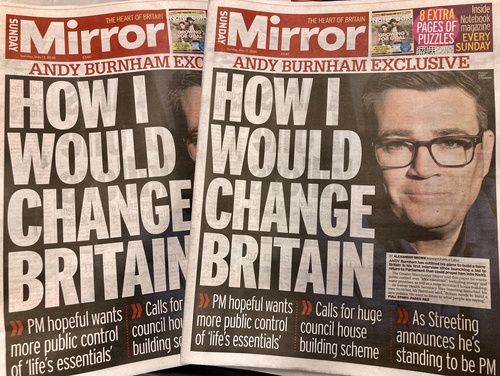
Can Britain’s Next Prime Minister Escape the Net Zero Trap?
Britain has burned through five Prime Ministers and is paying some of the highest electricity prices in the world.
The Scanner at the Gate: Europe’s China Policy Litmus Test
China’s industrial policy is entering Europe through public procurement—and reshaping sensitive markets from within.

Confronting the New Antisemitism
"The postwar effort 'to rebrand Judaism as a religion' has made it impossible for American Jews to understand what they are facing today, because what we are facing today is an attack on the idea of Jewish peoplehood.”
“Democratic” Socialism Is Undemocratic
By promoting class hatred, suppressing private initiative, and seeking enhanced control of our lives, today’s democratic socialists undermine patriotism and individual initiative—two qualities that have long distinguished the United States from other major nations.

