
Will Alberta Leave Canada?

Alberta is Canada’s Texas.
Alberta is Canada’s Texas. Its voters are the country’s most conservative. In the 2015 Canadian general election, 33 of the province’s then 34 constituencies or districts elected a Conservative Member of Parliament. The same tally was repeated in the 2019 general election. In the 2021 general election, it was 30 of 34. And in last year’s general election, which elected the Liberal Party’s Mark Carney as the new Prime Minister, it was still 34 of an expanded total of 37 constituencies or districts that voted Conservative. So while the left-of-center Liberal Party has been Canada’s natural party of government, having governed Canada for over two-thirds of the last century, Alberta has consistently and in large numbers preferred the Conservatives. And while Canadian conservatism is notably less red in tooth and claw than the Texan variant, Alberta is at the far conservative end of Canada’s political spectrum, along with its neighboring province of Saskatchewan.
To generalize, Canadians in the more populous eastern provinces of Ontario and Quebec tend to elect progressive-left Liberal governments, which are then resented in Alberta. Consider the four most recent elections detailed above. Despite being resoundingly rejected in Alberta, the left-leaning Liberal Party won all four of those national elections – the first three under Justin Trudeau and the most recent under Mark Carney. It is hard to think of an American state that has so consistently been at odds with the plurality of voters in the rest of the country.
The comparison with Texas continues because Alberta is an oil-producing powerhouse. The province has just under ten percent of the world’s proven oil reserves and well over 95 percent of Canada’s total. That puts Alberta alone roughly tied with Venezuela for third place in the world’s proven oil reserves. The Oil Sands in Alberta have a lot of oil! That said, Alberta does not produce what it could. At present, it pumps out between five and six million barrels a day, whereas the US produces more than double that amount, at around thirteen million barrels a day, making it the world’s biggest current producer (with Alberta sitting down at about fourth place on this ranking). Why? Well, look no further than the left-leaning federal government in Ottawa. Going back to the early 1970s and the Prime Ministership of Pierre Elliott Trudeau (yes, the father of the more recent Prime Minister Justin Trudeau), the federal government in Ottawa has tried to limit what Alberta can do in the way of selling and producing its oil. The resentment and alienation this western province experiences because of these policies is real. And the tussle over the oil grew considerably worse in 2015 with the election of the Justin Trudeau government.
Trudeau was a fully paid-up climate change exponent. The federal government did what it could to block Alberta’s fossil fuel production. No new pipelines were built to the sea, which put landlocked Alberta in something of a bind. A carbon tax was introduced, and the Supreme Court of Canada (only one of whose nine members is from Alberta) upended most people’s understanding of established federalism-related precedents to uphold this national law, which greatly affects Alberta. The pushback was so great that soon after last year’s election, Prime Minister Carney removed the carbon tax. But he too favors renewable energy and limiting fossil fuel production as much as is electorally possible. So Mr. Carney has found other, indirect ways to limit production. Most obviously, he has forced Alberta to increase the built-in carbon price on oil production, and he has yet to allow any new pipelines to be built. The result is that Alberta can only export its oil southwards into the US.
And that almost brings me to the big issue currently obsessing Albertans, their chance to vote in a referendum this October to leave Canada. Before I get to that, however, I need to give American readers a bit of background. First off, Canada’s federal system is different from America’s. Canada, unlike the US, has a two-list system of powers that separately enumerates the powers of the center and the provinces (rather than a US one-list system, the sort that Australia copied but not Canada). It is also the case that Canada’s constitution gives the center, to Ottawa, the power to appoint all superior court judges. That means that the provinces do not get to choose any of their own Province’s judges above the level of magistrates. Not the voters in the province. Not the elected government of the province. A province like Alberta that has for eons voted consistently conservative nevertheless has a non-conservative, left-leaning government in Ottawa appoint all its judges, from first instance ones right up to the highest judges on the Alberta Court of Appeal. There is no choosing or even vetoes by Alberta’s elected provincial government when it comes to the province’s judges. And given how frequently the left-leaning Liberal party wins in national elections, the result is that most of Alberta’s judges (about 95 percent of the current Court of Appeal) have very different political outlooks from the province’s voters and politicians.
It is also true in Canada that, unlike in the US and Australia, there is no overriding principle that each federal electorate or district should have roughly the same number of voters – no ‘one vote, one value’ or equal-representation principle. Alberta is a loser from this, while many of the smaller provinces are winners. Alberta has 37 seats in the federal lower house, or House of Commons. On an equal representation basis it should be 40. And though the upper house, the Senate, is appointed, not elected – yes, in the year 2026, the Canadian Senate is wholly appointed and has zero democratic legitimacy, hence rarely does all that much – here too, Alberta is a constitutional loser. Canada’s constitution gives each of the four western provinces only six Senators each. Meanwhile, Ontario and Quebec receive 24 each, the balance of the 105-person Senate coming from a few each from the Maritime and northern parts of the country. That means Quebec, with a population of nine million and barely growing, gets four times as many Senators in the Upper House as does Alberta, with a population of five million and expanding big time. Moreover, Canada runs an aggressive system of poor-get-it-not-rich equalization payments to the provinces. This is funded by the center from general tax revenues. Alberta, like its neighbor Saskatchewan, has not received a penny in ages. Last year, Quebec received almost Cdn$14 billion.
I hope this brief sketch has given readers a basic sense of why there is significant disenchantment in Alberta. With the election of Mr. Carney last year, the unhappiness grew to the extent that there were demands for an independence referendum. The Premier of Alberta, Danielle Smith, won office in 2022 by dislodging her party’s right-of-center predecessor over his mishandling of Covid restrictions. He tried to find a middle ground on lockdown. She was in the Ron DeSantis or Sweden-like camp, more favored by the caucus and party membership, and was able to replace him as Premier. She then called the 2023 provincial election and won, albeit with a reduced majority. Two years later, after the 2025 Canadian federal election I noted above, which saw Alberta’s voting preferences yet again have no effect on the result, Smith announced that her government would hold a referendum on Alberta’s separation from Canada if citizens gathered enough signatures to prompt a referendum. And they did. Over 300,000 signatures were collected, easily enough to meet the statutory requirement to hold the referendum.
Now here is where it gets interesting. This referendum result was challenged in the Alberta courts. The case was heard at first instance by a Trudeau-appointed judge, originally from eastern Canada. And very recently, this judge ruled that the referendum could not go ahead because there was some sort of duty to consult the ‘First Nations’ (or native Indian population for Americans). At first sight, admittedly from a distance, this is a very odd decision. A 2018 Supreme Court of Canada case held that the government has no duty to consult Indigenous groups when drafting or passing legislation. Here, there was no guarantee a referendum would lead to legislation (and the duty to consult would not apply to legislation anyway). One would have thought any duty applied to the Executive, not to voters asking for a referendum.
This has all put Premier Smith in a bind. She herself is a federalist, but one who has taken concrete steps to stand up to Ottawa and the federal Liberal government. That said, a significant chunk of her party’s voters, perhaps over half, now want independence. Smith has come out swinging, criticizing the court’s ruling. She has called it ‘undemocratic’. And she has promised to appeal the ruling. But that will not get the referendum onto the ballot for this coming October, when it was supposed to be held.
There is a second route to holding a referendum. Rather than do so under the Citizen Initiative Act via voter signatures, one could be held under the Referendum Act, which is triggered by the Premier and Cabinet. Put more bluntly, Smith could sidestep the whole citizen-driven process and just call the referendum herself. That would also be challenged in court, but most commentators think this route would withstand challenge even from Liberal-appointed judges. (I, personally, would not bet my mortgage on that, such is the state of lawfare in today’s Anglosphere.) One pragmatic reason it would be tricky to block a referendum initiated by the Premier, however, is that twice Quebec Premiers have called referenda to separate, once in 1980 and once in 1995. In neither instance did the courts require consultation with First Nations.
An unintended irony in these recent events is that the court decision has likely increased support for the independence vote, possibly quite noticeably. Premier Smith does not want Alberta to separate. But if she does nothing here, other than to lodge an appeal, no independence question would appear on this October’s ballot. That would infuriate her party’s base, and she knows it. What then did the Alberta Premier decide to do? She has opted to have a referendum question this October, asking if Albertans want a future, binding referendum. In short, ‘Should … the Government of Alberta commence the legal process … to hold a binding provincial referendum on whether or not Alberta should separate from Canada?’
This is a sort of referendum on having a referendum. The Premier’s goal seems to be to keep both the federalists and the separatists in her party satisfied. Well, if not satisfied, then at least something short of apoplectically angry. Basically, she is trying to navigate a camel through the eye of a needle here.
That, as they say, is the fluid, oscillating state of play in Alberta, Canada, now.
James Allan is the Garrick Professor of Law at the University of Queensland.

Politics
%20Richard%20Samuelson%20%20-%20Is%20American%20Nationalism%20Still%20Creed-able_-1.jpg)
Is American Nationalism Still Creed-able?
We are not there now, but there is reason to worry that the United States is in danger, if we are not careful, of ceasing to be a nation with the principles of 1776 at its core.

National Civitas Institute Poll: Americans are Anxious and Frustrated, Creating a Challenging Environment for Leaders
The poll reveals a deeply pessimistic American electorate, with a majority convinced the nation is on the wrong track.
.webp)
%20(1).avif)

.jpg)




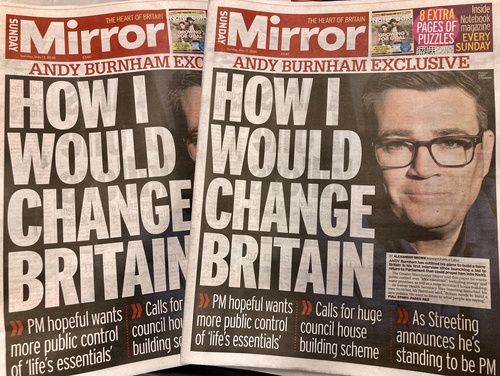
Can Britain’s Next Prime Minister Escape the Net Zero Trap?
Britain has burned through five Prime Ministers and is paying some of the highest electricity prices in the world.

The Scanner at the Gate: Europe’s China Policy Litmus Test
China’s industrial policy is entering Europe through public procurement—and reshaping sensitive markets from within.

Confronting the New Antisemitism
"The postwar effort 'to rebrand Judaism as a religion' has made it impossible for American Jews to understand what they are facing today, because what we are facing today is an attack on the idea of Jewish peoplehood.”
“Democratic” Socialism Is Undemocratic
By promoting class hatred, suppressing private initiative, and seeking enhanced control of our lives, today’s democratic socialists undermine patriotism and individual initiative—two qualities that have long distinguished the United States from other major nations.

