
When Mao Took China

Frank Dikötter’s Red Dawn Over China is a gripping tale of the tragic triumph of Chinese Communism.
Over the past several decades, Frank Dikötter has established himself as the leading Western authority on the history of Chinese Communism. After producing a state-of-the-art account of the horrors of the Great Leap Forward (Mao’s Great Famine, 2010), Dikötter peeled back to examine the Chinese Civil War with his evocatively titled Tragedy of Liberation (2013). He then applied his immense scholarly energy to the wild ructions of Mao’s later years in China’s Cultural Revolution:. A People’s History, 1962-1976 (2016), rounding out a definitive trilogy of China under Mao. Not resting on his laurels, Dikötter next turned his attention to the long, chaotic, and confusing aftermath with China After Mao: Rise of a Superpower (2022). With nowhere left to go in a forward direction, Dikötter has now written a prequel to his other four histories in the murderous saga of Communist China, setting out to explain, in Red Dawn Over China, “how Communism quartered a quarter of humanity” in the first place.
Readers hoping for relief from the darkness in Dikötter’s histories of “mature” Chinese Communism in power will be quickly disappointed. From the first days after the Bolsheviks took power in Russia in 1917, Communists emerged on the scene in China, and violent mayhem ensued wherever they went. Although financed all along by the Communist International in Moscow, the Chinese Communist Party (CCP) funded itself locally through “loot and ransom,” sacking food depots and towns, kidnapping foreigners, and robbing banks. Following party slogans like “Take the Land” and “Kill All Local Tyrants and Local Gentry,” Chinese Communists spent much of the 1920s carrying out what Dikötter calls a “ghastly riot of looting, burning, and killing,” culminating in a reign of Red terror during failed uprisings in Shanghai and Canton in 1927, which were then violently crushed in turn. Other regions through which Communists passed could be recognized by the signature of “burned villages, devastated temples and deserted farms,” with economic activity soon resembling a “lemon[] with all the juice squeezed out.”
How, then, did this destructive movement gain any kind of popular following in China? As in other unfortunate countries where Communist parties made inroads in the twentieth century, such as Russia in 1917 or Yugoslavia and Eastern Europe in 1941-45, Communism thrived on war, chaos, and misery, all of which were already present in China when the CCP was officially founded in 1921. Exploited by the European powers and the U.S. during a near-century of humiliation since the first Opium War of 1839-42 which had undermined the prestige of the Qing Dynasty until it fell in 1912, and invaded by Japan repeatedly in more recent decades, China was enjoying “interesting times,” as in the old curse, fractured, disunited, and ruled, to the extent she was ruled at all, by competing warlords who often committed atrocities no less garish than those of the Communists, who recruited most of their muscle from “bandits and disbanded soldiers.”
The CCP was only one of many armed factions vying for power and influence in China, and as Dikötter exhaustively demonstrates, the Communists were by no means the most important, influential, or popular – especially after the failed uprisings of 1927, which left the party isolated and weak across most of the country, outside of the “Jiangxi Soviet,” a Communist base in southern China comprising perhaps two percent of the country’s land, which endured until 1934. The CCP thrived there, meanwhile, not by improving anyone’s living standards but through ruthless terror and impressment, enrolling boys as young as six years old into their growing Red Army. Even these methods could not save the Soviet when Chiang Kai-Shek’s nationalist army, which had earlier crushed the uprisings in Shanghai and Canton, descended on Jiangxi province in the fall of 1934, ejecting the Red Army and CCP party headquarters.
The “Long March,” which followed, made the reputation of party leader Mao Zedong, furnishing the key legitimating event for Chinese Communism. As Dikötter shows, the real story was far more sordid than the legend. In a sign of the importance of propaganda for the party, Mao forced his foot soldiers to carry a printing press, although it was soon lost, along with most of the 81,000 men who first accompanied him. Their numbers were whittled down to a mere 6,000 by the time the Communists arrived in Shaanxi province, in the northeastern area of China abutting (not accidentally) Mongolia and the Soviet Union, which allowed Mao to regroup and resupply his forces. Significantly, it was only after the Long March was over, in October 1936, that the American journalist Edgar Snow arrived in Mao’s camp and lapped up his stories (Mao, Dikötter informs us, “checked and corrected every word Snow wrote”), introducing Mao to the world (including much of China, where he was still unknown) in his bestselling Red Star Over China, a book which did more for the Chinese Communist cause than anything the Communists did.
The other key catalyst in Mao’s rising fortunes, as Dikötter shows, was the reckless aggression of Imperialist Japan, urged on by the Soviet Union under Stalin. Japanese troops had occupied Manchuria since 1931, but Japan had (mostly) left the rest of China alone until the “Xi’an Incident” of December 1936, when Chiang Kai-Shek was arrested by his subordinates, who wanted to force him into a united front with Mao’s Red Army against Japan. Chiang, viewing the Communists as “stateless, inhumane, devoid of any morality,” wanted to crush Mao’s Red Army before undertaking operations against the Japanese. But the Xi’an incident – especially after Stalin brokered a deal, securing Chiang’s release in exchange for his agreement to leave the Communists alone – made this impossible. Alarmed by the emerging alliance between Moscow, Mao’s Communists, and Chiang’s nationalist armies, Japan invaded mainland China in July 1937, leading to horrific casualties in Shanghai, where Chiang mounted a bitter stand, and the infamous “rape of Nanking” in December 1937. Meanwhile, Mao, despite vows to crush the invader, carefully husbanded his forces instead, explaining to Communist aides that “there must be a difference between what we say we do and what we actually do.” The cynical fake “united front” against Japan served Mao brilliantly until 1945, as Chiang’s nationalist armies bore the brunt of fighting Japan, while Mao established ever-tighter control of the CCP via a “Rectification” campaign purging “spies” and “traitors,” stockpiled Soviet arms, and generally bided his time, waiting for Chiang’s armies to be attrited and weakened enough for his growing Red Army, untouched by Japanese forces, to take Chiang’s nationalists on directly.
Japan’s surrender in 1945 took both Chiang and Mao by surprise. But Mao’s Communists, as Dikötter shows, were better positioned to benefit. Whereas Chiang’s battered regime and exhausted armies tried to govern and rebuild a country devastated by war and inflation, all the Communists had to do was “destroy, sabotage and cripple” China through “pitiless partisan warfare.” Rich, industrialized Manchuria, conquered and looted by Stalin’s armies, which handed over Japanese and Soviet arms to Mao’s men, was the first to fall, its cities surrounded and starved out. Chiang might have had a fighting chance had the U.S. supported him, but instead Washington, where the press corps and statesmen such as General Marshall were in thrall to Communist propaganda, first imposed absurd conditions (e.g., that Chiang not use American funds or weapons to fight back against Mao) and then cut him off entirely – even the Soviets were stepping up their material commitment to Mao and training his armies. The wonder in this wholly one-sided proxy war is not that the Communists won, but that it took them until 1949 to do so.
Dikötter’s tale of the tragic triumph of Chinese Communism is gripping, and his arguments are well formed. Readers might have benefited from more maps to help them follow the story. The “Long March” map (1934-36) is excellent, and there is a decent map of the early second phase of the Civil War from 1947 to 1948, but readers are otherwise left to their own devices as they seek to make sense of the bewildering movements of competing warlords and Communist guerrillas. It would also be helpful to provide readers with a glossary of names, as so many often unfamiliar characters populate the story.
Dikötter, though authoritative on all matters Chinese, is on slightly less sure ground when he discusses Europe. The German Social Democratic Party (SPD) did not renounce revolutionary Marxism after Bismarck’s ban on the party was lifted in 1890, as Dikötter claims – in fact, it doubled down with its Erfurt program of 1891, which became the uncompromising “revolutionary” orthodoxy of the Second Socialist International right up to the First World War; the SPD did not renounce its revolutionary Marxist line until 1959. Nor did the SPD “refuse to hand over power to Soviet-inspired Councils” in Germany in 1918; those councils voluntarily voted not to seize power, but to wait for the “bourgeois” parliamentary elections to be held.
Still, these are mere quibbles in what is otherwise an authoritative and immensely readable history. Having already taught us so much about Chinese Communist history in his previous four books, Dikötter faced a difficult task to add something new. He has done so brilliantly.
Sean McMeekin, a Professor of History at Bard College, is the author of Stalin’s War and To Overthrow the World. The Rise and Fall and Rise of Communism, among other books.

Politics
%20Richard%20Samuelson%20%20-%20Is%20American%20Nationalism%20Still%20Creed-able_-1.jpg)
Is American Nationalism Still Creed-able?
We are not there now, but there is reason to worry that the United States is in danger, if we are not careful, of ceasing to be a nation with the principles of 1776 at its core.
National Civitas Institute Poll: Americans are Anxious and Frustrated, Creating a Challenging Environment for Leaders
The poll reveals a deeply pessimistic American electorate, with a majority convinced the nation is on the wrong track.
.webp)
%20(1).avif)









Can Britain’s Next Prime Minister Escape the Net Zero Trap?
Britain has burned through five Prime Ministers and is paying some of the highest electricity prices in the world.
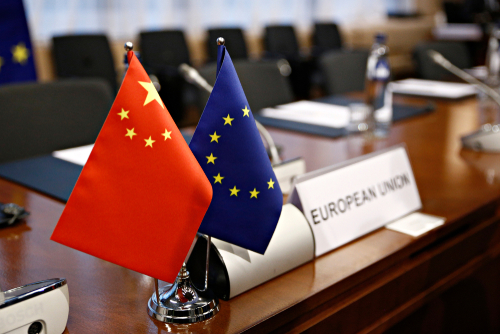
The Scanner at the Gate: Europe’s China Policy Litmus Test
China’s industrial policy is entering Europe through public procurement—and reshaping sensitive markets from within.

Confronting the New Antisemitism
"The postwar effort 'to rebrand Judaism as a religion' has made it impossible for American Jews to understand what they are facing today, because what we are facing today is an attack on the idea of Jewish peoplehood.”

“Democratic” Socialism Is Undemocratic
By promoting class hatred, suppressing private initiative, and seeking enhanced control of our lives, today’s democratic socialists undermine patriotism and individual initiative—two qualities that have long distinguished the United States from other major nations.

