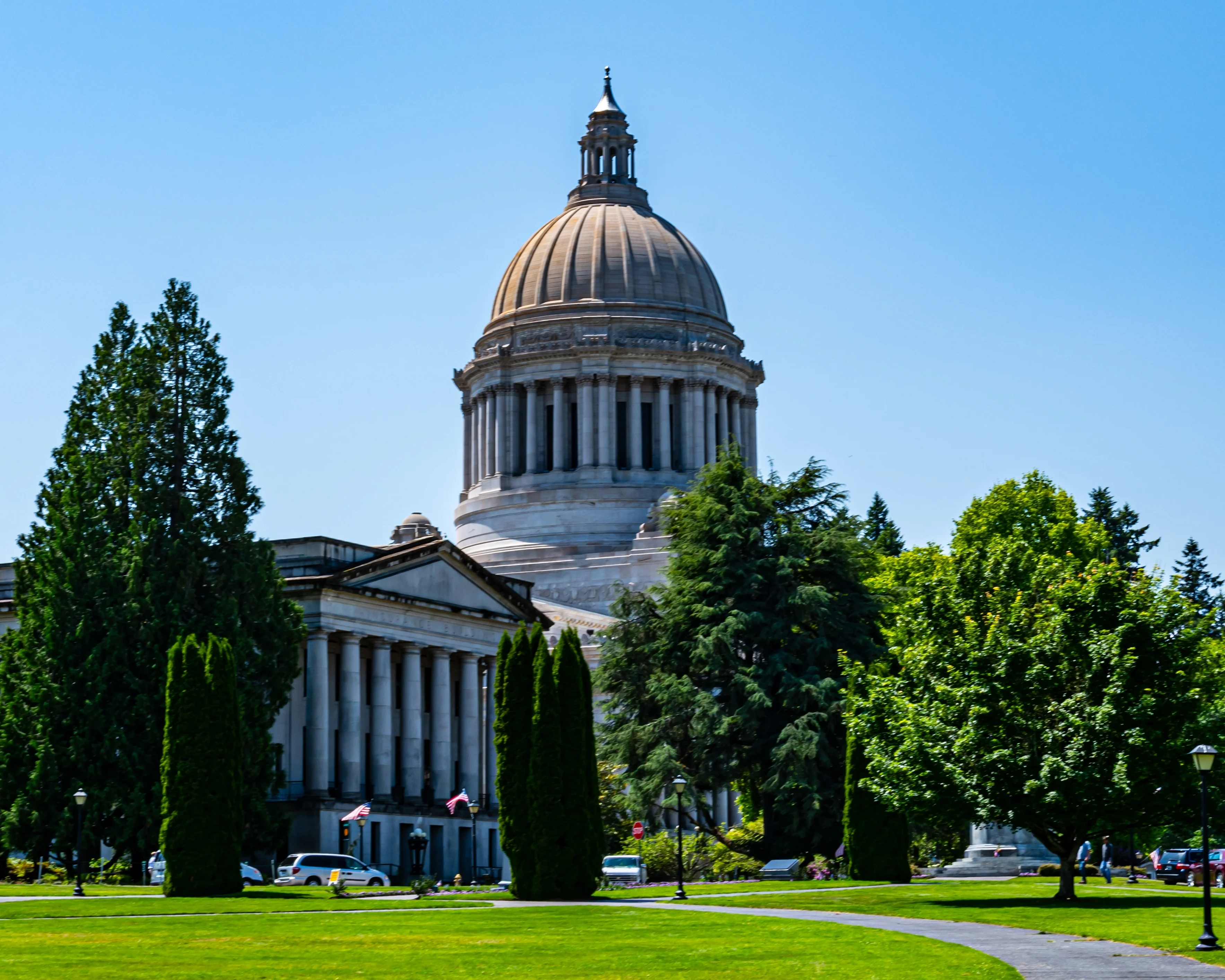
The Partisan Tax Divide Cuts Deeper Than You Think

All states must return to fiscally responsible budgeting as a core principle of government.
A recent article in The Wall Street Journal examined the divergence in tax policies between red and blue states, categorized by the party of the current governor. The general trend finds that states with Democratic governors tend to have higher income taxes than states with Republican governors.
Evidence from Americans voting with their feet shows that people are moving to states with a lower cost of living due to greater economic competitiveness. While many of these are red states, some blue states are also seeing population growth due to neighboring blue states with even higher taxes.
Examining party splits between the legislative and executive branches helps clarify why, in the Journal’s words, “The middle ground is quickly disappearing.” Greater continuous party consolidation within states drives divergence in tax policy.
To raise revenue, blue state policymakers risk shrinking the tax base and pushing the state closer to a fiscal crisis. Red states are also not immune. Without proper institutional constraints, red-state trifectas remain at risk of large liabilities and dependence on federal transfers.
Ultimately, all states must return to fiscally responsible budgeting as a core principle of government.
What Makes a State Competitive? Location Helps
Tax policy plays a large role in where people choose to live. Migration data show that low-tax red states have experienced a massive influx of residents and income from high-tax blue states. California’s proposed wealth tax, despite being opposed by the current governor, has already chased out $27 billion in potential revenue. New York state has consistently lost residents to other states since 2000. The hope that immigration would slow the Empire State’s population decline was dashed due to the nation’s recent “historic decline in immigration.”
Interestingly, some blue states, such as Oregon and Vermont, still attract residents and income fleeing their more expensive neighbors.
This highlights an important nuance: state competitiveness is relative. Despite stringent tax regimes, massive spending, and strict regulations, Oregon and Vermont are seen as relatively affordable options compared to some neighboring states.
Just to the south of Oregon is California, which imposes higher taxes, spending, and regulations than the Beaver State. This allowed Oregon to attract residents and businesses (especially from Northern California) that might find moving to Florida or Texas impractical.
More recently, however, Oregon has experienced net outmigration as it has become less economically free. The Beaver State may hope that Washington’s own tax binge can attract some residents, but that is unlikely when neighboring Idaho and Montana, farther inland, both offer greater economic freedom and opportunity.
Vermont occupies a similar position in New England. It borders New York and Massachusetts, two states that rank poorly in economic competitiveness. While Vermont has a strong competitor to its east, New Hampshire, it still entices people fleeing its high cost neighbors.
The broader implication is that state policy outcomes must be evaluated in context. States can maintain some competitiveness if their neighbors impose higher costs. It helps to be somewhat sane in a neighborhood of insanity. In such cases, geographic advantage can temporarily offset poor fiscal discipline, delaying but not eliminating the inevitable consequences of unsustainable policy.
Party Convergence Leads to Income Tax Policy Divergence
Divergence in state income tax policies reflects a larger political trend. Since 1992, the number of states with a divided government (different parties controlling the legislative and executive branches) has steadily declined. It peaked at 32 states with divided government in 1997; the number hovered around 28 in the early 2000s, then plummeted after the “Red Wave” in the early 2010s.
Democratic trifectas remained in the single digits until 2019, when they rose from 8 to 14, and then surpassed the number of states with divided governments the following year. As of January 2026, 39 states have trifecta governments (23 Republican, 16 Democratic) while only 11 have divided governments. States are currently experiencing historic levels of party consolidation.
Although there is no direct causal link between domestic migration and the rise of trifectas, evidence suggests a relationship exists. Americans are increasingly sorting themselves geographically along political lines, favoring ideologically congenial communities. Population flows tend to reinforce existing partisan strongholds, reducing political diversity and making unified party control more durable. The result is a feedback loop where migration strengthens partisan dominance, enabling policies that attract like-minded residents. Domestic migration is quietly reshaping state-level governance.
Party consolidation shapes policy outcomes. Research shows that states with divided governments often see more ideologically extreme legislators but moderate policies due to institutional constraints. This is a practical application of James Madison’s call for ambition counteracting ambition.
Vermont illustrates this dynamic. Over the past 34 years, Vermont has lived under some form of a divided government aside from brief Democratic Trifectas. Since 2017, Republican Governor Phil Scott has used his position to check tax and spending increases from the Democratic legislature.
In contrast, trifecta governments face fewer internal constraints. Governors and legislatures aligned under one party can enact policies more easily, help explain the acceleration of tax policy divergence.
Bipartisan Spending & the Case for Fiscal Discipline
Blue states pursuing tax increases (whether through new or increased income taxes or wealth taxes) are responding to structural fiscal pressures. After temporary surpluses driven by federal pandemic aid, many of these states now face deficits again. As residents flee, policymakers often raise taxes rather than cut spending.
Unsurprisingly, this means blue states tend to be in the worst fiscal shape, particularly blue states with long-term trifectas. These states often rely more heavily on income taxes (which produce volatile revenue) and accumulate long-term debt and liabilities such as pension obligations.
One election cycle of a trifecta, however, will not make or break a state. The key factor is the duration of unified control. California, New York, New Jersey, Illinois, Massachusetts, Connecticut, Hawaii, and Delaware have held Democratic trifectas for 15-25 years. The duration of continuous, unified government enabled the persistence and expansion of costly institutional commitments and reinforced interest-group coalitions, while the veto constraints that accompany divided government were reduced.
Alternatively, Washington, Colorado, Oregon, and Minnesota have experienced shorter periods of unified Democratic control, limiting the buildup of long-term obligations and leaving room for course correction.
For example, Washington recently enacted a “millionaires’ tax” under a Democratic trifecta despite constitutional and statutory barriers. Almost immediately, the policy was challenged in court. If upheld, it will prompt outmigration and tax bracket creep. If struck down, lawmakers in Olympia will still need to address structural deficits. In either case, spending reductions may have been the simpler solution.
Differences among Republican trifecta states are best understood through fiscal structure. Tennessee, Utah, Nebraska, Idaho, South Dakota, Indiana, and Oklahoma combined their sustained trifecta with relatively constrained spending growth and limited long-term obligations.
Others, including Texas, Alaska, Wyoming, and North Dakota, face higher liabilities due to infrastructure demands, volatility in energy tax revenue, and (in the case of Texas) the complex layering of local government structures, each of which has the power to tax, spend, and take on debt.
Like their blue state counterparts, Red states also heavily rely on federal transfers to fund substantial parts of their budgets. When the federal government must inevitably cut spending (as current trends suggest), states will face difficult tradeoffs of raising taxes, cutting spending, or increasing debt. Such changes could jeopardize the “flat tax revolution” in many states.
The best fiscal strategy is to implement constraints and prioritize core government functions. Two blue states, Colorado and Washington, offer feasible models. The Colorado Taxpayers’ Bill of Rights (TABOR) limits state and local revenue and spending growth by requiring voter approval for tax increases and refunding excess revenue. This amendment was approved by voters in 1992 under a sustained divided government.
In 2002, a Democratic Trifecta (coming off a previously divided government) in Washington, under Governor Gary Locke, enacted the “Priorities of Government” strategy, which ranked programs based on public value and essential government functions. This approach closed a $2.1 billion budget gap, just under $4 billion in current dollars, without raising taxes. This approach was sustained under divided governments in the following years, but slowly dwindled as administrations turned over and Democratic trifectas returned.
Alternatively, an independent commission, similar to the fiscal BRAC model, could propose spending cuts subject to legislative override instead of approval.
Finally, states must end dependence on federal transfers. Utah’s 2013 Financial Ready Utah (passed under a long-term Republican trifecta) provides a model by increasing legislative oversight of federal grants entering the state and requiring agencies to prepare for potential federal cuts.
Conclusion
State tax and spending policies are increasingly driven by partisan control, geographic positioning, and reliance on federal dollars. Party consolidation has widened policy differences, while geographic advantages can temporarily mask unsustainable policy.
Long-term stability demands that states prioritize core government functions, impose fiscal discipline, and reduce dependence on federal transfers. Without these reforms, states remain vulnerable to budget stress, regardless of political leadership.
Thomas Savidge is a Research Fellow at the American Institute for Economic Research. Follow on Twitter/X: @thomas_savidge.

Economic Dynamism


.jpg)


.jpg)





.jpg)

Kevin Warsh and the Future of Fed Communication
Warsh is right that the Federal Reserve should not speak so loudly that it hears only its own echo.

An AI Commencement Address That Might Not Elicit Boos
Someone has to dare to point the path forward in those communities. We need many more Nehemiahs.