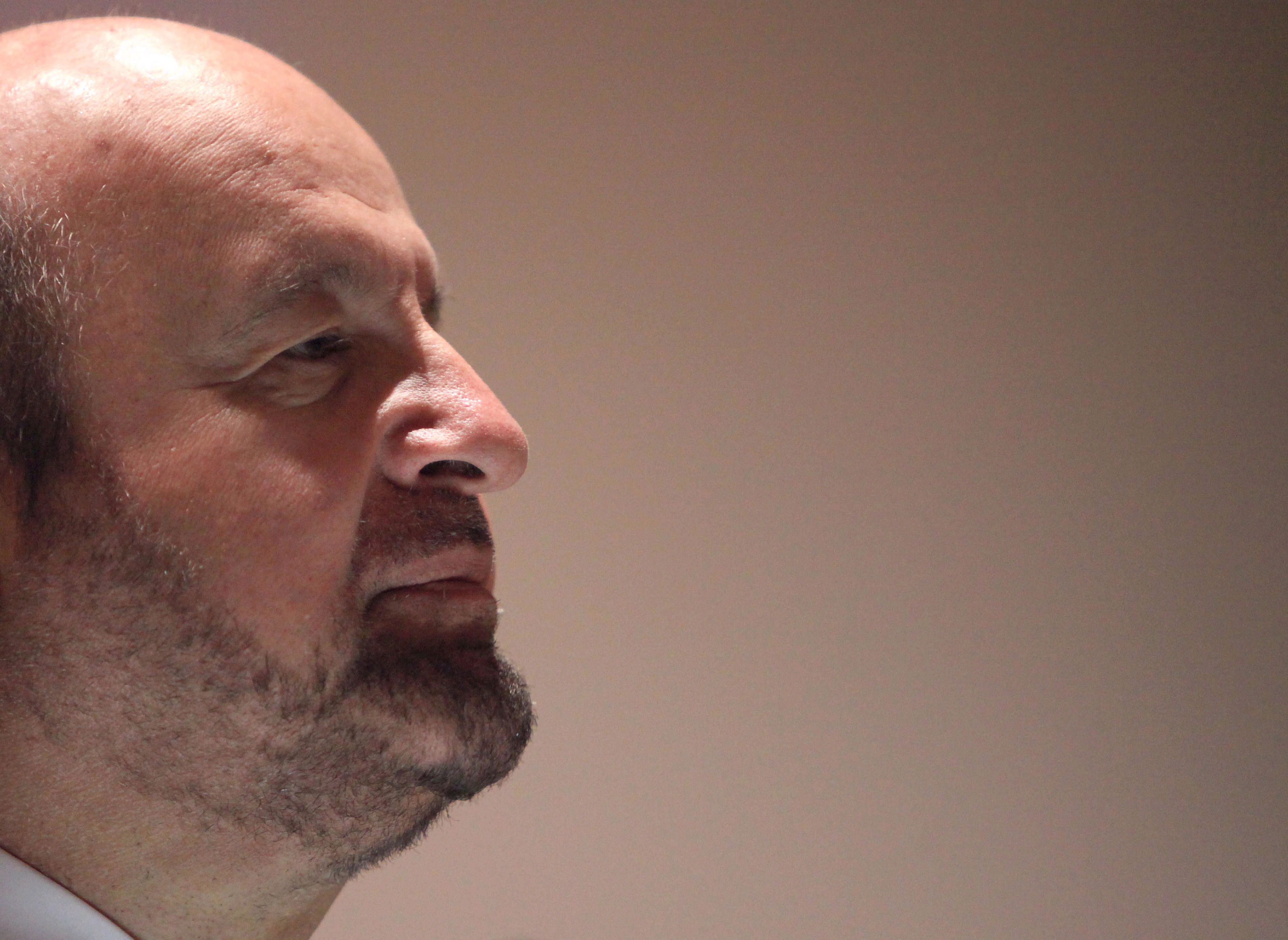
The Economist Who Knew Too Much

Few development economists have had as distinctive a career as Hernando de Soto.
A common belief in politics is that the solution to a country’s economic problems is simply to elect the right leader. If only the right person were in power, prosperity would follow, many think. Peru appeared ready to test that assumption when Marxist President José María Balcázar first announced that Hernando de Soto, one of the most influential development economists of the past half-century, would become prime minister. He then changed his mind days later in favor of Finance Minister Denisse Miralles. Balcázar touted de Soto “to guarantee [Peru's] economic model and ensure that the new president of the republic…has clear guiding principles and no economic shocks,” but likely changed his mind due to political pressure. For decades, de Soto has argued that the binding constraint on development is not geography, culture, or foreign aid, but weak and insecure property rights. By his own research and admission, he finds that solving these problems requires far more than placing the “right guy” in charge.
It is a significant missed opportunity for Peru that Hernando de Soto, one of the world’s most respected development economists, was ultimately passed over for the prime ministership. Few figures have spent as much time diagnosing the country’s structural economic problems or proposing concrete solutions. De Soto has found that institutional failures such as uncertain land titles, fragmented registries, judicial delays, and bureaucratic corruption create systems that resist reform even when leaders recognize the issue. If, de Soto argues, Peru strengthens property rights and formalizes ownership at scale, growth, investment, and upward mobility will follow. Yet the economy remains deeply informal, and the institutions needed to support a functioning property system are fragile, raising the question of whether Peru’s political system is willing to pursue the reforms it will take to put it on a more prosperous development path.
Few development economists have had as distinctive a career as Hernando de Soto. Born in Peru in 1941 and educated in Switzerland, he spent years working in international trade organizations before founding the Institute for Liberty and Democracy in Lima in 1981. His work focuses on the gap between the formal legal economy and the sprawling informal sector that dominates much of the developing world. In Peru, informal vendors, small manufacturers, and homeowners often operate outside the legal system, not because they want to evade the law, but because entering it is prohibitively expensive. De Soto found that legally registering a small garment workshop in Lima required nearly 300 days of bureaucratic procedures and visits to dozens of government offices. Due to these high costs, among many others, most entrepreneurs simply choose to remain informal.
De Soto’s research methods are famously hands-on. Rather than studying economic activity from afar, he and his team often attempted to start businesses, obtain permits, and register property themselves. By navigating the bureaucracy firsthand, they documented how regulatory systems pushed citizens into informality. These observations became the foundation for his influential books The Other Path (1986) and The Mystery of Capital (2000). In the latter, de Soto estimated that informal property owned by the poor in developing countries was roughly $9.3 trillion in untapped capital, far exceeding the total value of foreign aid flowing to those nations at the time. He argued that the problem wasn’t a lack of assets but the absence of legal systems capable of turning those assets into capital.
His ideas gained remarkable international influence. Political leaders across the ideological spectrum sought his advice on how to formalize property and integrate informal economies into legal systems. In Peru, President Alberto Fujimori’s administration adopted elements of de Soto’s proposals in the 1990s, launching a mass land titling program that ultimately provided legal titles to more than 1.2 million households, one of the largest property formalization efforts in the developing world. Governments in Mexico, Egypt, the Philippines, and Tanzania consulted with his Institute for Liberty and Democracy on property-rights reforms. In Egypt, his team estimated that citizens’ informal assets totaled roughly $240 billion, more than 30 times the value of foreign investment on the Cairo stock exchange at the time. Russian President Vladimir Putin also invited de Soto to discuss property-rights reforms during Russia’s transition from state socialism in the early 2000s. Although Russia ultimately pursued a different institutional path, the episode illustrates how widely de Soto’s influence resonated.
At the core of de Soto’s argument is a simple yet powerful insight: wealth in advanced economies is built on legal systems that transform assets into capital. Homes, land, and businesses are recorded in reliable property registries, legally represented through titles and contracts, and embedded in systems that allow them to be sold, collateralized, and leveraged for investment. In many developing economies, by contrast, assets exist outside this formal legal framework. Property records are fragmented across multiple agencies, ownership claims often conflict, and courts can take years to resolve disputes. The result is that assets remain legally insecure and economically “dead,” unable to serve as reliable collateral or attract investment.
For Peru, the implications of de Soto’s ideas are enormous. Despite decades of growth fueled by mining exports, much of the economy remains outside the formal system. In Peru, over 70 percent of workers operate in the informal economy, and the World Bank estimates the informal sector accounts for 20 to 40 percent of GDP, one of the highest levels among major Latin American economies. Land ownership illustrates the problem. Peru has made progress in issuing titles in urban areas, but despite titling efforts, rural property rights remain fragmented. The Inter-American Development Bank estimates that millions of rural land parcels still lack clear legal titles, particularly in the Amazon and Andean regions. Without secure documentation of ownership, farmers cannot use land as collateral for loans, which limits investment in irrigation, machinery, and improved seeds.
Yet de Soto’s work stresses that titles alone are not enough. Property rights only matter when they are embedded in institutions capable of enforcing them. Ownership must be recorded in transparent registries, recognized across agencies, and supported by courts capable of credibly resolving disputes. In Peru, that framework remains weak; for example, enforcing a commercial contract can take more than 400 days through the courts. Regulatory complexity also discourages entrepreneurship, as starting a business still requires navigating multiple procedures across national and municipal agencies. Building a property system investors trust requires issuing titles, but more importantly, it requires a legal infrastructure capable of enforcing them.
Overlaying these institutional weaknesses is Peru’s long-standing struggle with corruption. The extensive Odebrecht bribery scandal, exposed in 2016, revealed that the Brazilian construction firm paid millions of dollars in bribes to Peruvian officials between 2005 and 2014 for infrastructure contracts. The fallout affected almost every recent administration. Former President Alejandro Toledo (2001–2006) was accused of accepting $35 million in bribes linked to the Interoceanic Highway and was eventually extradited from the United States. Former President Ollanta Humala (2011–2016) faced charges related to illegal campaign contributions, while former President Pedro Pablo Kuczynski (2016–2018) resigned amid investigations into payments to his consulting firm. Former President Alan García (1985–1990, 2006–2011) died by suicide in 2019 as police arrived to arrest him over the case. Reflecting these persistent concerns, Transparency International’s 2024 Corruption Perceptions Index ranks Peru 130th out of 180 countries.
These conditions make reform difficult. Bureaucratic complexity often benefits officials who control permits, land records, or regulatory approvals, allowing them to extract rents through discretionary authority. This means simplification and digitization threaten entrenched interests. As public choice economists note, policies with concentrated benefits and dispersed costs are often politically resilient. De Soto’s reform prescription, therefore, goes beyond technical registry changes and includes institutional overhaul. Although very difficult to successfully execute, the potential payoff is substantial. Countries with stronger property rights consistently show higher investment and productivity growth, and research by the World Bank finds that improvements in legal institutions correlate strongly with long-term economic growth.
Latin America offers historical examples of institutional reforms that have reshaped economic trajectories. Chile’s transformation in the mid-1970s is perhaps the most famous case. After years of instability, Chile adopted a series of market-oriented reforms influenced by economists trained at the University of Chicago. These reforms included privatizing state-owned enterprises, liberalizing trade, reforming pensions, and improving protections for private property. Chile’s GDP per capita rose from about $1,400 in 1985 to over $16,000 today in current US dollars, and poverty fell from over 40 percent in the mid1980s to 15 percent by 2009.
Recently, Argentina, under President Javier Milei, has launched another ambitious experiment in market-oriented reform. When Milei took office in late 2023, Argentina faced inflation exceeding 200 percent annually, severe fiscal deficits, and dwindling foreign reserves. His administration implemented aggressive fiscal consolidation and attempted to dismantle layers of regulatory controls. Within his first year, Argentina’s monthly inflation rate fell from around 25 percent in December 2023 to below two percent by October 2025. Financial markets responded positively, with Argentine sovereign bond prices rising as investors anticipated greater fiscal discipline. However, these reforms have not been painless. Argentina experienced a short-term contraction in economic activity, and Milei has faced intense political resistance. Yet early indicators suggest that stabilizing institutions can quickly shift economic expectations and restore investor confidence.
Institutional reform could still unlock a new phase of development in Peru by allowing millions of citizens to convert informal assets into productive capital. Secure property rights would make land and businesses bankable, transparent registries would reduce disputes, and efficient courts would strengthen contract enforcement. None of these reforms require Hernando de Soto to hold office. Peru could still pursue this agenda by adopting the institutional changes he has spent decades advocating.
De Soto has dedicated much of his career diagnosing these institutional failures and proposing a roadmap for fixing them. Even without holding the prime ministership, his ideas remain a blueprint Peru could follow if it is serious about long-term development. If the country were to implement these reforms, it could become a clear demonstration of institutional economics in practice, validating the claim that secure property rights unlock capital and drive growth. If it does not, the obstacle will likely be not a lack of ideas but a lack of political will. In that sense, Peru’s situation highlights a broader lesson: development rarely turns on electing the “right guy” alone; it depends on whether a country is willing to adopt the institutions that make prosperity possible.
Julia R. Cartwright is a Senior Research Fellow in Law and Economics at the American Institute for Economic Research.

Economic Dynamism


.jpg)


.jpg)



.jpg)


Social Mobility Wins
When people live within an environment offering good jobs, good education, social networks, and a culture of self-improvement and hard work, they experience progress in a way that undercuts the philosophical rationale that socialists need to justify the policies they advocate.
Kevin Warsh and the Future of Fed Communication
Warsh is right that the Federal Reserve should not speak so loudly that it hears only its own echo.