Natural Disasters Can Reshape Politics

Now that the folly of California's policies has been made painfully manifest, the question is whether the Golden State will recognize them and change how it does business.
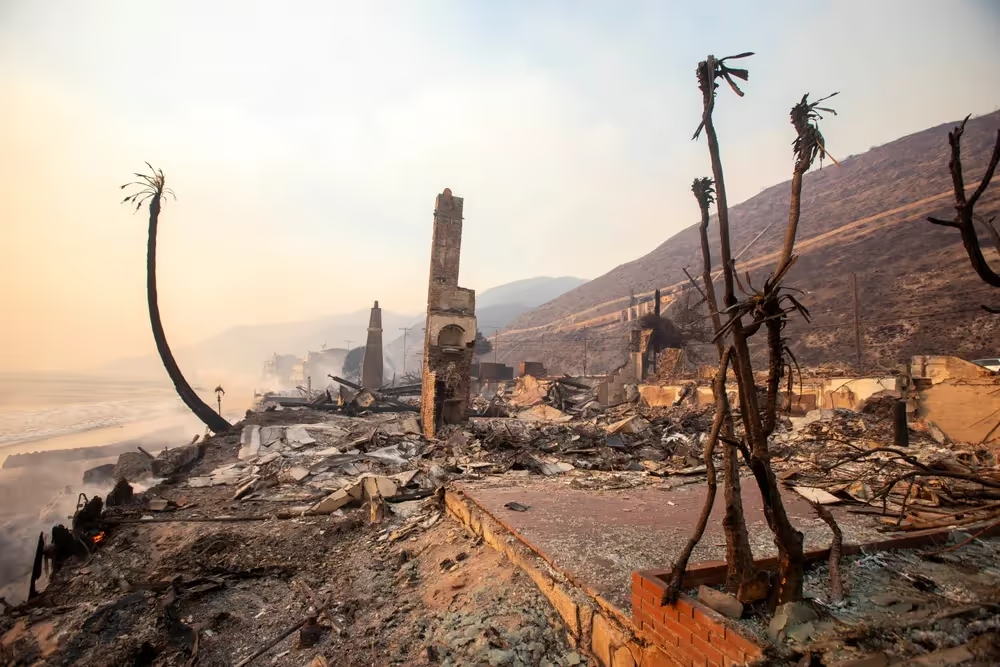
California’s recent wildfires provided a master class on how not to respond to a disaster. They also reminded us that preparing effectively is the most important step in handling a disaster. That didn’t happen.
State and local officials appeared to focus on politics instead of priorities. They hired firefighters based on demographic characteristics rather than skill in fighting fires. They focused on environmental groups’ interests instead of ensuring access to water resources. They failed to clear brush with controlled burns, which let the fires surge out of control. Then, there was hyperregulation in the insurance industry, meaning homeowners had no options for insuring their homes. Even as the fire season loomed, Governor Gavin Newsom designed $50 million for performative legal battles with the new administration rather than serving the citizenry's needs.
These flaws, touching many sectors of California life, stemmed from strident progressivism that put ideology ahead of the basic blocking and tackling of governing. Now that the folly of these policies has been made painfully manifest, the question is whether the Golden State will recognize them and change how it does business.
To answer this question, it is helpful to look at history and whether disasters lead to real change or whether government leaders kept stumbling along without improving. As it turns out, some of our nation’s worst disasters have led to needed changes.
In 1969, Hurricane Camille made landfall in Mississippi, killing more than 250 people. Richard Nixon was president then, and he got the federal government more involved than was typical in natural disasters up to that point. According to Nixon, Camille was “probably the worst natural disaster we have had in the century.” He sent 16,500 military personnel to help deal with the crisis and Vice President Spiro Agnew to see what was happening.
In response to Agnew’s report, which indicated citizens' inability to gauge the severity of incoming hurricanes, Nixon requested federal officials develop an improved weather forecasting system. In response, National Hurricane Center Director Robert Simpson and a consultant named Herbert Saffir developed the five-tier hurricane ranking category still in use today.
Another improvement can be seen in looking at C-SPAN footage of how the U.S., particularly FEMA, has handled hurricanes over the years. If you look at the FEMA operations center that George H.W. Bush visited during 1992‘s Hurricane Andrew, it was a relatively primitive operation where employees wielded corded telephones, notepads, and pencils to take down information. Today, FEMA operation centers are much more high-tech, using cell phones, social media, and detailed maps to report where assets are deployed and where the needs in the community are.
But while technological progress is helpful, human leadership and preparation are still vital.
In the wake of the horrific 9/11 Islamist terror attacks on the World Trade Center and the Pentagon, the nation was reminded how fragile our complex society and economy are. The crisis forced America to rethink its airport security system and re-orient government toward the challenge of terrorist attacks. Under the leadership of George W. Bush, the federal government created the Department of Homeland Security, which consolidated multiple agencies from different places within the government under one umbrella in a single cabinet department with an overarching mission of protecting the U.S. from future terrorist attacks.
Americans also had to get used to more invasive security machines and not just at airports. Entering almost any large building in New York, Washington DC, or Los Angeles now requires people to show IDs as they enter (raising the question of why there is no similar nationwide requirement for voting, but that’s the subject of a different article). While the airport experience is now much more invasive and much less pleasant, we have not had a major terrorist attack in the U.S. anywhere near the scale of 9/11 in these last two decades.
Another big change in the wake of a Bush-era disaster took place in New Orleans after Hurricane Katrina. The city, the state, and the federal government seemed willing to reevaluate how things were done after that disaster, and we have seen some significant changes since then. The levees are now in far better shape, the schools are now largely charter schools and getting better results, the number of murders is down significantly, and the population is approaching where it stood before the storm.
The U.S. faced another major crisis with the advent of the COVID-19 pandemic in 2019 and 2020. Unfortunately, the government’s response in this instance was wanting, and the so-called experts made a host of mistakes that eroded the fundamental trust of the people. The good news was that the creation of the coronavirus vaccine via Operation Warp Speed took place in record time, raising hopes that we could produce faster mRNA vaccines in the face of future pandemics. Unfortunately, the heavy-handed approach that the government took to requiring vaccinations meant that skepticism about vaccine usage increased rather than decreased, which was an unfortunate byproduct. In addition, the way that the government mishandled the mask situation, initially telling people that masks were not required, then mandating them, even in outdoor settings, where they should not have been required, led to additional skepticism and mistrust. Because there has been no accountability, it is not clear that the Covid response has led to cultural or political improvements that will make us more capable of facing future pandemics.
This mixed historical record shows that change is possible in the wake of disasters, but it does not happen as a matter of course. Governments must come to grips with what worked and what did not and then take concerted action to make the necessary improvements, something we have seen in Florida with Ron DeSantis’ efforts to make his state best in class regarding disaster response. DeSantis, however, may be an exception. While change is often necessary, we cannot assume that needed changes are coming.
Of course, at the heart of this question is whether California is willing to make changes to see better results in the future. In this, there is an unfortunate cause for skepticism. California’s stubborn progressivism and general resistance to change reminded one of the old joke about how many psychologists it takes to change a lightbulb. The answer is one, but the lightbulb really wants to be changed.
Tevi Troy, a senior fellow at the Ronald Reagan Institute and former senior White House aide, is the author of five books on the presidency, most recently The Power and the Money: The Epic Clashes Between Commanders in Chief and Titans of Industry.

Politics
%20Richard%20Samuelson%20%20-%20Is%20American%20Nationalism%20Still%20Creed-able_-1.jpg)
Is American Nationalism Still Creed-able?
We are not there now, but there is reason to worry that the United States is in danger, if we are not careful, of ceasing to be a nation with the principles of 1776 at its core.
National Civitas Institute Poll: Americans are Anxious and Frustrated, Creating a Challenging Environment for Leaders
The poll reveals a deeply pessimistic American electorate, with a majority convinced the nation is on the wrong track.
.webp)
%20(1).avif)


Confronting the New Antisemitism
"The postwar effort 'to rebrand Judaism as a religion' has made it impossible for American Jews to understand what they are facing today, because what we are facing today is an attack on the idea of Jewish peoplehood.”
“Democratic” Socialism Is Undemocratic
By promoting class hatred, suppressing private initiative, and seeking enhanced control of our lives, today’s democratic socialists undermine patriotism and individual initiative—two qualities that have long distinguished the United States from other major nations.