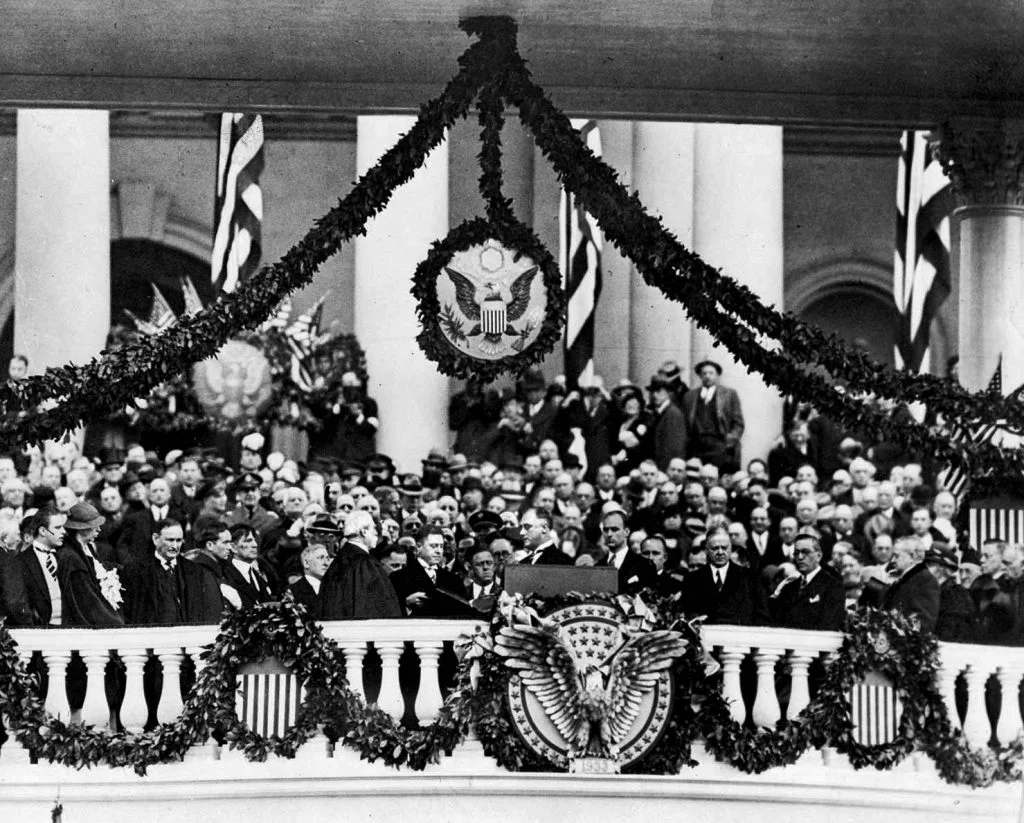
How FDR’s Bold Experimentation Blinkered the American Economy

The question is not whether the New Deal did things; it did. The question is whether those things restored a self-sustaining private economy.
There is a standard narrative of the New Deal, one that is universally understood and taught in schools. One textbook, The New Deal Era: 1933-1940, by Jim Ross-Nazal, puts it this way:
[After his election] President Franklin Delano Roosevelt went to work to bring immediate relief, long-term recovery and to save capitalism. In the first 100 days, President Roosevelt helped create relief opportunities to include the CCC, FERA, AAA, TVA, NRA, PWA, and HOLA.
It’s true enough that FDR took office in a storm. Banks were failing, output had collapsed, and mass unemployment had discredited not just the GOP or Hoover but (many feared) capitalism itself. What followed was the most ambitious burst of American domestic statecraft in a generation: “bold, persistent experimentation,” a swarm of new agencies, new rules, new taxes, new labor regimes, new monetary arrangements — an administration that seemed determined to fight the Depression with every tool a modern government could invent.
But things didn’t get much better. In fact, after 1936, things got much worse, and fast. If FDR was capitalism’s savior, how come it didn’t get saved? And why didn’t capitalism need a savior before, or after, the Great Depression? What was the cause, and what was the effect, in this turbulent period?
That is the mystery George Selgin sets out to solve in False Dawn: The New Deal and the Promise of Recovery, 1933–1947 (University of Chicago Press, 2025). If the New Deal was as energetic, as innovative, and as morally urgent as its admirers insist, why did recovery remain so halting, and why did the United States lag other industrial nations in returning to normal? Selgin’s answer is as bracing as it is carefully assembled: the Depression dragged on not in spite of FDR’s efforts, but precisely because of them. The New Deal’s shifting mix of “bold experimentation” — regulatory interventions, threats, unexplained reversals, and tax law experiments — produced deep policy uncertainty and discouraged the private investment needed for durable recovery.
Government programs target proximate goals: output, or jobs, or agricultural prices (up is good), or housing prices (down is good). A virtue of False Dawn is Selgin’s refusal to equate any proximate goal with the actual goal, “recovery,” or returning to something like full use of labor and capital. That sounds obvious, but it matters: relief work, cartelized output at higher prices, and wartime mobilization raised all measured activity while leaving the underlying economy distorted, fragile, and unproductive. As the Hayek character said in the famed “rap battle” with Keynes:
Creating employment’s a straightforward craft
When the nation’s at war, and there’s a draft
If every worker was staffed in the army and fleet
We’d be at full employment with nothing to eat
The question is not whether the New Deal did things; it did. The question is whether those things restored a self-sustaining private economy. They did not.
The table of contents signals what kind of book this is going to be: not a sweeping narrative biography of the Roosevelt years, but a systematic audit of the major recovery-relevant interventions, from banking to agriculture to industrial policy to fiscal and monetary debates, and then into the wartime/postwar transition.
- Part I (Groundwork) covers the record, the banking crisis, the bank holiday, deposit insurance, the RFC, and the gold story.
- Part II (The New Deal) moves through the AAA, the NRA (and the Brookings report), housing policy, the RFC again, “fiscal stimulus?”, the Fed, and then the mid-1930s turning points, especially the 1937–38 relapse and the “Keynesian myth” debates.
- Part III (After the New Deal) asks what changed during and after WWII, including the “phantom depression,” labor-market dynamics after demobilization, postwar monetary policy, and what Selgin calls the “Great Rapprochement.”
This structure is one of the book’s strengths: it lets Selgin separate what helped from what hurt, instead of treating “the New Deal” as a single undifferentiated blob. As noted above, the New Deal did things, a lot of things, and no Manichean account, whether taking the good or evil perspective, can do the New Deal justice. False Dawn is not a caricature or polemic; it does not depict every New Deal action as folly.
Still, the cumulative picture of even the most fair-minded tally of successes and failures is starkly negative: by any sensible standard, including its own stated goals, the New Deal was disastrous. The most defensible steps (bank holiday, suspending gold, guaranteeing deposit insurance) came early, while all of the later Rube Goldberg architecture — industrial cartelization under the NRA, agricultural restrictions and price controls under the AAA, and labor-policy shifts — worked by restricting supply or raising costs, thereby impeding recovery.
The most persuasive part of the book is the central claim: the decisive and durable drag on recovery was not a single policy error but a regime, an identifiable pattern of rules, threats, constant reversals, and ad hoc experimentation that left investors unsure what even the near-term rules of the game would be. A standard rule of tax policy is that the best policy is whatever we have right now, because those values and those incentives are “priced in.” A change in tax policy, or for that matter, in regulatory standards or subsidies for agriculture, have complicated effects, but businesses can adjust to them.
What cannot be adjusted to or capitalized is the unknown. If I know now what taxes will be next year, it may be expensive, but I can plan. If taxes are changing and will soon change again, I have to put off investing or choose some other activity to try to earn a return. Uncertainty is far worse than a misguided, but stable and predictable policy.
This “regime uncertainty” lens, originating in part in work by Robert Higgs, pierces through the murk of the supposed paradox of the New Deal’s frenzied activity and failure to achieve its ends. If firms expect that property rights, pricing rules, union power, antitrust posture, tax treatment of retained earnings, and the legitimacy of profits themselves are all politically unstable, then waiting becomes the only rational course of action. Capital formation is the most forward-looking activity in a market economy, because it requires costs now to obtain returns in an uncertain future. When the government intentionally makes the future impossible to foresee, investment stalls. According to David Beito, in his book FDR: A New Political Life, the business reaction to the New Deal may have been the closest thing we have seen to an Ayn Rand-style “capital strike.”
This is rather far from “bring immediate relief, long-term recovery and save capitalism.” In fact, the New Deal was never a heroic rescue that mysteriously failed; instead, the New Deal extended and deepened a garden-variety downturn into the “Great Depression”, by imposing a sequence of interventions that repeatedly substituted administrative improvisation for predictable governance — and thereby delayed the private-sector resurgence that could have made recovery durable.
This conclusion comports with some earlier work, of course, especially Amity Shlaes’s wonderful book, The Forgotten Man. Shlaes is, above all, a narrative historian of politics, personalities, and the lived experience of policy in motion. Selgin is closer to an economic historian-auditor, moving program by program, metric by metric, adjudicating claims against the research record. One can read Shlaes to get a feel for how improvisational power worked day to day; one can read Selgin to understand how those improvisations affected economic targets, investment incentives, and the economy’s capacity to heal.
In fact, the two books complement each other admirably: where Shlaes wrote a political history that uncovers conversations and highlights the importance of personalities and arrogance in the New Deal, Selgin has produced a meticulous and comprehensive catalogue of the specific economic policies and their effects. In an area often dominated by ideology and polemic, this careful and detailed registry of government actions is strikingly effective.
Selgin’s emphasis is on causal channels and mechanisms, rather than outcomes or stated intentions. Selgin does not merely say “recovery was slow”; he asks why particular programs would affect output, employment, prices, and investment. That’s why the book reads like an empirical brief rather than a mood piece. As I discussed at the outset, the focus on “recovery,” the central but also most elusive New Deal goal, allows for identifying successes and what seemed, at the time, like achievements, while keeping the Archimedean point of economic success in the foreground.
Of course, the virtue of Selgin’s book may also seem to be its central flaw. The (comparatively) narrow focus invites at least one predictable complaint: by bracketing relief and reform, he makes no attempt to assess the New Deal’s overall legacy — only its (non)delivery on its promise of recovery. That is a reasonable boundary, but it means that defenders of the New Deal can reply that it was the appearance of strong action and vigorous leadership that saved the country from revolution.
That question, of the counterfactual, is endlessly fascinating and hard to assess. As Shlaes notes in Forgotten Man, Hoover was far from inactive in the period after the Great Crash in October 1929 and FDR’s inauguration. But Hoover, for reasons Shlaes explains in some detail, took pains to disguise this activism, even as he meddled furiously behind the scenes. That is, I think, the best answer to the claim that “relief mattered,” in terms of perception. Hoover's policies and actions were not all that different from FDR's; what differed was public perception of engagement. And while that may have mattered politically, Selgin shows that there was no particular improvement in the Roosevelt version of economic dirigisme. To put it more simply, Roosevelt was in many ways a continuation and expansion of Hoover’s desperate lever-pulling, and the continuation of economic malaise is therefore hardly surprising.
Overall, False Dawn is a disciplined, evidence-heavy challenge to the New Deal’s most self-flattering myth: that bold experimentation rescued the American economy. Selgin’s alternative story is more unsettling — and, in its own way, more respectful of the market order’s logic. Recovery requires more than motion; it requires a credible expectation that the rules tomorrow will not punish or obliterate the investments made today. On Selgin’s telling, the New Deal repeatedly and in many cases intentionally undermined such expectations, and the result was a lost decade. This happened not because the government did too little, and ultimately not even because it did too much, but because policy-makers themselves showed a misplaced self-assurance and desperate, chaotic energy that destroyed confidence and held back the dawn.
Michael Munger is Professor of Political Science and Economics at Duke University. His research focuses on the relations between political and commercial institutions.

Politics
%20Richard%20Samuelson%20%20-%20Is%20American%20Nationalism%20Still%20Creed-able_-1.jpg)
Is American Nationalism Still Creed-able?
We are not there now, but there is reason to worry that the United States is in danger, if we are not careful, of ceasing to be a nation with the principles of 1776 at its core.

National Civitas Institute Poll: Americans are Anxious and Frustrated, Creating a Challenging Environment for Leaders
The poll reveals a deeply pessimistic American electorate, with a majority convinced the nation is on the wrong track.
.webp)
%20(1).avif)


Immigration Alone Won't Solve Canada's Population Decline
Rather than looking abroad for solutions, we should ensure young Canadians have a hopeful future
The G7 Is Failing To Address Global Imbalances
The G7 was not created to issue an endless procession of carefully calibrated communiqués.


Can Britain’s Next Prime Minister Escape the Net Zero Trap?
Britain has burned through five Prime Ministers and is paying some of the highest electricity prices in the world.

The Scanner at the Gate: Europe’s China Policy Litmus Test
China’s industrial policy is entering Europe through public procurement—and reshaping sensitive markets from within.

Confronting the New Antisemitism
"The postwar effort 'to rebrand Judaism as a religion' has made it impossible for American Jews to understand what they are facing today, because what we are facing today is an attack on the idea of Jewish peoplehood.”
“Democratic” Socialism Is Undemocratic
By promoting class hatred, suppressing private initiative, and seeking enhanced control of our lives, today’s democratic socialists undermine patriotism and individual initiative—two qualities that have long distinguished the United States from other major nations.

