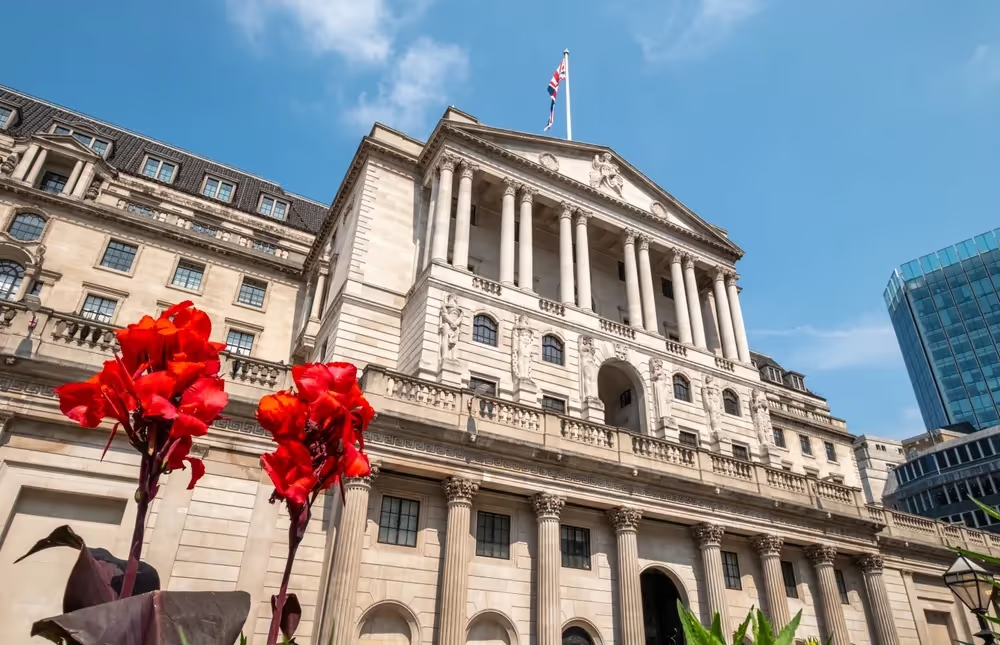
From Buenos Aires to London: Not All Bailouts Are Created Equal

America's effectual bailout of Argentina raises the question: When is a bailout a good idea?
The U.S. recently committed to provide twenty (and as much as forty) billion dollars in “reserves” for Argentina. It’s actually a currency swap, but everyone recognizes it as a bailout. Is that a good idea?
The problem is that all “bailouts” are not created equal. One hundred and fifty years ago, Walter Bagehot established when a bailout is effective, and when it is disastrous. Bagehot predicted (correctly) that politicians and finance insiders would dismiss his solution to the problem. And it’s still being debated, in spite — perhaps because? — of the fact that it is correct.
Born in 1826 in Somerset, England, Bagehot studied moral philosophy at University College London and trained briefly in law, pivoting quickly to history and political theory. As editor of The Economist, he expanded the publication into what it is today. But mostly he was a successful banker and financier in “The City,” London’s financial district.
Britain’s financial system was vulnerable to panics, in which depositors’ fears led to bank runs. But runs were more often about illiquidity than insolvency; even technically solvent institutions failed if they ran out of cash. The Bank of England could provide liquidity because it (alone) could issue notes backed by gold reserves.
Bagehot believed — following John Stuart Mill — that markets were self-correcting, so insolvent firms must be allowed to fail. But he also recognized that financial markets were uniquely susceptible to herd behavior. Consequently, the central bank must not make good the losses of the profligate, but must always stand ready to prevent the needless destruction of credit for the prudent.
Bagehot had trouble getting anyone to listen, and then the 1866 Panic made him want to write things down. So between 1870 and 1872, he wrote a short book that gave “a description of the money market,” the subtitle of Lombard Street, when it was published in 1873. The book is one of the best and earliest examples of the method later espoused by Ronald Coase: “I’d like to see people go study how things actually work. Then you would learn something.”
Bagehot’s goal was to oblige the Bank to take a clear public position as the “lender of last resort.” (The LOLR phrase is modern, never appearing in the book, but it captures well the intention of the proposal.) Further, and again in modern terms, Bagehot wanted to manage expectations, to avoid both Type I and Type II errors: the Bank would never, or always, make advances or loans, depending on clear criteria. This approach would prevent avoidable panics, because everyone knew a bailout was coming, and favoritism and corruption, because everyone knew that even strong political connections could not “buy” a bailout for the undeserving.
In Chapter VII, he writes that “the Bank has never by any corporate act or authorised utterance acknowledged the duty” to hold and use the nation’s cash reserve in a panic. In the same chapter, he reproduces the Bank Governor’s account of the May 1966 “Overend crisis”: “when… it became known that the house of Overend and Co. had failed,” the Bank “made advances which would hardly be credited” to “support the banking community”— evidence Bagehot mines to codify consistent rules for such moments. He is outraged that, because of political influence, Overend was bailed out, since their “losses were made in a manner so reckless and so foolish, that one would think a child who had lent money in the City of London would have lent it better.”
On the other hand, there had been times when the Bank not only failed to act but also hadn’t even stated a clear guiding principle.
[T]hough the Bank of England certainly do make great advances in time of panic, yet as they do not do so on any distinct principle, they naturally do it hesitatingly, reluctantly, and with misgiving. In 1847, even in 1866 — the latest panic, and the one in which on the whole the Bank acted the best — there was nevertheless an instant when it was believed the Bank would not advance [reserves], or at least hesitated to advance… The moment this was reported in the City and telegraphed to the country, it made the panic indefinitely worse. In fact, to make large advances in this faltering way is to incur the evil of making them without obtaining the advantage.
Bagehot uses this example to show that the Bank had wasted money on trying to support Overend, which was in fact insolvent, and then failed to support the fully solvent but temporarily illiquid firms of the City. The combination of errors made 1866 far worse than necessary: the Bank poured in massive reserves, after otherwise solvent firms had been needlessly ruined.
His solution anticipates Milton Friedman’s later push for “rules” rather than “discretion.” Bagehot frames his purpose as showing the danger of entrusting the reserve to the discretion of a single board, and argues for a clearly stated and binding crisis policy.
I shall have failed in my purpose if I have not proved that the system of entrusting all our reserve to a single board, like that of the Bank directors, is very anomalous; that it is very dangerous; that its bad consequences, though much felt, have not been fully seen; that they have been obscured by traditional arguments and hidden in the dust of ancient controversies.
The goal of Lombard Street, then, was to take stock, after years of observing and writing amid repeated panics — especially, but hardly only, 1866 — regarding how the money market actually functions. From those observations, Bagehot stated, plainly and with examples, the Bank of England’s responsibilities in a panic. That responsibility had four aspects.
Lend Freely: “The holders of the cash reserve must be ready not only to keep it for their own liabilities, but to advance it most freely for the liabilities of others.
On Short Terms: [When this dictum was followed, in 1825]: “After a day or two of this treatment, the entire panic subsided, and the ‘City’ was quite calm.”
Only Lend on Good Collateral: “[The Bank] must lend to merchants, to minor bankers, to ‘this man and that man,’ whenever the security is good. In wild periods of alarm, one failure makes many…”
At Penalty Rates: “Very large loans at very high rates are the best remedy…” Bagehot’s dictum, then, can be stated simply:
Lend freely, on short terms, on good collateral, and at penalty rates. No long-term, low-rate bailouts will ever be made, so don’t ask.
Announcing and then carefully following this dictum solved both problems that had plagued the bank. The first problem was the vagueness and discretionary nature of spending the reserve: firms that took large risks believed there was some chance they would be rescued. This creates what’s known as “moral hazard,” or the choice of more risk because another party pays the costs of failure. And charging a “penalty” rate gives firms every reason to seek private financing first, before resorting to “the lender of last resort.” Bagehot’s dictum indeed robs the Bank of the discretion to act if there is a significant failure, but in the absence of moral hazard such failures are much less likely in the first place. Prevention is much less costly than any attempt to cure, after the fact.
The second problem was the uncertainty about whether the Bank would step in during a liquidity crisis. The lack of a clear standard and dithering about the decision behind closed doors meant that bank runs could be started and likely have proceeded quite far before the Bank belatedly acted. At that point, very substantial amounts of reserves would have to be committed because the fear of being unable to cash out one’s position caused panic. If the Bank stated the commitment to act, and acted, then depositors and creditors are satisfied not to demand settlement in the first place.
The genius of Bagehot’s dictum, then, is that it deterred excessively risky positions, while ending simple panics before they even happened.
Bagehot’s principles have endured as the foundation of crisis management for central banks worldwide. During the 2008 global financial crisis, Bagehot’s name was often explicitly invoked, though in practice his strict conditions were less frequently followed — especially regarding collateral quality and penalty rates.
Right now, many people are looking at the Argentina deal. Some have praised the bailout, while rather more have decried it, because “bailouts are bad.” But Bagehot’s insight was to show that not all bailouts are the same: it’s not just about the deal itself, but what Argentina does with the reserves that matters.
In previous crises, Argentina has poured money into insolvent firms, to help political cronies reduce losses. But it doesn’t have to be that way. The funds could be used to expand liquidity and unlock exchange markets while allowing large, powerful firms to fail. That won’t be easy, politically, but economically it’s imperative. Further, there are strong reasons to support Argentina if the policies of the Milei government (now newly reelected) continue to lead to economic success.
The actual policy has yet to be determined. Bagehot is watching.
Michael Munger is Professor of Political Science and Economics at Duke University. His research focuses on the relations between political and commercial institutions.

Economic Dynamism


.jpg)


.jpg)


.jpg)


Social Mobility Wins
When people live within an environment offering good jobs, good education, social networks, and a culture of self-improvement and hard work, they experience progress in a way that undercuts the philosophical rationale that socialists need to justify the policies they advocate.
Kevin Warsh and the Future of Fed Communication
Warsh is right that the Federal Reserve should not speak so loudly that it hears only its own echo.