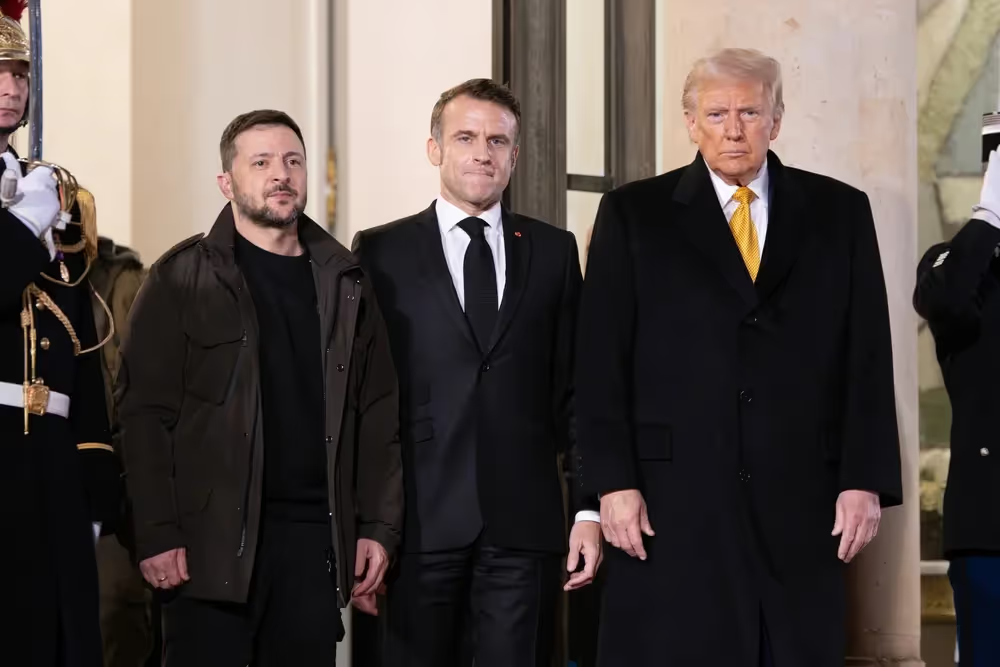
Ukraine's Cause Can Be Vindicated

By playing into Putin’s hands with the current ceasefire, we are setting the stage for future aggression in Eastern Europe.
The American public has been led to believe by a cadre of officials and journalists that the war in Ukraine has become an unwinnable stalemate that will either result in the loss of further territory or persist indefinitely as a bloody grind. By subsidizing this grind, the United States is depleting (evidently scarce) resources, prolonging unnecessary bloodshed, risking nuclear war, and distracting itself from more important conflicts on the horizon in East Asia. Accordingly, we must end the war as soon as possible by pushing for a ceasefire that Ukraine itself does not want. To force compliance, we must threaten to turn off aid and possibly abandon Ukraine entirely to its arms and those of the Europeans.
This assessment is not without merit. That the war has become a stalemate is unobjectionable; the lines have remained stable for two years. Moreover, if we are indeed in a global contest against an anti-liberal axis of totalitarianism, it is crucial that Europe step up as strong partners capable of shouldering the burden of global conflict.
But it is wrong to imply that Ukraine cannot be placed in a better negotiating position and even more so that the Ukrainians and Europeans are capable of thwarting Putin should the conflict end today. We should welcome a rearmed and revived Europe, but our allies in the Old World are not now that strength that once moved earth and heaven. Instead of pursuing an unsustainable peace, the United States must continue to support Ukraine until the Ukrainians liberate more territory, thereby putting them in a position of strength.
The United States Can Help
It perfectly aligns with the national interest and is true to American values to help Ukraine recover as much of its conquered territory as possible and retain its sovereignty as a democratic nation. Let there be no doubt: Russia is an adversary, working closely with our most dangerous competitor to upend the American-led international order. This order has served us well for four generations. By playing into Putin’s hands with the current ceasefire, we are setting the stage for future aggression in Eastern Europe. Worse, we signal to China a lack of resolve that will make the world (to say nothing of East Asia) more dangerous. A premature peace is little more than an invitation for future chaos.
A common refrain among those seeking appeasement is that the US cannot afford to keep aiding Ukraine because we have serious economic problems at home, including a 30 trillion-dollar debt. However, to aid Ukraine, we need not rely on cutting a 60 billion-dollar check every eight months; free money and weapons are far from the only policy levers available. We are granting loans to the Ukrainians with generous terms—we allowed the British 65 years to pay back their WWII loans. Should this be considered overly generous, there remains over 300 billion dollars in frozen Russian assets held by the United States and the European Union. This sum could greatly benefit the Ukrainians; over three years, it has received just over half that amount from the United States. Strangely, only recently have the allies begun using the interest of these assets to support Ukraine. The US should press for this sum to be sent to the Ukrainian war effort.
Similarly, the US is not handicapped by continuing to send arms to Ukraine. To be sure, Russia’s invasion revealed startling inadequacies in the US defense industrial base. But it also forced the US to revitalize production and increase investment in arms production, thereby driving down costs. As one writer points out, favorite items used by Ukraine (such as 155mm shells) are now slated to be produced at a rate six times that before the war. Enhancing production extends to more lethal equipment like the much-discussed Army Tactical Missile Systems (ATACMS). Ukraine is not a drag on our arsenal; it has given it a long-needed boost.
What Ukraine Can Do
Despite American support and early successes, Ukraine still stands at a stalemate with the larger, more sophisticated Russian military. But this stalemate results from a conflagration of factors that, when addressed, may still occasion future success.
First, Ukraine suffers from a manpower problem, requiring exhausted troops to remain at the front. The draft age in Ukraine was 27 at the start of the conflict; only in November 2024 did President Zelensky lower the age to 25. Not only are soldiers spending too long in the field, but the recruits that relieve them are often middle-aged and not promising material for launching offensive operations. If there is a point where the United States should strong-arm Ukraine, it is this. Any future success requires the country to reduce its conscription age to 18. This war is too important for young Ukrainians to sit out.
Second, Ukrainian counter offenses have been poorly managed. As a report by the New York Times details, the much anticipated 2023 offensive failed because Ukrainians chose to split their forces to attack on two fronts, deviating from the plan designed by American generals that focused the bulk of brigades on the center of Russia’s holdings. Similarly, this past August, Ukraine diverted substantial resources to launch its surprise attack in the Kursk region of Southern Russia, an attack that has now failed.
These strategic missteps reflect a confused strategy and intention. The first was a hope to take more land than Ukraine could reasonably have hoped to at the time, and the second was a distraction that would have, at best, been a minor bargaining chip. Should Ukraine continue to receive aid and support, and succeed in rebuilding its army, it can take a more focused offensive in the future to recapture Kherson or Zaporizhia, either of which would prove a major victory.
It is and always has been unlikely that Ukraine will liberate all areas seized by Russia in 2022, let alone 2014. But with sustained assistance, it is perfectly plausible for Ukraine to liberate more territory and enter future negotiations from a position of strength. In continuing support, the United States risks little, bleeds an adversary, retains its moral and international stature, enhances its defense manufacturing, and sends a powerful signal of resolve to the cadre of despots that would see the free world collapse.
Max Prowant is an Associate Editor at Law & Liberty. He holds a PhD in Government from the University of Texas at Austin. He writes on political philosophy and national security.

Politics
%20Richard%20Samuelson%20%20-%20Is%20American%20Nationalism%20Still%20Creed-able_-1.jpg)
Is American Nationalism Still Creed-able?
We are not there now, but there is reason to worry that the United States is in danger, if we are not careful, of ceasing to be a nation with the principles of 1776 at its core.
National Civitas Institute Poll: Americans are Anxious and Frustrated, Creating a Challenging Environment for Leaders
The poll reveals a deeply pessimistic American electorate, with a majority convinced the nation is on the wrong track.
.webp)
%20(1).avif)

The G7 Is Failing To Address Global Imbalances
The G7 was not created to issue an endless procession of carefully calibrated communiqués.

Immigration Alone Won't Solve Canada's Population Decline
Rather than looking abroad for solutions, we should ensure young Canadians have a hopeful future


Can Britain’s Next Prime Minister Escape the Net Zero Trap?
Britain has burned through five Prime Ministers and is paying some of the highest electricity prices in the world.
The Scanner at the Gate: Europe’s China Policy Litmus Test
China’s industrial policy is entering Europe through public procurement—and reshaping sensitive markets from within.

Confronting the New Antisemitism
"The postwar effort 'to rebrand Judaism as a religion' has made it impossible for American Jews to understand what they are facing today, because what we are facing today is an attack on the idea of Jewish peoplehood.”
“Democratic” Socialism Is Undemocratic
By promoting class hatred, suppressing private initiative, and seeking enhanced control of our lives, today’s democratic socialists undermine patriotism and individual initiative—two qualities that have long distinguished the United States from other major nations.

