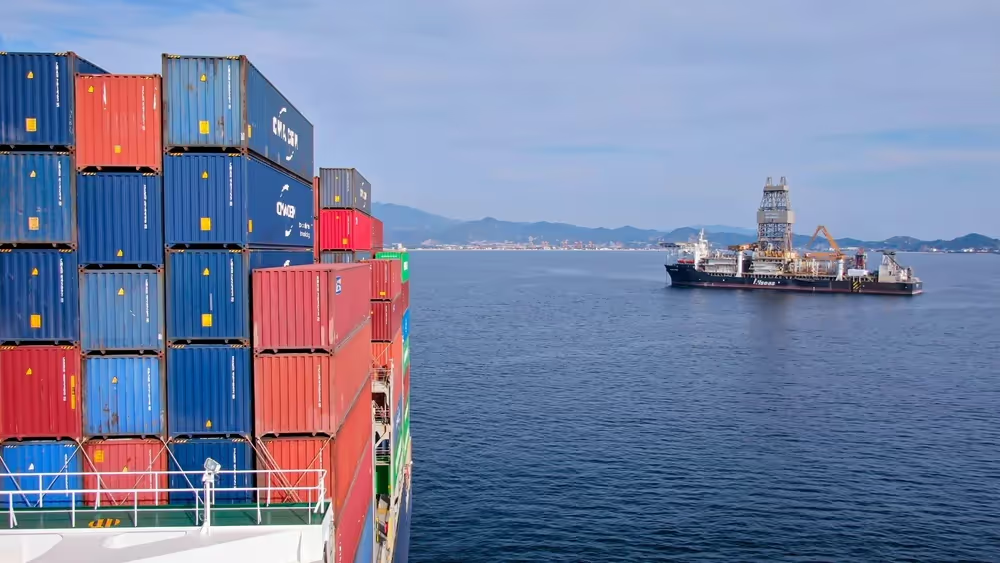
The Twilight of Free Trade

Contrary to what is often believed—especially in Latin America—these countries stand to gain the most from a closer relationship with the United States.
The international landscape has been especially turbulent at the start of this year. Some long-term trends have accelerated, while other waves of change carry unpredictable consequences. The political and economic shifts heralding a new surge in protectionism and a transformation of alliances among the world’s major powers inevitably involve a cultural shift that calls into question the very definition of the West. In this broad context, we must understand the relationship between the United States and Latin America, and what it should be like in our time for the mutual benefit of all involved.
As these lines are written, we witness a significant qualitative change in the relationship between the United States and Europe. The postwar Atlantic alliance that functioned for eight decades is fracturing, and alignment among its key partners is no longer automatic or predictable. Considering this, major changes lie ahead, extending beyond the countries directly involved. On the one hand, the national budgets of these nations will reflect a new reality in which defense spending is expected to increase in Europe, fueled by budget cuts—seemingly hinted at by the British government—and by the fiscal margin in Germany’s case. Indeed, Germany is almost the only country in the world with sufficient budgetary space, thanks to its ingrained fiscal discipline.
On the other hand, we are also witnessing a more profound cultural shift that has far-reaching consequences, raising fundamental questions that are more complex to answer today than two decades ago: What is the West? What values does it defend? Do those values still make sense in the third decade of the 21st century? Do they offer lasting value for life in each society and international relations? The answers to these questions extend far beyond the scope of this article, but they form the backdrop against which the concerns it addresses are set.
Given this scenario, let us address some questions directly: What is the current state of relations between the United States and Latin America? What can we expect in the years to come? And, beyond this immediate situation, what should form this relationship?
First, it is necessary to recognize that Latin America is neither a homogeneous nor a particularly relevant subject of analysis in and of itself. Grouping countries as different as Mexico, Brazil, Chile, Panama, Uruguay, Venezuela, El Salvador, Nicaragua, Bolivia, or Cuba into one single “basket” makes little sense. Beyond the rhetoric of the “Gran Patria” (Great Homeland) in Latin America, the truth is that these countries tend to trade relatively little with each other, lack (in most cases) institutions that link them fluidly—even where agreements exist, such as Mercosur or the Pacific Alliance—and do not share a genuine esprit de corps.
Perhaps it is possible to group them by specific characteristics. For example, there are a few stable democracies with market economies that function relatively well and have predictable rules, with Uruguay being the clearest example. Then there is a large group of countries with various types of political and/or economic problems: Peru with significant institutional instability; Bolivia with severe democratic erosion, as in El Salvador; Mexico with a judicial reform that calls essential freedoms into question; Brazil with significant and growing fiscal imbalances; Haiti, unable to break out of its permanent crisis; and Chile, abandoning its successful development model and sliding down toward the regional average. Finally, there is a third group of political dictatorships and wholly repressed economies—Cuba, Venezuela, and Nicaragua—where living conditions are dire and, regrettably, no positive changes seem likely in the medium term. A notable outlier here is Argentina under Milei, which is expected to see significant growth this year, having succeeded in reducing inflation, balancing the public accounts, and instituting notable deregulation reforms in various sectors. Granted, it has an Achilles’ heel in its limited parliamentary backing and in how quickly political winds can shift in that country; still, it stands out as a particularly notable case that has drawn international attention.
The outlook is not encouraging. A new wave of protectionism in the United States will have significant economic consequences, directly affecting growth in countries such as Mexico and Brazil and in the United States itself. The Federal Reserve lowered its growth forecast from 2.7% to 1.7% this year, and some international banks assign a significant probability to a recession. Of course, this will also have a reverberating effect in Europe and China, meaning that the impact on Latin American economies will come from multiple directions. If we add the enormous uncertainty that multinational companies must factor into their production processes, it becomes more apparent that the decline in trade and investment could be quite substantial.
Contrary to what is often believed—especially in Latin America—these countries stand to gain the most from a closer relationship with the United States. In commerce (both goods and services), inward investments, and scientific and technological exchanges, Latin American nations can benefit from converging on the standards of a highly developed country. Greater trade openness drives greater growth and broader mental and cultural openness.
As we have seen, the current political and economic context does not foster this vision but rather the opposite. It is necessary to consider how to reverse the enormous conceptual errors that have led Latin American countries and the United States to adopt misguided protectionism, nationalist, and populist policies, which only cause harm within each country and beyond. Both historical evidence and economic theory are unequivocal in their support for the benefits of free trade for all parties involved, so the persistence of outdated rhetoric must be countered with clear and compelling arguments. In the short term, measures benefiting specific sectors at the expense of the broader, long-term public interest may prevail, but that does not mean giving up on the vision of a continent united by ties of friendship and free trade, from Patagonia to Alaska.
The recent announcement by President Trump regarding the implementation of "reciprocal tariffs" makes it difficult to believe that free trade can advance in the coming years on our continent, and more generally, worldwide. We will likely see a global increase in tariffs and other measures opposed to free trade, which will have grave consequences for the global economy. The risks of a recession in the United States and other parts of the world are real, and everything seems to suggest that the probable escalation of protectionism will only worsen the situation. Therefore, as in other eras when misguided ideas prevailed—such as the so-called “Keynesian era”—it is essential to keep the torch of free trade alive, following the tradition of the great Adam Smith, until clarity once again dawns on the horizon.
Hernán Bonilla is an economist, President of the Center for Development Studies, Full Member of the National Academy of Economics of Uruguay and Professor of Uruguayan Economy and Society at the ORT University.

Economic Dynamism


.jpg)


.jpg)




.jpg)


An AI Commencement Address That Might Not Elicit Boos
Someone has to dare to point the path forward in those communities. We need many more Nehemiahs.

A Tech Republic, If You Can Keep It
Before destroying the sources of American technological dominance, perhaps we should consider what would happen if the U.S. finds itself envying technological advances happening elsewhere