Russia and the Solitary Historian

Jonathan Daly's The Man Who Knew Russia offers a meticulously researched portrait of Richard Pipes's life and legacy.
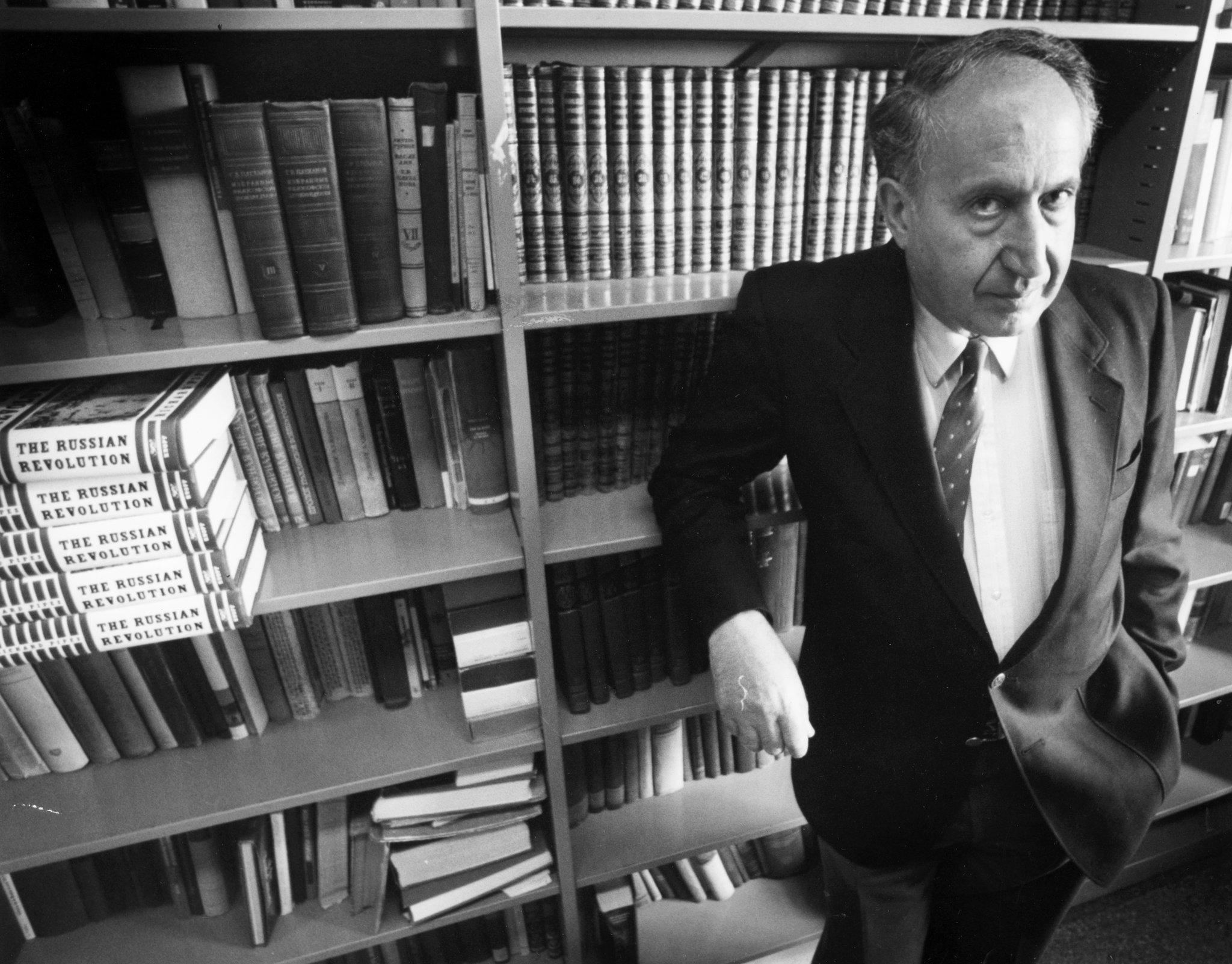
In the aptly titled book, The Man Who Knew Russia, Jonathan Daly presents a meticulously researched portrait of Richard Pipes’s life and intellectual contributions. Pipes was a longtime Harvard professor, an influential historian of imperial and Soviet Russia who also applied his deep knowledge to shape American policy toward Moscow. I admit I approached this biography with some trepidation because Pipes wrote an exquisite autobiography in 2003 entitled Vixi: Memoirs of a Non-Belonger. In it, he described his life from his early youth in Poland; his escape from Nazi occupation with his family through Rome to the United States; his college years at Muskingum College in Ohio and then Harvard; and his academic and policy career. Above all, his autobiography was infused with an immense gratitude for surviving and prospering, making it a pleasure to read. Hence, a biography of Pipes has a high standard to match. Thankfully, this one meets it.
Daly examines Pipes’s intellectual contribution in great detail, a feat that is difficult to achieve given the historian’s prolific output. At the end of the book, there is an exhaustive list (seven pages of small font) of Pipes’s writings, from his first essays while in college in 1941 to his articles as a 90-plus-year-old professor emeritus of Harvard. His books, such as The Formation of the Soviet Union, Russia Under the Old Regime, The Russian Revolution, and Russia Under the Bolshevik Regime, remain foundational and ought to be on the reading list of any student of Russia. Unafraid of public debate, Pipes applied his historical knowledge to policy and wrote a slew of essays and op-eds, many of which were highly influential in American discussions about the most appropriate strategy toward the Soviet Union. He was a hawkish analyst of Soviet intentions and a policy advisor in the Reagan administration. The image of Pipes that the reader draws is of an erudite gentleman committed to staunchly independent thought and to deep study, even if it meant being a solitary figure - a non-belonger.
Pipes’s core idea was that the Soviet Union was not a political creation that appeared ex nihilo in Russia, but was built on the ruins of the preceding empire. For instance, the overbearing controlling state was not an invention of Lenin, but had its roots in the late 19th century tsarist regime. The “origins of the modern police state, or of totalitarianism,” Pipes wrote, were to be found in the last decades of 19th century Russian history, “rather than in Marxist ideology.” After all, he kept pointing out in various venues that Marx wrote his tracts in Europe, but neither England nor Germany had become Soviet; Russia, however, did. The USSR was made possible because it found fertile ground in Russia, devoid of a tradition of ordered liberty, a history of decentralized government, and a culture of civic participation. Instead of political theory, Russians developed the novel; there is no Russian Locke or Burke, but Dostoyevsky and Gogol. Inward-looking mysticism was more prevalent than political participation. Without civil society, Russia throughout its history had a bureaucratic chain of command controlled by a centralized administration.
Pipes backed this view with extensive research and a prolific output of books, essays, lectures, and debates. He did not shy from countering even the most popular exponents of opposing arguments. He criticized Aleksander Solzhenitsyn, who held strong anti-Western views, despite having been welcomed by the West. For Solzhenitsyn, the Soviet Union was evil, and opposing it was a moral duty. But, as Pipes put it, though Solzhenitsyn “rightly stressed the European origins of Marxism, … he never asked himself why Marxism in other European countries led not to the gulag but to the welfare state.” Here again, Pipes placed the blame for the Soviet tragedy not solely on deeply misguided leftist theories, but also on the history of Russia. Removing the latter would have still left the former. Russia was not of Europe, even though it lay on an extension of the European continent.
Most fellow academics despised Pipes. Facing his critics, Pipes would reply: “They’re all simply wrong.” His confident dismissal of academic pablum and wrongheadedness did not win him many friends. But it was the substance of his positions that above all else upset his opponents, who tried to contain Pipes’s influence by, among others, not hiring students who were seen as too aligned with his conclusions.
Pipes opposed the vision of the Soviet Union as a modern state with well-meaning leaders and a path of progress that would have converged with the West’s political development. Some academics, such as Jerry Hough, thought that Russia was similar to Western states, so much so that he changed the title of a new edition of a book by Merle Fainsod from How Russia is Ruled to How the Soviet Union is Governed, arguing that the Kremlin was not a totalitarian dictatorship ruling over people but an administrative center governing citizens. Others, such as Bernie Sanders, who spent his honeymoon in the USSR, were impressed by Moscow’s infrastructure and the allegedly superior Communist healthcare system, pining for Western democracies to converge toward the Soviet system.
Pipes had no patience for such daft rationales. There was no moderate form of Communism that could have created a paradise without the gulag. Historians had a duty to study their topic objectively, but they also had a moral obligation to express judgment. Evil is evil. One should examine it sine studio but perhaps not sine ira, to use Tacitus’s famous advice on how to write history. Communism, therefore, was an object to study and to judge. For Pipes, Communism “was a dreadful experiment… which left absolutely nothing positive, nothing constructive.” It was not reformable and certainly would not have converged into some sort of regime midway between Western democracy and Stalinist totalitarianism. The theory of convergence, popular in the 1960-70s, was silly because it completely ignored the particularity of each nation.
The Harvard historian also correctly noted that the hypothesis that higher standards of living would result in political freedom had its causation wrong: Russia (and we may also add China, as well as any other country) would not become freer as its economic conditions improved because money does not lead to freedom. Western societies enjoyed greater liberty as their economic welfare increased but “only because civil and political rights had emerged and had become institutionalized during the Middle Ages.” Liberty preceded wealth, not the other way around.
Pipes was also disliked because his study of Russian history rested on the belief, backed by evidence, that culture mattered more than institutions. “Political, economic, and social institutions can be changed by decree, but the underlying culture not so easily.” Hence, Pipes warned presciently, it was highly unlikely that the collapse of the Soviet Union would have resulted in a dramatically different Russia. “Grafting economic, social, and even political elements borrowed from the industrial West onto an essentially authoritarian or even totalitarian institutional structure” could not work. Culture mattered more than institutions, class, or even a generic idea of historical progress. Men could not be improved through “education, legislation, and terror.” Pipes added: “I do not trust humans to improve on the sixth day of creation.” Progress, or a progressive path of history, was not a concept he understood or accepted.
Thankfully, academia could not contain his scholarship and advocacy. Pipes thought that a historian had the obligation, if the opportunity arose, to apply his knowledge to policy, and he did so with gusto. First, in 1976 he led the famous “Team B,” which was set up to examine existing intelligence and offer an alternative analysis of the Soviet Union. The group of outside experts produced an estimate of Soviet capabilities and intentions that was very different from the one supplied by the CIA, which chronically underestimated the goals and the power of the Soviets. A few years later, Pipes joined President Reagan’s National Security Council as the top advisor on the USSR.
In these policy roles, Pipes argued convincingly that the Soviet Union was an expansionist power. The conclusion of Team B’s efforts was that “evidence suggests that the Soviet leaders are first and foremost offensively rather than defensively minded.” Moscow’s view of nuclear war was that it could fight it — nukes were not just for deterrence but for warfighting. In a hard hitting and influential article in Commentary published in 1977, entitled provocatively “Why the Soviet Union Thinks It could Fight and Win a Nuclear War,” Pipes observed that Soviet nuclear doctrine was based on the idea that a nuclear exchanged “would not be mutual suicide” but, on the contrary, “the country better prepared for it and in possession of a superior strategy could win and emerge a viable society.”
The article stirred the pot. It challenged a deeply held view that conflict with the USSR could be mitigated by avoiding anything considered offensive by Moscow: if the Soviets were merely concerned with their security, peace was possible if we did not threaten them. Similarly, arms control advocates kept insisting that the US should not increase or improve its nuclear arsenal because it would threaten a defensively minded USSR. In brief, tensions and conflict were caused mostly by American efforts to augment its military capabilities.
Pipes had none of that. First, the USSR was an illegitimate and weak power, based on brute force and oppressing several nations. US policy should target this weakness by, among other things, encouraging centrifugal tendencies. He pointed out that, for example, there were “more people of Turkic origin under Soviet rule than there are Turks in Turkey.” He understood Soviet fears better than any other academic or policy expert. The Soviet Union was a colonial empire, seeking to expand not only because of its ideology but also, and perhaps above all, because an aggressive foreign policy helped the authoritarian regime stay in power.
Hence, second, it was dangerously wrong to assume that Moscow was defensively minded. In fact, Pipes wrote in that Commentary article, “Soviet culture, whose roots feed on another kind of soil, and which has had for centuries to weather rougher political climes,” does not disfavor war. Moscow’s “ruling elite regards conflict and violence as natural regulators of all human affairs.” Given such an attitude toward war, it was counterproductive, even suicidal, to disarm or even lower American military readiness and capabilities.
Pipes rejected the idea that all states and nations behaved the same way. Each state was unique in its past and culture, and peculiar in its goals and strategies. Hence, he viewed history not as a social science but as “a branch of the humanities that deals with human affairs and therefore is closer to literature and the arts than it is to the natural sciences.” Social science, he argued, was a modern invention that did not work well in politics or life, both of which existed in “constant turmoil.” This is what Goethe meant, Pipes said in a speech he gave on his last trip to Europe as an NSC staffer, when he affirmed that “theory fits life as the human body fits the cross.”
In an academic and policy world that favors a progressive vision of the world built on social engineering through the application of power and that believes in the inevitability of outcomes for those who are “on the right side of history,” Pipes was an outsider. And we should be grateful for that.
Jakub Grygiel is a professor at The Catholic University of America, a visiting fellow at the Hoover Institution, and a senior advisor at The Marathon Initiative.

Politics
%20Richard%20Samuelson%20%20-%20Is%20American%20Nationalism%20Still%20Creed-able_-1.jpg)
Is American Nationalism Still Creed-able?
We are not there now, but there is reason to worry that the United States is in danger, if we are not careful, of ceasing to be a nation with the principles of 1776 at its core.

National Civitas Institute Poll: Americans are Anxious and Frustrated, Creating a Challenging Environment for Leaders
The poll reveals a deeply pessimistic American electorate, with a majority convinced the nation is on the wrong track.
.webp)
%20(1).avif)

.png)
Why ‘Progressive’ Ro Khanna Wants to Lend Money to Billionaires
California's Prop. 40 isn’t just a “tax.”

Proxy Firms Don’t Have to Disclose Conflicts. That Should Change
The firms whose advice can move those votes bear no comparable duty for the advice itself. States can close that gap by applying an enduring standard from the Supreme Court.



.png)