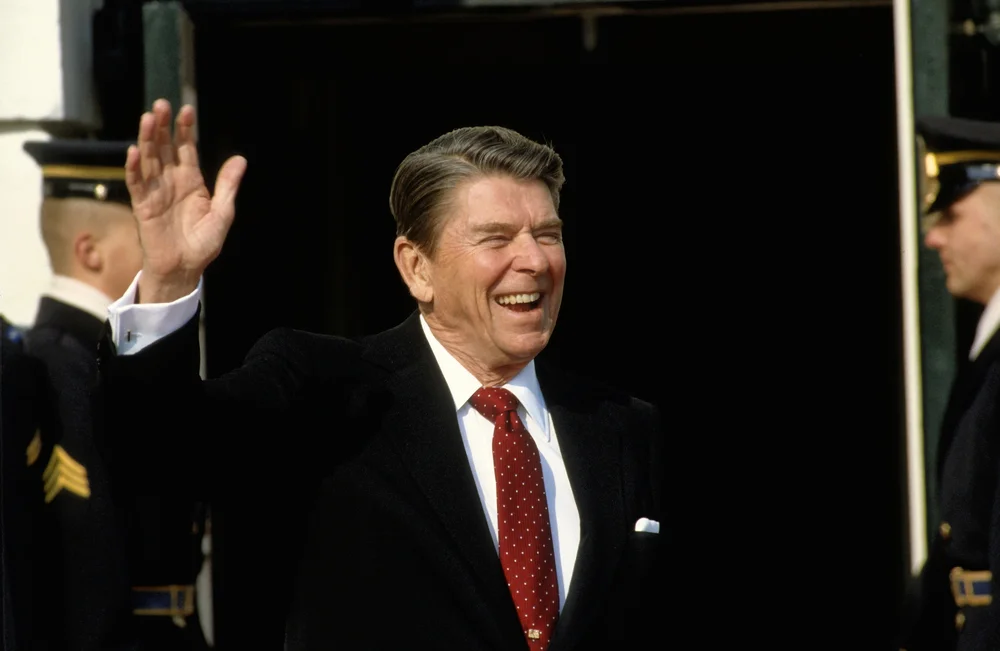
Reagan, the Original MAGA President?
If the nation is restored to its intended constitutional boundaries, future historians will likely apportion credit to Reagan, Trump, and Trump's successors.
One of Ronald Reagan's most famous remarks, first made in the 1960s when he became governor of California and repeated throughout his presidency, was that "Freedom is never more than one generation away from extinction; it has to be fought for and defended by each generation."
It seems that we were only one generation away from forgetting Ronald Reagan, too. Many of today's new generation of populist conservatives haven't merely neglected Reagan and his legacy, but have shown active contempt for him. Some of Reagan's key causes are considered obsolete. His anti-Communism seems as relevant today as the Abolitionist and Temperance movements of the nineteenth century, while other Reagan policy principles — especially free trade — are rejected as "Zombie Reaganism." Some conservative populists have even embraced the left's pejorative attack on Reagan for his "neoliberalism." (A reminder: "neoliberalism" is the derogative term ginned up by the academic left in the late 1990s, but now appears approvingly in conservative publications, a rhetorical victory for the left which ought to arch eyebrows.) For older Reaganites, it is a disorienting scene.
The historian Richard Hofstadter wrote in 1948 that Franklin Roosevelt's passing "left American liberalism demoralized and all but helpless," and something similar could be said about the overpowering legacy of Reagan for conservatives in the first decades after he left office. Up to the 2016 election cycle, every Republican presidential hopeful tried to claim the mantle as the worthy successor of Reagan, sometimes in pathetic fashion. In 1996, GOP nominee Bob Dole declared, "I'm willing to be another Ronald Reagan if that's what you want me to be," hoping conservatives would conveniently forget that he had often opposed many of Reagan's policies in the 1980s.
Conservatives were dissatisfied with Reagan's GOP successors in office, who could be said to have embodied the GOP's petty Bushoisie, and even more unhappy with GOP nominees who ran feckless losing campaigns. Still, Reagan emulation persisted through the 2016 election cycle, with one conspicuous exception: Donald Trump.
In one sense, this moment was the inevitable result of generational succession. Democrats couldn't get FDR out of their heads until a new charismatic figure arose in 1960: John F. Kennedy. Kennedy's arrival inspired the next generation of Democrats — the junior officers of World War II, as Daniel Patrick Moynihan described the JFK set — with his "New Frontier" replacing the New Deal. Likewise, Trump quickly became a galvanizing figure for the next generation of conservatives looking for someone and something new, even though Trump's trademark slogan — "Make America great again" — was a main campaign slogan of Reagan's in 1980. And Reagan certainly had a definite populist streak, talking of the "prairie fire" of heartland resistance to Washington, DC elites.
The irony is that Reagan and Trump are similar in many ways. Both are former Democrats; both had a background in show business that powerfully shaped their approach to retail politics; they are the only two divorced presidents we've ever elected. Above all, they are highly unconventional figures in the Republican Party. We should look beyond stylistic and issue differences to inquire about what made both men so unique.
There is one other salient fact they share: a main line of attack on both Reagan and Trump, by their Democratic opponents and their mainstream media echo chambers, is that they are "divisive." Bear in mind that "divisive" is a euphemism for "opposing the agenda of the left" — a semantic tactic intended to delegitimize conservative politicians without having to argue with them. Seldom do the media accuse Democratic presidents such as Bill Clinton, Barack Obama, or Joe Biden of being divisive, even though there is plenty of public opinion survey data suggesting all three Democrats were viewed as much more divisive than Reagan or the hated George W. Bush. Whenever Democrats and the media are attacking a conservative as "divisive," we should smile and realize that they must be doing something right.
We forget that the left and the media charged that Reagan was a dangerous "extremist" just as much as they do Trump today. Reagan likely held the record for leftist Hitler comparisons before Trump came along. It is also an exaggeration that Reagan and Democratic House Speaker Tip O'Neill were amiable drinking buddies after 5 pm; there was real animosity between them, which they papered over because it served both their interests to do so, while there were significant budget fights throughout the 1980s, with each side fighting to a draw in most years.
Thus, we begin to recognize that the gauzy filter Americans eventually apply to all ex-presidents has especially skewed our recollection of Reagan, whose style appears retrospectively meek and mild compared to Trump's smash-mouth style. Reagan assailed the left with a stiletto and a genial laugh, while Trump wields a broadsword backed with a menacing glower. A chief criticism of Reagan now is that he wasn't sufficiently hostile toward the left. The left didn't think so at the time. As the Reagan-hating liberal journalist Richard Reeves wrote a decade after Reagan left office, Reagan “damned near destroyed American liberalism.” Reeves noted in 1999 that Bill Clinton only rescued his presidency when he "gave up after a couple of years and joined the Reagan revolution. . . President Clinton is governing in his shadow." He did not mean this as a compliment.
One retrospective criticism of Reagan used in support of Trump's more aggressive disposition is that Reagan didn't fight hard enough against "the swamp." There is an element of truth to this. In retrospect, the Reaganites underestimated the seriousness and depth of the constitutional deformations of the administrative state, which only grew worse after he left office. It is a long subject, but in sum, when regulatory reform proved impossible because of congressional and bureaucratic resistance, the Reagan Administration sought regulatory relief. Keep in mind that the recently overturned "Chevron doctrine" arose from a case the Reagan Administration won at the Supreme Court in 1984. They thought it would enable them to rationalize regulation and reduce its deadweight economic cost, which it did in the short run. Few foresaw at the time that it would become a carte blanche for the administrative state to run amok.
The Trump Administration's successes to date in attacking the administrative state owe much to learning from the defeats and lessons of the Reagan years. I take a small amount of ironic satisfaction from the current disrespect for Reagan that young conservatives are expressing today. When my narrative history of the Reagan presidency, The Age of Reagan: The Conservative Counter-Revolution, appeared in 2009, some conservatives were critical that the conclusion of the book, whose last chapter was "The Reagan Revolution and Its Discontents," wasn't fully triumphant, especially my observation that Reagan was more successful in rolling back the Soviet empire than he was in rolling back our bureaucratic empire at home because the latter was a harder problem. Tax cuts and deregulated markets were great, but the administrative state — and its spending machine — was emboldened by surviving Reagan's attempts to reform it. Now these disappointments from the end of the Reagan years, which he and many of his team were fully conscious of at the time, are used as a cudgel against his reputation.
But recognizing our debt to Reagan does not depend on ignoring "what time it is." The historicist dismissal of Reagan is the most churlish of the current contempt for his memory. That the "issue map" may differ from 1980 should not diminish the enduring lessons to be learned from studying Reagan (or other significant figures of our past) as an example of high statesmanship and prudence. It is now forgotten that Reagan represented a stark departure from the prevailing orthodoxy on both the left and the right on foreign and domestic policy. He also saw a unity between the two problems rather than distinct kinds of issues. He knew that the fundamental problem was the centralized modern state, whether in totalitarian forms such as the Soviet Union or in the supposedly benign scientific and administrative form of our own centralized state. One observes a close parallel today in Trump's justified hostility toward the European Union.
Reagan was an anti-establishment figure, deeply troubling to many Republicans, just like the current president. Rather than heap contempt on Reagan, serious students of politics ought to contemplate the parallels that made both men so unique and consequential. Reagan had a completely independent and unconventional mind and expressed his unconventional views fearlessly and usually with original language — that is, a vocabulary that didn’t use the regular Beltway terms that everyone else in politics used. In these traits, Trump and Reagan are very much alike. Trump's tax cuts, both in his first term and last year, were influenced by some of the supply-side thinkers who helped craft Reagan's tax cuts, and keep in mind that Reagan's embrace of supply-side economics was a controversial departure from Republican orthodoxy of the era. Now it is the conventional GOP wisdom that Trump builds upon.
Trump and his team acknowledge considering the lessons of the Nixon years, and Trump himself has said Reagan was a great president (though he was "bad on trade," a claim that may be contested). One might also wonder what Reagan might have accomplished if he had had two full terms to devote his skills solely to domestic policy rather than having to devote so much time and political capital to what turned out to be the climax of the Cold War.
A century ago, G.K. Chesterton observed that "The business of Progressives is to go on making mistakes. The business of Conservatives is to prevent mistakes from being corrected." This proved accurate for most Republican administrations over the subsequent century. If the nation is restored to its intended constitutional boundaries, future historians will likely apportion credit to Reagan, Trump, and Trump's successors, as it is certain that it will take several more elections and sustained efforts to fully reverse the administrative state. At the end of Reagan's presidency, William F. Buckley Jr. wrote that the most powerful man in the world is not powerful enough to do everything that needs to be done. A good lesson to keep in mind, while taking seriously the wisdom to be acquired by studying those statesmen who came before, rather than haughtily dismissing them for not aligning with our present frame of mind.
Steven F. Hayward is visiting professor at Pepperdine University's School of Public Policy.

Politics
%20Richard%20Samuelson%20%20-%20Is%20American%20Nationalism%20Still%20Creed-able_-1.jpg)
Is American Nationalism Still Creed-able?
We are not there now, but there is reason to worry that the United States is in danger, if we are not careful, of ceasing to be a nation with the principles of 1776 at its core.
National Civitas Institute Poll: Americans are Anxious and Frustrated, Creating a Challenging Environment for Leaders
The poll reveals a deeply pessimistic American electorate, with a majority convinced the nation is on the wrong track.
.webp)
%20(1).avif)




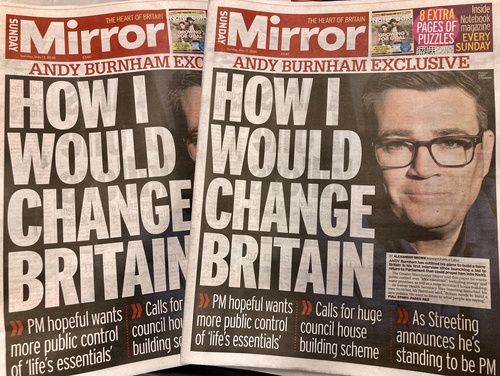
Can Britain’s Next Prime Minister Escape the Net Zero Trap?
Britain has burned through five Prime Ministers and is paying some of the highest electricity prices in the world.

The Scanner at the Gate: Europe’s China Policy Litmus Test
China’s industrial policy is entering Europe through public procurement—and reshaping sensitive markets from within.

Confronting the New Antisemitism
"The postwar effort 'to rebrand Judaism as a religion' has made it impossible for American Jews to understand what they are facing today, because what we are facing today is an attack on the idea of Jewish peoplehood.”
“Democratic” Socialism Is Undemocratic
By promoting class hatred, suppressing private initiative, and seeking enhanced control of our lives, today’s democratic socialists undermine patriotism and individual initiative—two qualities that have long distinguished the United States from other major nations.

