LA’s Dreams Went Up in Flames

Politicians are to blame for a shocking lack of preparation.
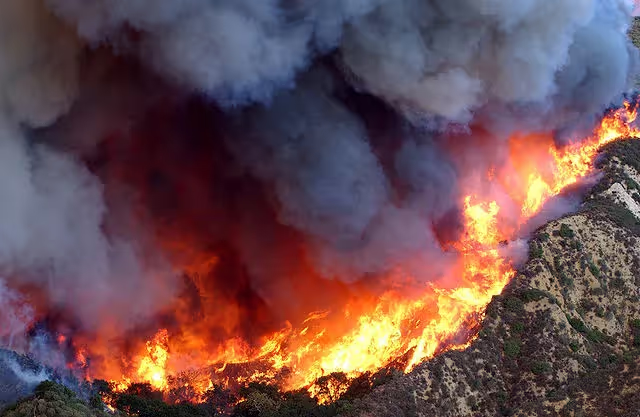
The fire still engulfing large swaths of Los Angeles has done more than destroy homes, businesses, and livelihoods. It has scorched the whole dream of Los Angeles, part of a downward spiral unfolding for a generation — and cast into severe doubt the city’s ability to host the 2028 Olympics.
Fires have been a reality in California for at least 20 million years. In my own, far shorter lifetime, I have seen numerous blazes, and covered several on television. They aren’t predictable, but you know when they are likely to occur. They aren’t preventable, but you can be prepared for them. Fires, floods, and earthquakes — disasters are us, and that has been the case as LA grew over the past century.
This time around, city and state leaders bear a heavy blame for a shocking lack of preparation, given weather conditions that were well predicted and have caused disasters in the past. As Traci Park, a member of the City Council, recently suggested, the fires revealed “chronic underinvestment in our critical infrastructure”. Perhaps the most remarkable failure was the lack of pressure to get water out of hydrants.
This disaster reflects the failure of the one-party progressivism currently dominating governmental structures. In this worldview, basic infrastructure is less important than addressing climate change and “social justice”; measures such as building dams or hardening the electric grid are demoted to a secondary role, with catastrophic effects.
Continue reading the entire article at UnHerd
Joel Kotkin is a Presidential Fellow in Urban Futures at Chapman University and a Senior Research Fellow at the Civitas Institute.

Politics
%20Richard%20Samuelson%20%20-%20Is%20American%20Nationalism%20Still%20Creed-able_-1.jpg)
Is American Nationalism Still Creed-able?
We are not there now, but there is reason to worry that the United States is in danger, if we are not careful, of ceasing to be a nation with the principles of 1776 at its core.

National Civitas Institute Poll: Americans are Anxious and Frustrated, Creating a Challenging Environment for Leaders
The poll reveals a deeply pessimistic American electorate, with a majority convinced the nation is on the wrong track.
.webp)
%20(1).avif)


Proxy Firms Don’t Have to Disclose Conflicts. That Should Change
The firms whose advice can move those votes bear no comparable duty for the advice itself. States can close that gap by applying an enduring standard from the Supreme Court.
Texas May Soon Have More People Than California — Here’s Why
California natives are voting with their feet.




.jpg)