Elon Musk vs. Jeff Bezos: Is the Moon Big Enough for Two Lunar Billionaires?

As it stands today, it's actually unclear who will end up owning this "next Amazon".
"Space," we are told in one moderately successful 1960s-era television drama, is the "final frontier."
But as Washington Post staff writer Christian Davenport explains in his recent history of space exploration in America, Rocket Dreams, space is simultaneously just the newest frontier of competition between the United States and China. This is a competition America really ought to have won easily, given its fifty-year technological lead over China. Instead, space has become a contest that it might lose if America doesn't get its act together.
Whether America beats China back to the moon — and ultimately to Mars — will depend very much on another competition entirely: a contest for space industry dominance between billionaire Amazon.com founder Jeff Bezos and even more billionaire Tesla CEO Elon Musk.
Often portrayed in the press and social media as a petty feud between corporate titans, the subtitle to Davenport's book, Musk, Bezos, and the Inside Story of the New, Trillion-Dollar Space Race, makes it clear that America's new space race holds more significance than just that, both for investors and for America as a whole. This new space race has the potential to create vast wealth for the country, driving America's economic dynamism for decades.
Indeed, Davenport probably undersells the case. More than a mere "trillion-dollar space race," Amazon.com founder and Blue Origin leader Jeff Bezos predicts that space will ultimately turn Blue Origin into a two-trillion-dollar company.
You actually have to read Davenport's book almost to the end to come upon this revelation. It's only in the book's final chapter that we find Bezos interviewing for the Blue Origin CEO position in 2023. And it's there that Amazon executive Dave Limp asks his once-and-future boss whether Bezos sees space exploration as a business or merely a hobby — a fun way to spend his billions in retirement? Bezos's response is unequivocal: "It's so obviously a business. [In fact] I think it's going to be the best business that I've ever been involved in," worth more than even Amazon.com itself.
Amazon.com is worth $2.3 trillion today.
As it stands today, it's actually unclear who will end up owning this "next Amazon," so to speak. Will it be the man who invented, nurtured, and grew the original Amazon.com? Or will it be the upstart immigrant from South Africa, the man who popularized the idea of electric cars, and turned it into a company nearly as big as Amazon already?
This question serves as the focal point of Davenport's book, which opens with SpaceX's jaw-dropping launch-return-catch sequence, in which the Mechazilla launch tower caught a Starship Super Heavy rocket booster out of the air after a successful October 13, 2024, test flight. For years, Jeff Bezos and Blue Origin had been worrying about what a world with a workable Starship might look like. In a 2018 "proprietary and confidential" memo prepared for Bezos and his (then) Blue Origin CEO, Bob Smith, personally, one Blue Origin investigator warned that a successful, fully reusable Starship could help SpaceX "plausibly achieve a monopoly" in space launch.
On October 13, that scenario looked closer than ever.
The balance of Davenport's book examines the seesawing contest between Musk and Bezos, as both billionaires attempt to will a new space economy into existence. Despite starting his space company first, Bezos adopted a gradatim ferociter (step by step, ferociously) strategy for Blue Origin, in which the company methodically built products for Bezos to review during occasional visits, and fell further and further behind SpaceX.
Initially, Blue's approach didn't seem obviously wrong. Yes, SpaceX took a quick lead in orbital-class rockets, the kind that can not only reach "space" but also maintain the Mach 25 speeds necessary to avoid being pulled right back down to Earth. (Blue Origin's first orbital-class rocket, New Glenn, didn't reach orbit until January 2025). But Blue Origin notched a few early successes of its own, building a space tourism business centered on its suborbital New Shepard rocket, for example, and even demonstrating a successful Earth-to-space-and-back landing a month before SpaceX did the same with its Falcon 9 rocket.
In 2020, Blue even came out ahead of SpaceX in a NASA contract award for the development of a new Human Landing System (HLS) moon lander. With nearly $1 billion in development contracts up for grabs, Blue Origin was awarded 60% of the funds on offer -- $579 million. SpaceX won only $135 million. (A third company, Dynetics, which would ultimately fail to win any lander contract, was awarded nearly twice as much as SpaceX at $235 million).
Unfortunately for Bezos and Blue Origin, however, these rare wins were the proverbial exceptions proving the rule: More often than not, Elon Musk and SpaceX ran circles around their competitors. After coming up short in the development competition, SpaceX nevertheless won the first HLS production contract. SpaceX also turned its Starlink satellites (nearly 7,500 in orbit) into a globe-spanning orbital high-speed internet service long before Amazon (note: not Blue Origin, but still Jeff Bezos-adjacent) got its first "Kuipersats" (53 now in orbit) launched, and then parlayed Starlink into a military Starshield satellite business as well.
How did SpaceX get so far ahead? Corporate culture is one reason.
Davenport describes visits he made to each company's facilities, and paints a clear picture of the different corporate cultures at play:
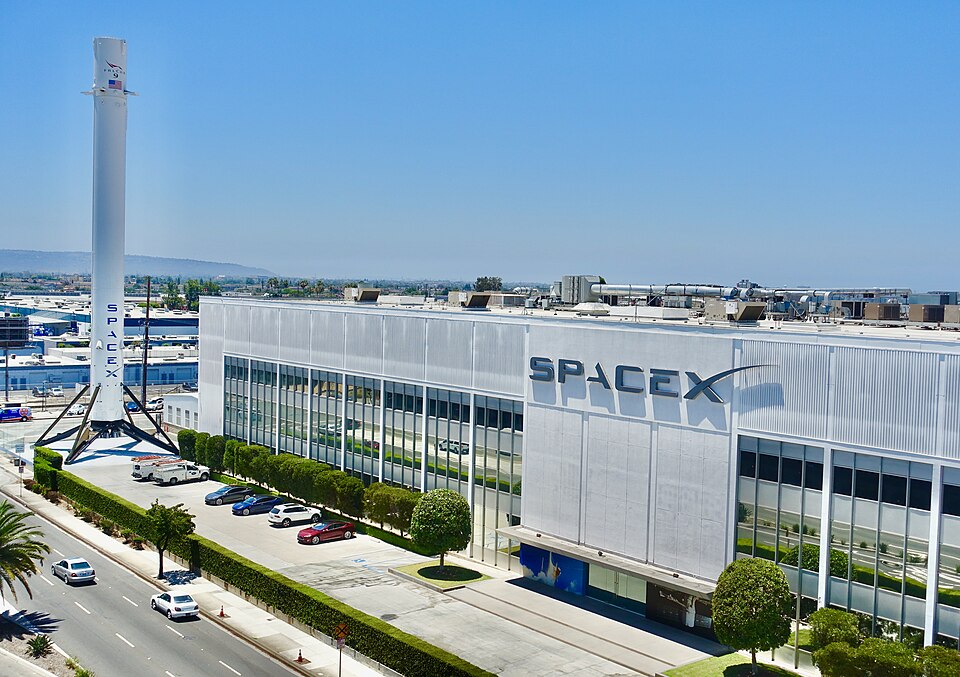
SpaceX "was more Detroit than San Francisco -- workers in T-shirts, jeans, and hard hats bending metal. Country music playing. Pickups in the parking lot. An oversized American flag hanging from the rafters. At the stroke of midnight, security guards started clearing us out: All the workers not assigned to the [Commercial Crew launch of astronauts to the International Space Station] had to leave, their shift cut short. Otherwise, they would have kept on going, keeping up the breakneck 24-hour operations that at SpaceX were the norm."
Conversely, a visit to Blue Origin's facility at Cape Canaveral revealed "an impressive piece of real estate that stretched for hundreds of yards. But I couldn't help notice how clean the place was. How quiet. Blue was chasing SpaceX, in a so-far fruitless effort. Would they ever catch up? Watching what was happening all around me, it didn't seem possible."
(Reading Davenport's reaction, the reader begins to understand why not long after, Dave Limp would ask his boss straight out, that surprising question: Was Bezos running a business here, or just indulging a hobby?)
But a second reason why SpaceX outran its rival so dramatically was that SpaceX seemed to want it more. ("It" being a piece of the space business). For example, when NASA asked commercial space companies to bid on its Commercial Resupply Contract to shuttle supplies to the International Space Station, SpaceX bid and, alongside United Launch Alliance, the incumbent space giant at the time, won. Blue Origin didn't even bid.
Later, when NASA went a step further and asked commercial space companies to build a spacecraft capable of taking over the Space Shuttle's former role, and carrying astronauts to the International Space Station, again, SpaceX bid on the contract (and won). Blue Origin did not even bother to bid.
Was SpaceX simply "hungrier" than Blue, and willing to bid low to win space work and break the United Launch Alliance monopoly? Perhaps. Bezos's single-minded focus on creating a space economy centered on a moon base made him uninterested in contracts servicing Earth's aging space station. Whatever the reason, though, SpaceX's bid and win of these contracts gave Elon Musk access to eventual billions of dollars in NASA and Pentagon funding. This is money he was able to put to work, first creating the Falcon 9 reusable rocket, then the Falcon Heavy reusable. To develop Dragon space capsules for supply delivery, and Crew Dragons for transporting astronauts.
It's not too much of a stretch to say that competing for these initially smaller contracts laid the groundwork for October 13, 2024, and the successful catch of a Starship experimental rocket in the claws of an equally experimental Mechazilla, at a launch pad called Starbase, all three of which were paid for partly with monies earned from NASA and the Pentagon.
But what comes next?
It took some time — and his retirement from Amazon — for Bezos to realize that gradatim ferociter. At the same time, a poetic motto for a space company might not be the best way to build a competitive space business. But ultimately, as Davenport explains, Bezos does seem to have realized that Blue Origin must change how it does business and pick up the pace if it expects to keep pace with the frenetic Mr. Musk.
Hiring a new hard-charging CEO (the aforementioned Mr. Limp) is part of the solution. Adopting a new policy that "from now on, we go after [every contract] that SpaceX bids on," as Bezos put it, contesting SpaceX's ability to create a monopoly at every turn, has also helped. After all, NASA points out every chance it gets that, in an ideal world, it wants to have multiple providers for every mission it assigns, so that if something goes wrong with one company's spacecraft, there's an alternative ready to step in and fill the gap. This redundancy can be crucial when a mission must be completed and a fierce competitor in China is ready to exploit any mistake, using it to close the gap with America in the race back to the moon.
And these changes are bearing fruit at Blue Origin. While the progress SpaceX is making with Starship is undeniable — an August 26 test flight conducted just weeks before Rocket Dreams went to print — Blue's successes, too, are starting to pile up. As already mentioned, the company's long-awaited Kuiper internet satellite constellation is finally coming together. The New Glenn rocket reached orbit successfully on its first try, and a second launch could come any day now. Perhaps most importantly, Blue Origin has pulled victory from the jaws of defeat in the HLS competition, finally winning a contract to build a backup lander for NASA, in addition to the one (actually two) that SpaceX is already building.
This good news for Blue Origin is also good news for NASA, for the Pentagon, and for the taxpayers who fund them both. At long last, the space agency has two well-funded, billionaire-backed private space companies developing a whole host of space equipment to help America beat China back to the moon. Two companies capable of challenging the once-dominant United Launch Alliance to control contract costs while encouraging innovation as they compete to secure contracts for themselves.
And thanks to this competition, as SpaceX President Gwynne Shotwell says, "a permanent presence on the moon and American boots on the surface of Mars are not impossible, and they are not long-term goals." The future is here now.
Richard Smith is a former international lawyer practicing in Moscow, Kyiv, and Washington, D.C. He writes regularly on the subjects of space, aerospace, and defense investments for The Motley Fool.

Economic Dynamism

.jpg)


.jpg)



.jpg)


Social Mobility Wins
When people live within an environment offering good jobs, good education, social networks, and a culture of self-improvement and hard work, they experience progress in a way that undercuts the philosophical rationale that socialists need to justify the policies they advocate.
Kevin Warsh and the Future of Fed Communication
Warsh is right that the Federal Reserve should not speak so loudly that it hears only its own echo.