Australia: A Nation Adrift

Australia is a country that has lost many of its moorings.
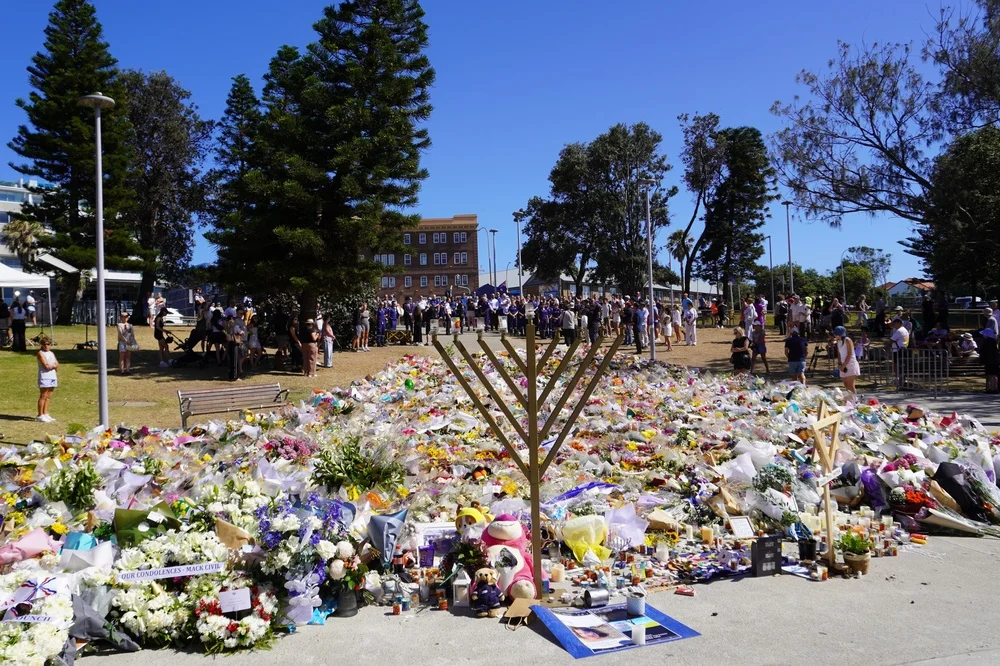
When I heard on December 14, 2025, that two jihadists had gunned down 15 Jewish Australians at a Hanukkah celebration on Sydney’s iconic Bondi Beach, my reaction was two-fold.
On the one hand, I was shocked. The Australia in which I grew up was not one in which terrorism was on anyone’s horizon. It was also a country noted for its hospitality to Jews who, by any measure, have played an outsized role in Australian culture, politics, and economic life, despite being less than 0.5 percent of the population.
Jewish Australians are indeed a remarkable people. Australia’s first native-born Governor-General, Sir Isaac Isaacs, for example, was Jewish. In fact, Australia has had two Jewish Governor-Generals. And whenever I am asked who I consider to be the greatest Australian in the country’s history, my answer is always Sir John Monash. That’s not a name many Americans will recognize, but Monash was an extremely successful—perhaps the best—Allied general in World War I. As the general commanding the Australian Corps, Monash played a key role in breaking the German Army’s will to fight on the Western Front in 1918. He was also the son of two Yiddish and German-speaking Jewish migrants to Australia.
My shock, however, at the attack on the Jewish community on December 14 was accompanied by something else: a lack of surprise. The growth of vocal and violent anti-Semitism in Australia since October 2023 has gone largely unchecked by Australia’s Labor government. Prominent Jewish Australians and others had been warning for months that extreme violence was likely to happen. But the reluctance of Prime Minister Anthony Albanese and his government to speak plainly about the problem — let alone address it in any meaningful fashion — was palpable.
One reason for this timidity is pure electoral calculation. Muslims may be just 3.2 percent of the Australian population, but they are concentrated in parts of Sydney and Melbourne that also happen to be home to many Labor seats in the Federal and state parliaments. The Labor Party is anxious to fend off attempts by the Greens (the hard left of Australian politics) to siphon off Muslim votes, especially those Muslims animated by the Israel-Palestine conflict. That has translated into what can only be described as a limp approach to dealing with problems such as the truly vile anti-Jewish rhetoric expressed at mass demonstrations in the wake of October 2023, the vandalism of Jewish-owned property, abhorrent anti-Semitic graffiti, the mass doxxing of Jewish Australians, and the firebombing of a synagogue.
There is, however, a deeper background to these developments: one that involves understanding that Australia is a country that has lost many of its moorings. There are good reasons why anti-Semitism is often described as the canary in the coalmine that signals wider problems, and Australia, sadly enough, confirms this.
Perception versus Reality
Most Americans, in my experience, think of Australians as pragmatic, easy-going, tolerant, sports-loving, and friendly individuals who work and play hard, and who are far more pro-American than, say, your average Canadian. And, if you can get them to talk about politics at all, they are quietly proud of the country’s superb record as a liberal constitutional democracy.
There is much truth to this image. Whenever I am in Australia, I see it reflected among everyday Australians from a kaleidoscope of social, ethnic, and religious backgrounds. At the level of politics, institutions, culture, and even economic policy, however, the story is very different.
Over the past twenty years, there has been a distinct drift in the Australian public square towards positively dystopian stances that do not bode well for the country’s future. For one thing, Australian universities, the ABC (Australia’s equivalent of the BBC), and most of the media are dominated by a cultural left that views everything through the oppressed-oppressor lens. A left-leaning slant in such institutions is the norm in Western countries and has long been so. But in Australia, it has assumed alarming proportions.
If you pick up a book on Australian history written over the past twenty years, for example, you will likely encounter one long tale of the evils of colonialism, systematic racism, white privilege, etc. Certainly, there are dark parts of Australian history, the most notable being the treatment of Australian Aboriginals. But Australians have good reasons to be proud of their country.
Few nations can point to things like an excellent record of liberal constitutionalism and the rule of law, a healthy egalitarianism expressed in the hard-to-translate concept of “mateship,” and an economy that has delivered enviable levels of prosperity and upward mobility to millions. Taken together with what was — until recently — an enviable history of integrating migrants from all over the world, these are no small accomplishments.
None of these things, however, mean much to the Australian cultural left. That has consequences. “Why should migrants integrate into a country, and a way of life,” one Australian journalist wrote a few days after the Bondi massacre, “whose past was presented as little more than a catalogue of racism, expropriation and oppression — compounded by a cringing subordination to imperial Britain?”
If most of a nation’s culture-forming institutions are telling the rest of the country that they should perpetually hang their heads in shame, that is bound to have an effect over time — especially on younger, more impressionable Australians. The result, in the words of one commentator, is that Australians now “live in a society of often invented and exaggerated grievances.” That outlook has helped open the door to the toleration of soft and hard versions of anti-Semitism. The Albanese government’s own special envoy on anti-Semitism has pointed out that “Anti-Semitism is evident within schools and universities and has become ingrained and normalized within academia and the cultural space.” “We are,” she added, “on a dangerous trajectory where young people, raised on a diet of disinformation and misinformation about Jews today, risk becoming fully fledged anti-Semites tomorrow.”
Drift Abounds
Other disturbing developments in the Australian body-politic manifest themselves in critical areas of public policy. Consider, for example, climate change. For much of the Australian political class — including significant portions of the center-right — climate change activism effectively functions as an ersatz-religion. To express doubts about, for instance, the wisdom of a net-zero carbon emissions policy is to risk being cast out into social and political darkness.
A similar dynamic was at work during Covid. Government reactions to the pandemic differed from state to state. The approach, however, of some political leaders was positively authoritarian. The State of Victoria — by far the most left-leaning of Australia’s six states — endured some of the world’s most draconian lockdowns. It also persisted with lockdowns for some time after the rest of the world realized that such measures had limited effectiveness, were having detrimental effects on children’s mental health, and were inflicting considerable damage upon the economy. Four years after the pandemic, there is still a considerable reluctance throughout official Australia to admit how badly it misread things.
Backwards steps are also evident in economic policy. Australia is a long way from the period between 1983 and 2007 when it was a trailblazer in economic reform. The opening of the Australian economy through deregulation, privatization, the overhaul of an antiquated tax-system, the dismantling of tariff walls, the abandonment of fixed exchange-rates, labor market reform, and other liberalizing measures under two courageous Labor prime ministers, Bob Hawke and Paul Keating, and a far-sighted Liberal prime minister, John Howard, essentially saved the country from economic obsolescence. Their reforms—especially those driven by Keating—set the country up for years of uninterrupted, high economic growth.
Since the early 2010s, however, the trend line has not been good. The fiscal picture across the different states differs, but Victoria’s left-wing Labor government, which has been in power since 2014, has given the phrases “severe fiscal mismanagement” and “addiction to public debt” whole new meaning. In the realm of welfare, what are called “social benefits” (non-cash assistance provided by the federal and state governments to individuals and households) increased by 137.1 percent between 2014 and 2024. Covid had a role in that, but the overall trajectory is of the unhealthy variety.
A similar trend is evident in the number of people employed in the public sector. As one researcher observed recently, “The only boom sector of the Australian economy is the public service, with the latest data revealing an explosion in the number and wages of bureaucrats across Australia.” Public sector employees constituted 18 percent of the Australian workforce in June 2025. In America, the equivalent number is about 14 percent. Moreover, Australian public sector employees earn, on average, 26 percent more than those in the private sector. Not only does a growing public sector contribute to the Australian economy’s slowing productivity. The political effect is to expand the number and influence of those with no interest in retracting excessive government reach into the Australian economy. Public sector employees vote, and few of them will vote for anyone proposing to reduce their numbers.
Conflicting Voices
One way that much of official Australia tries to deal with these manifold problems is to try and distract people from the core issues. A prominent instance was the attempt by Prime Minister Albanese to portray the Bondi massacre as exemplifying the need for more gun control.
Australia does not have a Second Amendment, and it already has some of the world’s most stringent gun laws. The fact, however, that Albanese tried — but conspicuously failed — to shift the conversation away from the actual causes of the worst terrorist incident in Australia’s history speaks volumes about how official Australia all too often refuses to face itself and the country up to real problems.
The good news is that there are limits to which everyday Australians are willing to indulge their political masters. One sign of hope was the 2023 referendum in which 60.06 percent of voters comprehensively rejected the Labor government’s attempt to embed into Australia’s constitutional arrangements something called the “Aboriginal and Torres Strait Islander Voice.”
The Government insisted that “the Voice,” as it was called, would serve primarily as an advisory body. However, the vague wording of the proposed constitutional amendment left many Australians wondering whether it would open a Pandora’s Box of constitutional problems. Others doubted whether it would do anything practical to address the very real plight of far too many Indigenous Australians. More generally, Australians have always been reluctant to amend their constitution without bipartisan support.
But post-referendum analyses indicated that one major factor leading to a thumping majority of Australians in every state rejecting the proposed constitutional change was their opposition to the idea that certain political rights should be accorded to some Australians based on their race. “The Voice” desired by official Australia, it turns out, was crushed by the voices of millions of Australians disinclined to constitutionalize the politics of racial identity. Tellingly, the response of many in favor of the change was to hint that those who voted against the proposed amendment were closet or unconscious racists.
A Grey Future
Is the center-right of Australian politics in any position to reverse these tendencies? Alas, I am skeptical. Australia’s center-right parties were in power in Canberra between 2013 and 2022, and (much like Britain’s Tory party) they comprehensively blew it. Hopelessly split between their conservative and moderate factions, fractured by interminable internal fights about climate change, and paralyzed by deep animosity over leadership, they achieved little at the policy level. They also failed to address fundamental problems at the cultural and economic levels. Now they are vulnerable to an uptick in populist-nationalist sentiment that, while never having gained the traction it has achieved in America, would nonetheless further splinter the non-left in a country that remains, in many ways, pragmatically conservative in its basic political dispositions.
Will the Bondi massacre spark any fundamental self-reflection by Australia’s main culture shapers? I have even less confidence about that prospect. Far too many Australian media outlets, cultural institutions, and almost all universities are in thrall to the type of leftism that views anyone who disagrees with them as an actual or likely oppressor. The ironic fact that they are actually the ones in charge is completely lost on them.
No nation’s future is guaranteed. While countries can renew themselves, much as Australia did from the 1980s until the mid-2000s, few nations can indefinitely withstand ongoing disorder in the foundations that have made them successful. Therein lies the ultimate challenge for Terra Australis — the great Southern Land — and answering it goes far beyond the capacities of everyday Australian politics. Ultimately, it is about the battle of ideas, and one that must be urgently engaged if the descent of a great country into tribalism, economic stagnation, cultural self-loathing, and perpetual grievance-mongering is to be averted.
Samuel Gregg is the President and Friedrich Hayek Chair in Economics and Economic History at the American Institute for Economic Research.

Politics
%20Richard%20Samuelson%20%20-%20Is%20American%20Nationalism%20Still%20Creed-able_-1.jpg)
Is American Nationalism Still Creed-able?
We are not there now, but there is reason to worry that the United States is in danger, if we are not careful, of ceasing to be a nation with the principles of 1776 at its core.

National Civitas Institute Poll: Americans are Anxious and Frustrated, Creating a Challenging Environment for Leaders
The poll reveals a deeply pessimistic American electorate, with a majority convinced the nation is on the wrong track.
.webp)
%20(1).avif)






Confronting the New Antisemitism
"The postwar effort 'to rebrand Judaism as a religion' has made it impossible for American Jews to understand what they are facing today, because what we are facing today is an attack on the idea of Jewish peoplehood.”
“Democratic” Socialism Is Undemocratic
By promoting class hatred, suppressing private initiative, and seeking enhanced control of our lives, today’s democratic socialists undermine patriotism and individual initiative—two qualities that have long distinguished the United States from other major nations.