Storm Over the Appointment Process

The Framers' appointment power process has been distorted in the last two decades.
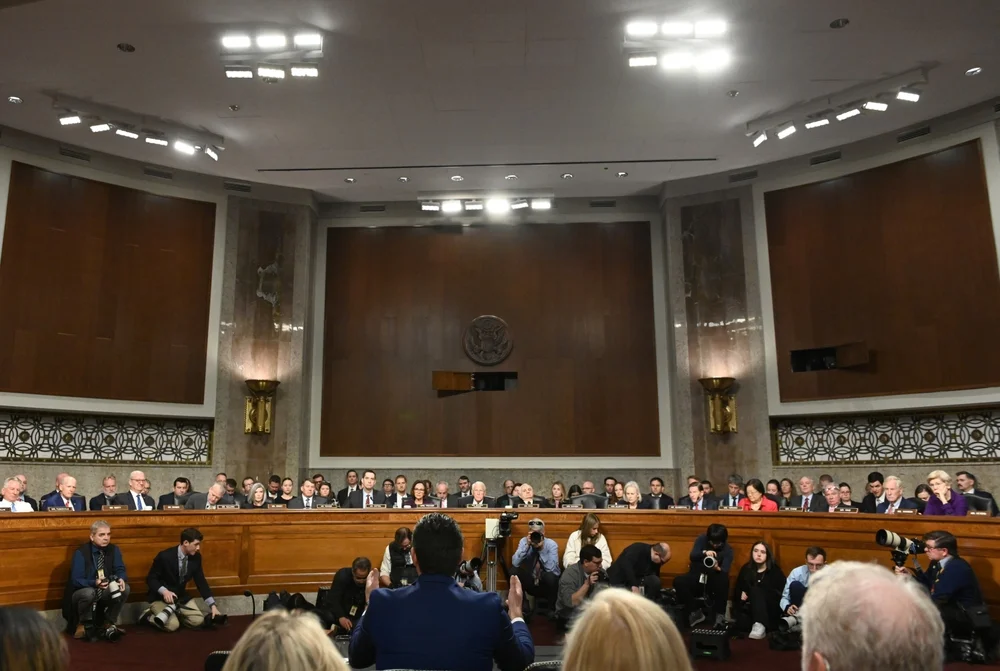
One of any president’s most important ongoing responsibilities, and a major factor in his impact on the country, is appointing men and women to important positions in the other branches of government. For two centuries, whether either party held the White House or controlled the Senate, certain norms guided the appointment process. No more. Especially in the last decade, these norms have been radically altered or abandoned altogether. This is not your grandfather’s appointment process; in fact, it’s not even your older brother’s.
The Constitution and federal statutes currently require that 1,852 positions be filled by presidential nomination and, with the Senate’s “Advice and Consent,” appointment. These include 870 positions on courts with life-tenured judges, 46 on courts with judges serving 15-year terms, and 936 positions in the executive and legislative branches.
Requiring Senate approval is one of the “checks and balances” built into our system that prevents too much power from falling into too few hands. The Constitution’s framers believed that the Senate would have, in general, a “silent” role, with “the possibility of rejection” discouraging the appointment of “unfit characters.” Rejection, they thought, would require more than simply “the preference they might feel to another” but rather would need “special and strong reasons” to be justifiable.
The appointment process generally reflected this understanding for two centuries. Not only did the Senate confirm nearly all nominations, but it did so without opposition or, in most cases, without a recorded vote. Confirmation conflicts were few and far between, focusing on individual nominations that raised concrete concerns.
Democrats changed the appointment process to reflect a Senate role radically different from what the Framers designed. They abandoned the “silent” role of checking the president’s appointment power, possibly by rejecting a nominee, in favor of a politically aggressive role of using the president’s nominations as proxies to fight him. Along the way, Democrats destroyed several bipartisan norms that had guided the confirmation process since the nation's founding.
Unnecessary Recorded Votes
The Senate can conduct its regular activities, such as debating and voting on nominations, efficiently or in a cumbersome and time-consuming manner. Confirming judicial nominations by unanimous consent or a voice vote is efficient, requiring the presence of only a few Senators and taking just a minute or two. Confirming them by a formal recorded vote is cumbersome and time-consuming, requiring the presence of every Senator and taking 45 minutes or more. As a practical matter, there exists no reason for a recorded vote if no Senators oppose a nomination. Consistent with the Senate’s traditional role, between 1789 and 2000, 96.3 percent of judicial nominees were confirmed with no opposition and 95.9 percent without a recorded vote.
Democrats changed this norm in 2001, vowing to fight President George W. Bush’s judicial nominations “by whatever means necessary.” Mind you, 92 percent of Bush’s judicial nominations were still confirmed without opposition, but Democrats forced the Senate to take a recorded vote on 59 percent of them anyway – a 14-fold increase over the historical pattern. Democrats were determined to make even the Bush nominations they supported difficult to confirm.
Unnecessary Cloture Votes
An important limitation on government power is a bicameral national legislature (most around the world have just one) that handles legislation differently. In the House, which represents the population, the rules facilitate action by a simple majority. In the Senate, which was designed to represent states, the rules make it harder for a simple majority to always get its way by giving smaller groups of Senators greater influence.
Since 1806, this has included requiring a supermajority (60 votes since 1975) to invoke cloture, or end debate, on a bill or resolution before a simple majority can pass it. A filibuster occurs when fewer than 60 Senators vote to end debate, blocking any vote on final passage. But while extended debate has been the defining feature of the Senate’s legislative process for more than 200 years, consistent with the Framers’ design, it was never intended to be part of the Senate’s confirmation process. A 1949 amendment to the Senate’s cloture rule, intended to reach all legislative actions, however, could also make this an inadvertent possibility. Still, the Senate did not take a cloture vote on any nomination for another 20 years. In fact, the Senate took a cloture vote on fewer than one percent of the judicial nominations confirmed in the second half of the 20th century.
Democrats’ “whatever means necessary” campaign also destroyed this norm. They had 49 seats in the 109th Congress (2003-04), not enough to defeat a nomination outright but enough to prevent a final vote on confirmation by filibuster. And filibuster they did, forcing 20 cloture votes on 10 different nominations to the U.S. Court of Appeals, more than in all of American history to that point. Half of those filibustered nominations were never confirmed.
But Democrats weren’t finished. By 2013, they occupied the White House, controlled the Senate, and found a way to prevent Republicans from doing what they had done by eliminating the supermajority requirement for cloture altogether. Democrats did not have the 67 votes needed to change the text of the cloture rule, but they did have the simple majority needed to achieve the same result by voting to reinterpret it. The Senate, by a 52 to 48 vote, determined that, going forward, the words “three-fifths” in the cloture rule would mean a simple majority for nominations. In other words, 52 Senators made 60 equal 51. Strange, I know.
Changing the interpretation, but not the text, of the cloture rule achieved its specific objective, but it caused longer-term distortion of the confirmation process. Because the cloture process itself remained unchanged, Senators could still force the Senate to take a separate cloture vote on any nomination, adding days and multiple recorded votes to the process for confirming everyone. Taking a cloture vote that cannot prevent confirmation has no more real use than a recorded vote for confirming a nomination with no opposition. Democrats changed these norms solely to make the process more cumbersome and time-consuming.
It appears this may already be a regular part of the confirmation process. The Senate took a cloture vote on 27.9 percent of Obama nominations, 79.9 percent during Trump’s first term, 93.2 percent of Biden picks, and 100 percent of Trump’s second-term nominations. All these votes passed, no filibusters occurred, and the nominations were confirmed.
Routine Partisan Opposition
One way of looking at the confirmation process partisanship is the percentage of nominations by a president of one party opposed by Senators of the other party. That percentage was just 3.5 percent between 1981 and 2016. During Trump’s first term, that figure jumped more than 12-fold to 42.4 percent. Clearly, the focus was no longer on the nominations the Senate was asked to approve, but squarely on the president who made them. Democrats were opposing Trump by opposing his nominees. Before Trump, no Senator opposed more than 14 percent of other-party judicial nominations. During Trump’s first term, no Democrat opposed fewer than 19 percent, and seven Senate Democrats actually opposed more nominees than they supported.
Like unnecessary recorded or cloture votes, routine partisanship is fast becoming a regular feature of the confirmation process. The average Republican voted against 78.6 percent of President Biden’s judicial nominations, with all but three voting against a majority of those nominees. And during the first year of Trump’s second term, the partisan divide is even deeper, with the average Democrat opposing more than 92 percent of judicial nominations in 2025.
Forced Individual Confirmations
A final norm has long helped the Senate handle hundreds of nominations for executive branch positions that can quickly pile up. In the past, the minority party regularly consented to the majority confirming nominations en bloc rather than one at a time. Even that minimal act of cooperation, however, came to an end with Trump’s second term. As a result, even though Trump made more nominations and Senate committees processed a higher percentage of them in the first three quarters of 2025 than in either 2021 (under Biden) or 2017 (under Trump), the Senate was able to confirm only 58.6 percent of available executive branch nominations compared to 82 percent in 2021 and 75.1 percent in 2017. Republicans voted in September 2025 to allow consideration of multiple nominations with one vote to invoke cloture and one to confirm, both by simple majority. After confirming three large groups of nominees in this way, the Senate had, by the end of the calendar year, approved 95.5 percent of executive branch nominations approved by committee, ahead of the historical pace.
The Senate has been evaluating and approving Trump’s second-term judicial nominations about as efficiently as it can be done. Three measures of confirmation efficiency are the percentage of nominees given a hearing and the number of confirmations as a percentage of either nominations or current vacancies. By any of these measures, the judicial confirmation process has been more efficient than during the first year of any president since Ronald Reagan.
Two caveats. First, as noted above, the number of current vacancies and the emergence of new vacancies have each been historically low since Trump took office. Frankly, it’s easier to keep up when the workload is light. The better test will come when vacancies increase to nearer historic levels, putting more pressure on the process. Second, as explained here, the obstruction headwinds have never been greater, which means efficiency is more difficult at any confirmation pace. So far at least, Senate leadership has been determined to make confirmation a real priority.
The appointment process has taken such a sharp and sudden turn away from the Framers’ design that the natural question is whether this will be the “new normal” going forward. Unfortunately, that seems likely. Confirming a reasonable percentage of a president’s nominations will be possible when the president’s party controls the Senate, but only through a cumbersome, time-consuming process. When the other party controls the Senate, it will be much easier simply to minimize confirmations to whatever level the party chooses. This is a radical departure from historic norms but may well be the pattern for the foreseeable future.
The Framers gave the president appointment power and defined a modest check-and-balance role for the Senate. That design successfully guided the appointment process for more than 200 years but has been distorted in the last two decades. That will likely continue until there is a recommitment to the Framers’ design, a genuine desire to reduce political conflict, or both.
Thomas Jipping is a Senior Legal Fellow in the Edwin Meese III Institute for the Rule of Law at Advancing American Freedom. He served for 15 years on the Judiciary Committee staff of Senator Orrin G. Hatch (R-Utah).

Politics
%20Richard%20Samuelson%20%20-%20Is%20American%20Nationalism%20Still%20Creed-able_-1.jpg)
Is American Nationalism Still Creed-able?
We are not there now, but there is reason to worry that the United States is in danger, if we are not careful, of ceasing to be a nation with the principles of 1776 at its core.

National Civitas Institute Poll: Americans are Anxious and Frustrated, Creating a Challenging Environment for Leaders
The poll reveals a deeply pessimistic American electorate, with a majority convinced the nation is on the wrong track.
.webp)
%20(1).avif)


The G7 Is Failing To Address Global Imbalances
The G7 was not created to issue an endless procession of carefully calibrated communiqués.

Immigration Alone Won't Solve Canada's Population Decline
Rather than looking abroad for solutions, we should ensure young Canadians have a hopeful future





Can Britain’s Next Prime Minister Escape the Net Zero Trap?
Britain has burned through five Prime Ministers and is paying some of the highest electricity prices in the world.

The Scanner at the Gate: Europe’s China Policy Litmus Test
China’s industrial policy is entering Europe through public procurement—and reshaping sensitive markets from within.

Confronting the New Antisemitism
"The postwar effort 'to rebrand Judaism as a religion' has made it impossible for American Jews to understand what they are facing today, because what we are facing today is an attack on the idea of Jewish peoplehood.”

“Democratic” Socialism Is Undemocratic
By promoting class hatred, suppressing private initiative, and seeking enhanced control of our lives, today’s democratic socialists undermine patriotism and individual initiative—two qualities that have long distinguished the United States from other major nations.

