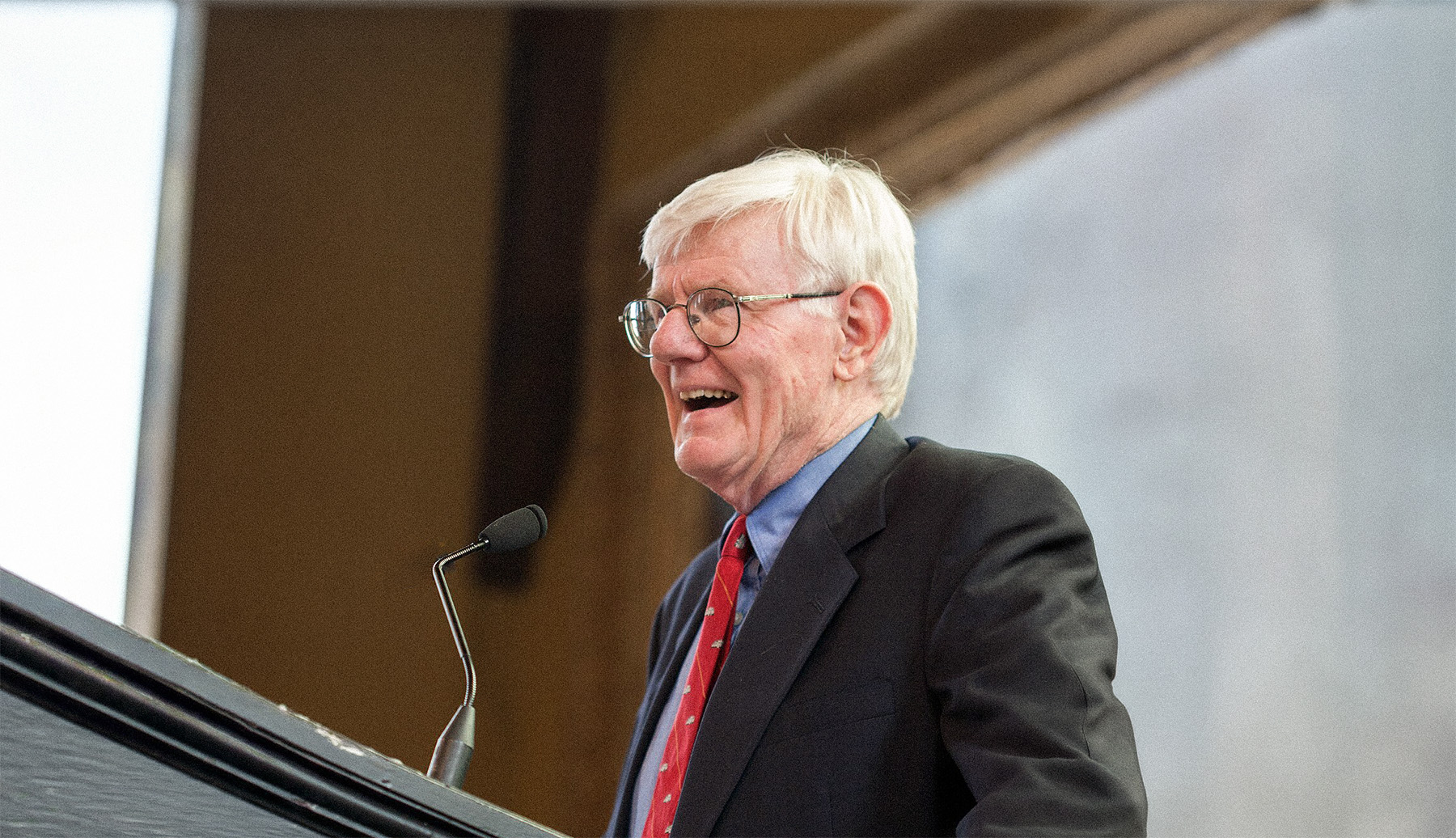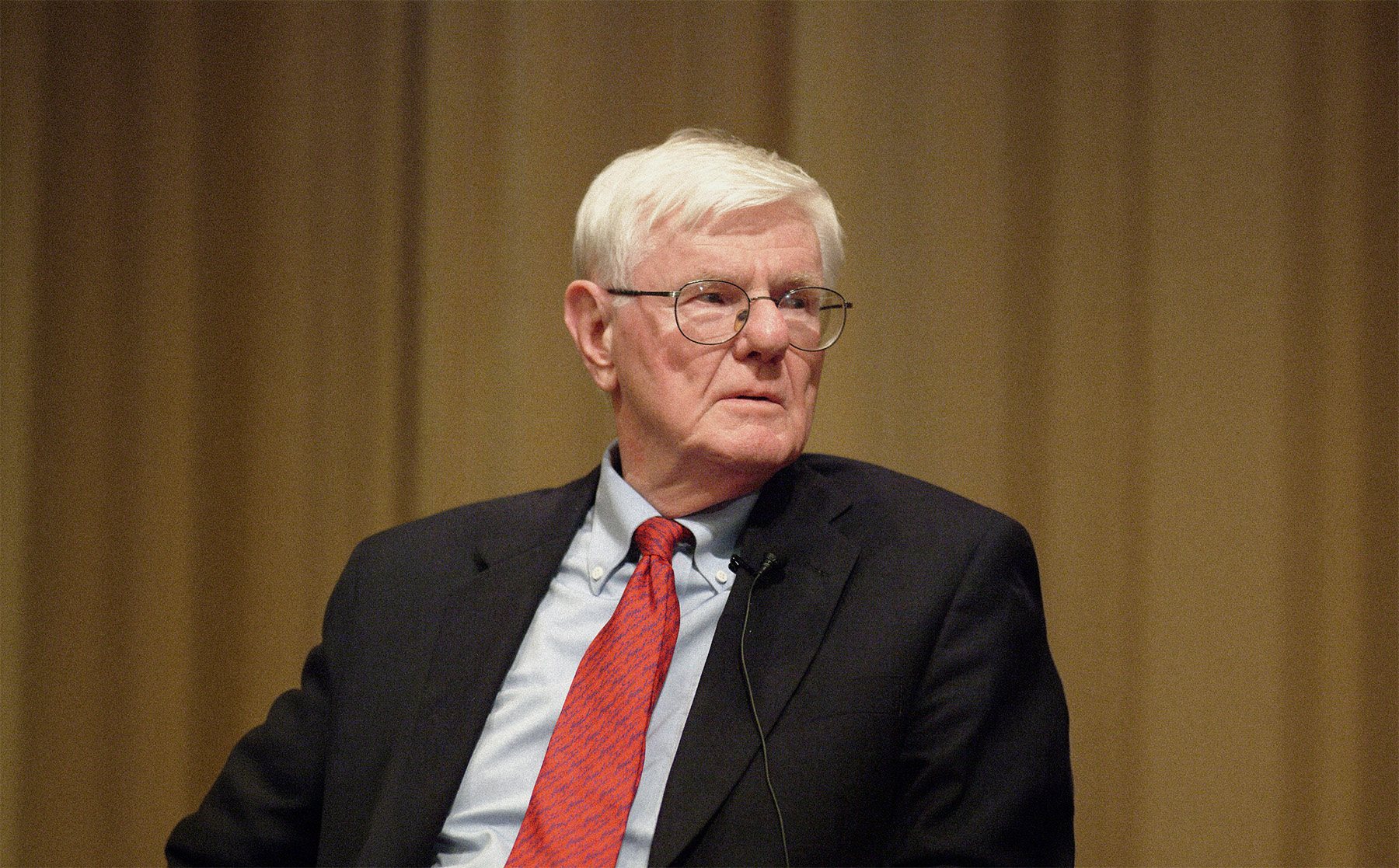
Gordon S. Wood's American Revolution

Next month we shall mark the 250th anniversary of the American Founding without Gordon Wood's cheerful demeanor and fund of hard-earned wisdom and knowledge. It will not be the same without his presence.
It is hard to avoid wondering whether the shocking news of the ghastly accidental death of historian Gordon S. Wood, struck down by a motorist in a shopping center parking lot, is a bad omen, coming within a month of our observance of the 250th anniversary of the Declaration of Independence. Wood has been enjoying a much-deserved spotlight in the runup to the sesquicentennial, but now his voice will be absent on July 4.
Widely acknowledged as the pre-eminent historian of the American Founding in our time, Wood was virtually without peer within academic American history today. There is, however, an arc to his career and thought as a historian that offers encouragement that, in this time of doubt and division about the character and future of American democracy, it is possible to capture and celebrate America’s complex and enduring foundations.
Wood burst onto the scene in 1969 with the publication of The Creation of the American Republic, 1776-1787, a capacious 653-page exploration of the ideas that crystallized into the American Revolution and the Constitution eleven years after the Declaration. Wood had been a student of Bernard Bailyn, one of the leading historians of American political thought in the mid-twentieth century, and Wood built upon Bailyn’s well-regarded Ideological Origins of the American Revolution, but can be said to have advanced and refined a bold new interpretive strand of American historiography—the “civic republican school.”
The civic republican school argued that modern democracy owed less to Lockean liberalism than to a more classically inspired tradition centering on “civic virtue.” It was an explicit alternative to the liberal tradition of natural rights and rugged individualism. Although Wood was restrained in staking out a clear position, his book offered considerable backup for the civic republicans, many of whom were openly seeking an alternative for understanding America and to displace the “liberal tradition” as defended by Louis Hartz and other mid-century historians. He gave aid and comfort to the older Progressive-era view of thinkers like Charles Beard, J. Allen Smith, and Vernon Parrington, who saw the Constitution as a counter-revolution against the more egalitarian spirit of 1776 rather than its fulfillment.
In the 653 closely argued pages of Creation of the American Republic, the Declaration of Independence barely receives a glancing nod, while Locke and social contract theory are shunted aside in a perfunctory way. One of Wood’s most memorable and provocative passages declares that
Ideally, republicanism obliterated the individual... Republicanism was essentially anti-capitalistic, a final attempt to come to terms with the emergent individualistic society that threatened to destroy once and for all the communion and benevolence that civilized men had always considered to be the ideal of human behavior.
Wood’s Creation became the ur-text of contemporary historiography of the Founding. Not since George Bancroft in the nineteenth century did a single figure so dominate the field. And his reputation spread beyond the academy, becoming a pop culture plot point in the Matt Damon-Ben Affleck breakout film Good Will Hunting in 1997.
Although Wood was never a partisan of the left, his writing for a general audience appeared most often in the New York Review of Books and The New Republic. One memorable long article in the New York Review in 1988 took a critical aim at the “quasi-religious view of the Founding” found in the “fundamentalism” of what he called “the Leo Strauss bicentennial.” The Straussians, he said,
are wrong to see the Constitution as having timeless and universal meaning embodied in the philosophical aims of the Founders and discoverable through textual exegesis. . . But historically, there can be no real ‘original intention’ behind the document.
Seldom has the disciplinary divide between political philosophy and academic history been more evident than in this article, where Wood revealing added, “To an outsider the sources of the sectarian squabbles within the Straussian faith are often bewildering.”
Aspects of the civic republican tradition are not without merit in understanding the political development of America’s constitutional democracy, but it has been prone to mischievous and ahistorical distortions. In the 1990s, many left-leaning thinkers found Wood’s work congenial to the project of overthrowing the Lockean-liberal foundation of America. There was a flurry of interest among legal scholars for a “civic republican revival” that would displace Lockean individual rights and limited government, and Wood’s work was invariably the principal citation in support of an alternative lineage for reinterpreting the Constitution and the powers of government. In the 1990s, Wood was cited more than 600 times in law review articles—likely more than any other American historian.
It was candidly admitted that this was a project to find a theory to rival constitutional originalism that was beginning to gain steam at the time. Many of the usual suspects showed up to deploy Wood. Cass Sunstein cited Wood in the Yale Law Journal in support of the proposition that
It is no longer possible to see a Lockean consensus in the Founding period, or to treat the framers as modern pluralists believing that self-interest is the inevitable motivating force behind political behavior. Republican thought played a central role in the framing period, and it offers a powerful conception of politics and of the functions of constitutionalism.
Sunstein adopts the post-modern formula that property rights are “socially constructed,” adding that “republicans are hardly hostile to redistribution or to collective efforts to reassess the existing distribution of wealth and entitlements.” Mark Seidenfeld of Florida State University Law School wrote in the Harvard Law Review:
I view the civic republican conception as providing an essential justification for the modern bureaucratic state. . . Moreover, given the current ethic that approves of the private pursuit of self-interest as a means of making social policy, reliance on a more politically isolated administrative state may be necessary to implement something approaching the civic republican ideal.
But Wood appeared to have some second thoughts about both the possible overstatement of the civic republican thesis in Creation and the misuse of his work. He began to draw some serious criticism from intellectual historians and political scientists such as John Patrick Diggins, Edward Countryman, and Thomas Pangle. He pushed back on the law professoriate who had embraced his work, writing in the Chicago Kent Law Review that
the idea that we today can restore some sort of classical politics to our public life strikes me as utterly chimerical. . . All of [the legal scholars] seem to speak and write as if we had more freedom and choice in the matter than we do. They seem to suggest that people can actually be talked into restoring classical politics or even aspects of classical politics to American political life.
He began to attack “multiculturalism” (the prior term for today’s wokery) in strong terms.
“Multiculturalism,” he wrote in the William and Mary Quarterly, “not only falsifies our past; it destroys our future.” He deplores the “insidious” relativist attack on the idea of objectivity in historical research and writing. He rejects the victimology of the class- and group-based obsession with “oppression,” taking special aim at the prominent oppression-studies specialist Gary Nash (Nash criticized Wood for not paying more attention to the left’s anointed victim classifications): “What is extraordinary about the American Revolution was not, as Nash suggests, the continual deprivation and repression of the mass of ordinary people but rather their release and liberation.”
In 1992, Wood published The Radicalism of the American Revolution, perhaps the most thorough and engaging inventory of the astonishing democratic social changes the Revolution unleashed. “[T]he American Revolution,” Wood writes, “was not conservative at all; on the contrary: it was as radical and as revolutionary as any in history.” The American Revolution upset social hierarchies and accelerated social mobility, which has always been one of the cornerstones of America’s democratic character. In 2020, Wood joined a number of eminent historians in deploring the ahistorical and ideologically driven 1619 Project. “We all want justice, but not at the expense of truth,” Wood wrote, adding that “I don’t know of any colonist who said that they wanted independence in order to preserve their slaves.”
By degrees, Wood moved perceptibly toward a more balanced view of the Founding, writing a new short history (only 190 pages) of the American Revolution in 2002 for the Modern Library. In The American Revolution: A History, the Declaration fared much better, with Wood affirming the Declaration in Lincoln’s terms: “The Declaration of Independence set forth a philosophy of human rights that could be applied to peoples everywhere. It was essential in giving the American Revolution a universal appeal.”
More nods to conservative understandings of the Founding followed. Last November, in his Irving Kristol Lecture to the American Enterprise Institute, Wood sheepishly confessed embarrassment at having voted for Adlai Stevenson back in his student days, asking rhetorically “What was I thinking?,” and confessing that today he can be regarded as “one of those liberals mugged by reality.” There followed a lecture devoted almost exclusively to the centrality of the Declaration of Independence—both the document and these ideas that had been so conspicuously absent in Creation of the American Republic. His ending peroration proclaimed: “To be an American is not to be someone, but to believe in something. That is why we are at heart a credo nation, and that is why the 250th anniversary of the Declaration next year is so important.”
Now we shall mark the occasion next month without his cheerful demeanor and fund of hard-earned wisdom and knowledge, which finds no intellectual equal in this nation of equal citizens. It will not be the same without his presence.
Steven F. Hayward is visiting professor at Pepperdine University’s School of Public Policy.

Pursuit of Happiness

The Rise of Latino America
In The Rise of Latino America, Hernandez & Kotkin argue that Latinos, who are projected to become America’s largest ethnic group, are a dynamic force shaping the nation’s demographic, economic, and cultural future. Far from being a marginalized group defined by oppression, Latinos are integral to America’s story. They drive economic growth, cultural evolution, and workforce vitality. Challenges, however, including poverty, educational disparities, and restrictive policies, threaten their upward mobility. Policymakers who wish to harness Latino potential to ensure national prosperity and resilience should adopt policies that prioritize affordability, safety, and economic opportunity over ideological constraints.












Spielberg’s Empty Hope
'Disclosure Day' should have been called 'Hope and Change,' or rather 'Change and Hope.'
.jpg)
Deliberative Republicanism and the Triumph of the American Founding
Instead of rejecting the moral urgency of the postliberal right and left, it is fitting and proper that we redirect it through the right kind of education—both formal and informal—that can inspire affection for our Constitution.
.jpg)