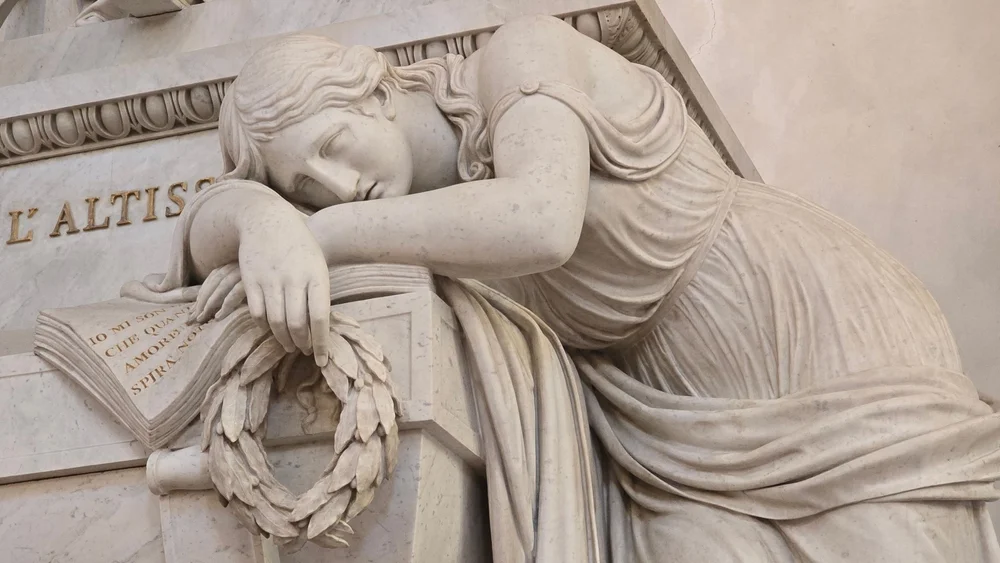
The Great Books and Great Books: An Education for Liberty

The Western tradition is not a fixed body of knowledge to be possessed, but an inheritance to be received, tested.
Perhaps the most powerful image in the history of college marketing is a poster first produced in the 1990s by St. John’s College. Against a black backdrop stand three stacks of books—thumb-worn, precariously high, practically teetering. The message they convey is disarmingly simple: spend four years with us, and these are the texts you will read and discuss.
It is a promise of a particular kind of education. Not a menu of majors, not a pathway to a profession, but an encounter with difficult books across disciplines and across centuries. There are works of mathematics and philosophy, literature and science, theology and politics. Hamlet sits atop Euclid’s Elements, Newton’s Principia Mathematica, below The Brothers Karamazov. Some are esoteric—Ptolemy’s Almagest appears in the stack. Some are notoriously abstruse, such as Kant’s Foundations of the Metaphysics of Morals.
These are all great books—if greatness is defined as significance. Each has, in its own way, shaped how many people have come to understand the world. And yet, they are not The Great Books.
The phrase “the great books” inevitably calls to mind Mortimer Adler and the mid-twentieth-century project he helped bring to life: a formally constructed canon, published in uniform volumes, carefully organized, authoritative in tone, and complete in aspiration. Adler was, notably, an admirer and supporter of St. John’s College, whose curriculum embodied many of the principles he championed. Yet his own project took a different form. The Great Books of the Western World, first published in 1952, represents an effort not simply to preserve a tradition, but to reconstitute it—to recover what he believed had been neglected in an age increasingly shaped by scientism and pragmatism, intellectual movements that elevated the scientific method and empiricism while often marginalizing philosophical and humane inquiry.
The Great Books of the Western World are bound identically, ordered deliberately, and presented as an encyclopedic inheritance. Adler, upon celebrating the release of the first edition, called his work an act of “piety,” and suggested that the volumes represented “the West” itself. At the center of its architecture sits the Syntopicon, an index of ideas that maps themes across the entire set—linking, for example, “justice” from The Republic to Nicomachean Ethics, or “liberty” from Two Treatises of Government to On Liberty—an effort to render the whole visible, to make the tradition navigable as a unified field of thought. There is something undeniably noble in this ambition. It reflects a schematizing impulse—the desire to recover and arrange a canon that could serve as a shared moral and civic foundation, a kind of secular corpus of “sacred” texts for a democratic society. It represents a profound confidence that the accumulated wisdom of the past can be organized, made accessible, and, in some meaningful way, mastered through disciplined study.
The Great Books of the Western World were sold as a deluxe, hard-bound fifty-four-volume set, conveying an aura of prestige, of learnedness, of acquisition—here, in your home, on your shelf, the inheritance of a civilization. Over a million sets were purchased. But one is left to wonder: how many of those bindings were ever cracked? How many pages were dog-eared, underlined, and argued within the margins? How many volumes bear any trace of having been lived with at all? We speak at times of “possessing” a tradition. The deeper question is whether we inhabit that tradition—whether we wrestle with it, return to it, allow it to shape and unsettle us—or whether it remains, like those curated and manicured volumes, admired, rather than encountered.
There is also a striking irony in recognizing that the vast majority of the writers we now consider “canonical” would not have read most of the works in Adler’s canon. Aristotle did not read Aquinas; Aquinas did not read Kant; Kant did not read Nietzsche. Each encountered the tradition partially, unevenly, and idiosyncratically. Their educations were not comprehensive but contingent—shaped by circumstance and chance. The tradition they inherited was not bound together. It was not serialized. It was not complete.
The “great books” did not emerge from a fixed canon. They were shaped by the vicissitudes of chance encounters, partial inheritances, and sudden moments of insight. This is not to collapse into historicism, as though these works are nothing more than artifacts of their time. On the contrary, it is to recognize that their enduring power lies precisely in their ability to transcend the conditions of their making, even as they bear their marks.
In contrast to the uniformity of The Great Books of the Western World, each volume in the St. John’s poster carries its own history. Different editions, different typefaces, different bindings—some thick and densely printed, others spare and wide-margined. Translations inflected by the sensibilities of their time. A well-worn Meditations might rest beside a lightly annotated Tacitus. They may have passed through many hands—teachers, students, solitary readers—each leaving traces, visible or invisible. A cracked spine, a scrawled signature, a page folded down by a reader who meant to return and perhaps never did. These are not pristine volumes arranged for display; they are worn from handling, from transport, from the abrasion of minds grappling with their contents. The image does not promise that you will “cover” this material. It promises that you will wrestle with it.
Most of the books in the St. John’s curriculum come from what we commonly understand as “the West.” Thus, one’s reaction to the image on the poster often depends on one’s response to this idea. For some, the Western canon represents a triumph—a record of civilizational achievement, and the foundation of modern freedom and reason. For others, it represents exclusion, hierarchy, and domination. And there are many positions in between. One may believe that the project of the West has been, on balance, a remarkable success, albeit marked by tragedies and failures. One may see it as deeply entangled with extraction and empire, yet still containing within it enduring sources of illumination and insight. One may regard it as morally ambiguous, or simply too vast and complex to be reduced to any final judgment at all.
Yet what is most remarkable is that the Western tradition itself makes all these positions available. It equips us not only to inhabit them, but to examine them. In doing so, it gives us the rare capacity not merely to land on a point along a spectrum, but to stand, however provisionally, apart from the spectrum itself.
What is distinctive about the Western tradition is that it enables us—and indeed compels us—to reflect upon it critically, and even to challenge its deepest assumptions. This is not a betrayal of the tradition but its highest expression. A tradition rooted in inquiry must make room for dissent; a conversation worthy of joining must permit contradiction. And so, paradoxically, the act of stepping outside the tradition is one of the ways we most fully enter it. We live in a society increasingly conditioned to think in binaries—either/or, for or against, inside or outside. But the tradition itself resists such simplifications. It is neither a closed system calling for our fealty nor a corrupt structure needing to be dismantled. It is a living conversation that asks us to hold competing ideas in tension rather than resolve them prematurely—to inhabit the space of both/and.
For the Western tradition, rightly understood, is not a political project. It is an epistemological one. It is a mode of inquiry—a sustained, centuries-long conversation about what it means to be human. The books are not the tradition itself; they are its record, its artifacts, and its interlocutors. They are how we enter what earlier generations called the Republic of Letters—a kind of city of the mind in which human beings, separated by time and place, nonetheless speak to one another.
And it is a cacophonous, polyphonic conversation. Aristotle sits uneasily beside Francis Bacon, who seeks to supersede him. Karl Marx and Adam Smith square off. The tradition persists not by consensus but by contestation, reinterpretation, and renewal. Its structure is dynamic, unstable, and alive. It represents not a settled body of knowledge, but an ongoing struggle to understand an infinitely complex cosmos.
Indeed, unlike the neatly ordered shelf of The Great Books, the stacks of St. John’s, chaotically sorted, threatening to tumble, ultimately reveal not how much we know, but how little. The self-evident gaps, silences, and lacunae testify to the limits of human understanding. No canon, however ambitious, can be complete. No tradition, however rich, can encompass the whole.
Yet this does not absolve us of judgment. One should emerge from these books with serious and sustained convictions—political, moral, and metaphysical. But the deeper lesson of the tradition is that such commitments must remain open to reflection. Even as we take a stand, we are called to turn back upon it, to test it against the arguments we have encountered, and to subject it to the discipline of thought and the matrix of experience.
The original St. John’s poster was produced when a member of the admissions office stacked the books she had read as an undergraduate and took a photo; the three columns were composed of the texts she had read in common with her fellow Johnnies, but they were also intimately hers.
The St. John’s reading list does not contain the compiled wisdom of the West, as Mortimer Adler envisioned; in fact, the Western tradition is wise only insofar as it fosters intellectual humility, coupled with a passion for seeking what is true. These stacks offer, more modestly, a bounded beginning—a set of w deliberately chosen to make possible a shared intellectual life. There are innumerable great works beyond these few, which are simply the books selected for a common intellectual journey within a single institution. Reading them—and more importantly, discussing them—forms the foundation of a liberal education. The end is not to master a curriculum, but to cultivate the intellectual virtues required for freedom: how to ask questions, how to listen, how to analyze, how to think.
For the Western tradition is not a fixed body of knowledge to be possessed, but an inheritance to be received, tested, and renewed. It lives only insofar as it is taken up—personally, seriously, and in conversation with others. A liberal education, therefore, entails not the completion of a prescribed reading list, but the formation of a mind capable of extending that inheritance—of discerning, judging, and building upon what has been received.
The invitation set forward in the St. John’s poster, which is, in essence, the invitation that every program grounded in a proper liberal education extends, is this: let us come together around these books and join our conversation to the great conversation that has been unfolding across the centuries. Our time together, however, will be circumscribed, and the responsibility to continue piling further sacks will be yours alone. If you carry out this promise and accept its attendant liberty, you will lead a life well lived.
Pano Kanelos is a senior fellow in the Civitas Institute and the Director of the Center for the Future of Higher Education.

Higher Education


The Constitution of Academic Freedom
“If the university no longer seeks the production and dissemination of knowledge, it loses the primary justification for its academic freedom.”
.webp)
Trump's Overreach Against Harvard
A close look at the allegations in the second complaint provides further evidence that Harvard should not be forced to relitigate old issues in a new forum.